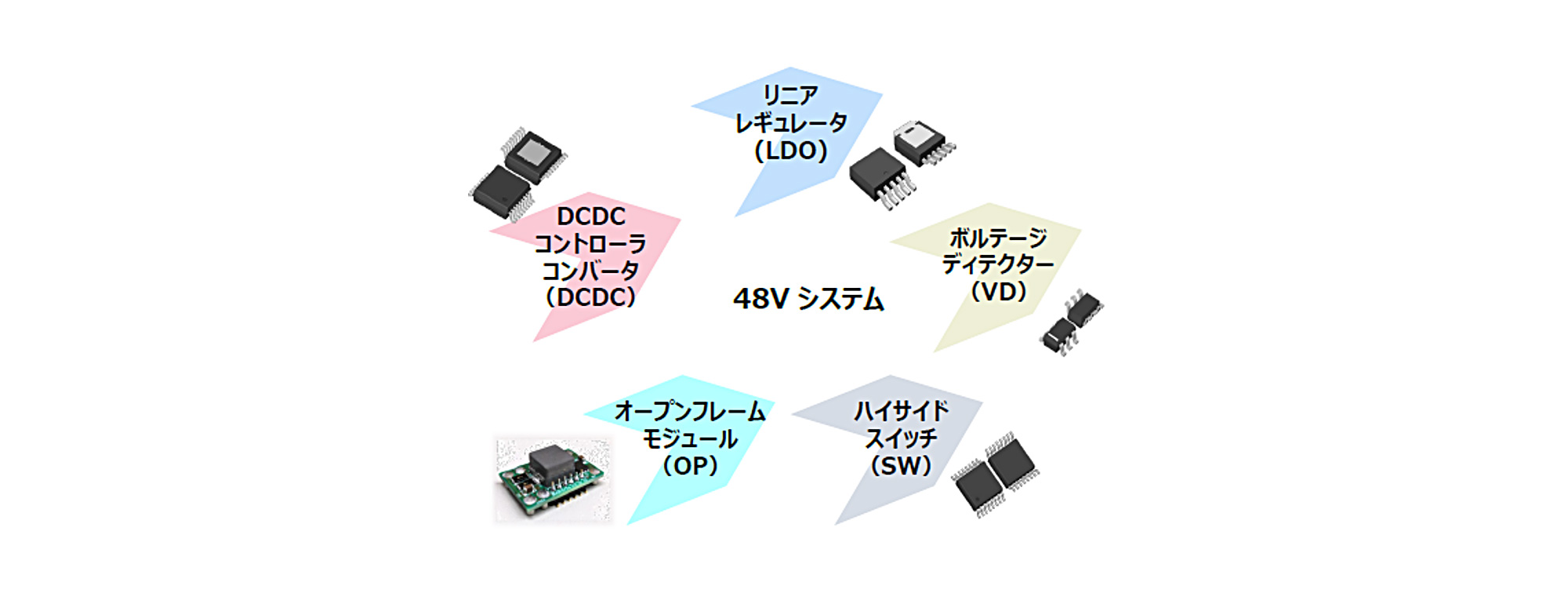
In increasingly electrified and sophisticated in-vehicle ECUs, "POWER SUPPLIES design" has become a more crucial factor influencing the overall system performance and reliability than ever before. 48V in-vehicle POWER SUPPLIES systems have attracted particular attention in recent years. While 12V systems are bottlenecked by current, heat generation, and harness weight, 48V offers a practical alternative that fundamentally improves upon these issues. It is expanding not only to the main batteries of MHEVs (mild hybrid vehicles) but also to the auxiliary batteries of HEVs (hybrid vehicles) and EVs (electric vehicles).
This article is aimed at engineers who are about to start designing 48V compatible ECUs. It will explain step by step, from the background of "why 48V is necessary," to the concepts to keep in mind when designing POWER SUPPLIES in the 48V era, and to a concrete design image using Nisshinbo Microdevices' mass-production compatible ICs. Technical terms will be explained with their background as they are used, so even those who are new to 48V design can grasp the overall picture just by reading along.
Why are automotive systems moving towards 48V?
As vehicles become more electrified, the power required by ECUs and ACTUATORS is increasing year by year. In the conventionally dominant 12V system, increasing power requires increasing current, which results in problems such as thicker wiring harnesses, increased weight, heat generation, and power loss.
Increasing the voltage to 48V allows the same power to be handled with less current. For example, when driving a 1000W load, approximately 85A is required at 12V, but this can be reduced to approximately 21A at 48V. This current reduction can significantly decrease the weight of the harness from approximately 2kg per 5m to approximately 0.3kg in this example. It also leads to greater flexibility in wiring layout, positively impacting ECU placement and the overall vehicle design.
For these reasons, the 48V system is being considered for adoption not only in mild hybrid vehicles, but also in a wide range of applications such as auxiliary POWER SUPPLIES systems for HEVs and EVs, as well as area ECUs, BMSs, and heater control.
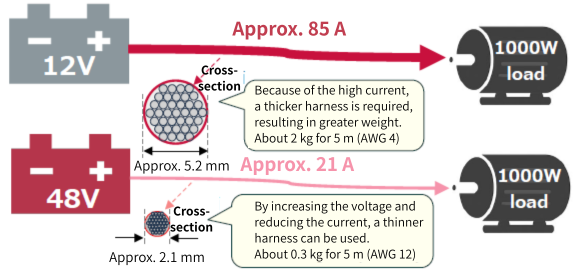
Differences in current, losses, and wiring weight between 12V and 48V systems (at a 1000W load)
POWER SUPPLIES design principles for 48V systems
The transition from 12V to 48V systems presents a fundamental challenge in POWER SUPPLIES design: how heat and losses are handled changes completely.
Even if the output voltage and load current remain the same, simply increasing the input voltage from 12V to 48V will result in a dramatic increase in the losses generated within the device.
LDOs (linear regulators), in particular, have a simple structure and excellent noise characteristics, but they also have the property that the difference between the input voltage and the output voltage is directly dissipated as heat. While this characteristic was not much of a problem in 12V systems, it suddenly becomes a significant design constraint in 48V systems.
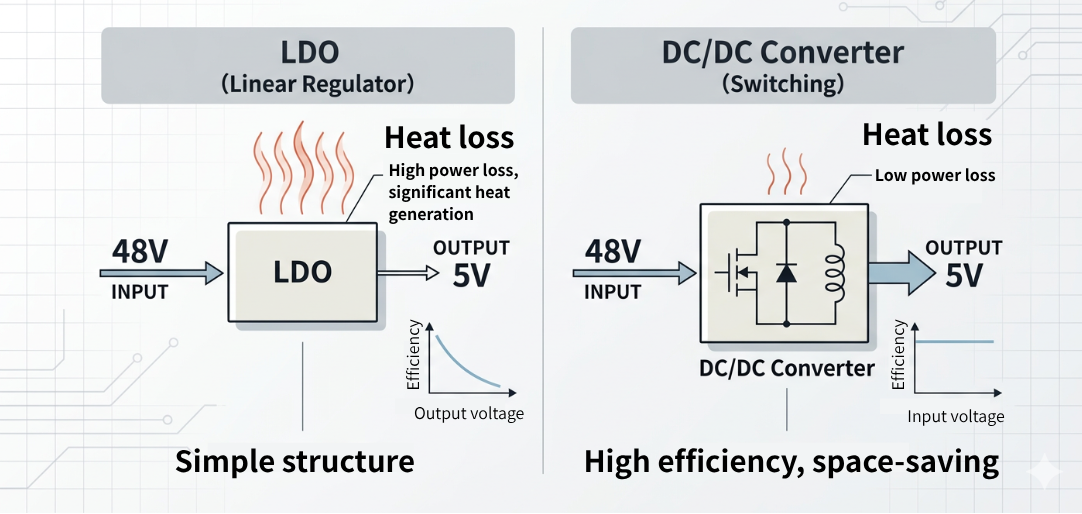
Comparison of LDO and DCDC
Why LDO losses increase several times over and the advantages of DCDs
Let's consider the losses in an LDO with 12V and 48V inputs, using a typical 100mA load in an ECU as an example. A load current of 100mA is representative of typical loads that are "not particularly high currents, but have been supplied by LDOs," such as the microcontroller peripheral circuits, sensor POWER SUPPLIES, communication ICs, and analog circuits mounted on an ECU.
In the era of 12V systems, it was generally assumed that currents in the 100mA range could be handled without problems by an LDO.
However, when generating 5V from 48V using an LDO, even with the same 100mA load...
- At 12V input: Approximately 0.7W loss.
- At 48V input: Approximately 4.3W loss.
Therefore, even with the same 100mA, simply increasing the input voltage to 48V causes the heat generation to jump by approximately six times.
At this level of loss, depending on the package's allowable power dissipation and the board's heat dissipation conditions, mounting may not even be possible in some cases.
When using a DC/DC converter, for example, even when converting from 48V to 5V, if an efficiency of around 80% can be achieved, the power loss at a 100mA load can be kept to approximately 0.1W (100mW).
At this level of loss,
- Easy to manage fever
- High degree of freedom in parts selection and layout
- It is easier to ensure the reliability of the entire system.
These are some of the implementation benefits you can gain.
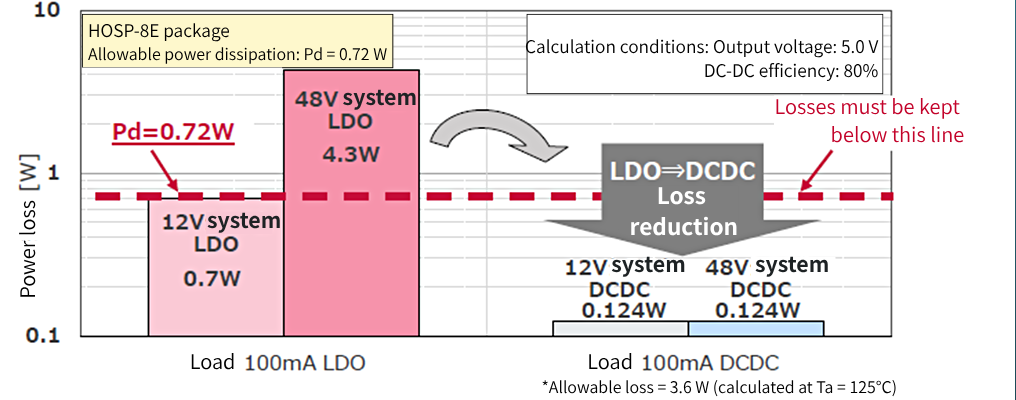
Example of calculated losses for 12V/48V systems
Organizing the required POWER SUPPLIES architecture for 48V systems
Just because you've switched to 48V doesn't mean you need to replace everything with SWITCHING POWER SUPPLIES.
The important thing is to configure the components appropriately for each application, taking into account the loss structure at 48V.
- Main POWER SUPPLIES supply that handles currents above a certain level
→ High-efficiency conversion with a DC/DC converter (48V to 12V, 48V to 5V, etc.) - Low current, noise priority, and always-on power supply system
→ Use LDOs only in a limited way (e.g., 20mA or less)
In 48V systems, it is crucial to correctly understand these differences in loss structure and to determine POWER SUPPLIES method in the early stages of design.
48V input voltage compatible DC-DC converter: R1260S series
The R1260S is the DC-DC converter currently being mass-produced by Nisshinbo Microdevices that supports a 48V input voltage.
The R1260 is a step-down DC/DC controller that operates over an input voltage range of 5 V to 60 V and can drive high-side and low-side external N MOS FETS to generate output voltages from 1.0 V to 16.0 V. It employs a unique current-mode PWM control architecture that does not require current sensing, enabling the construction of a stable and highly efficient DC/DC converter even when using low-Ron FETs and low-DCR INDUCTORS as external components. One typical application of the R1260S is as a step-down converter from 48 V to 12 V. Since many automotive ECUs are still designed for 12 V systems, stepping down to 12 V is essential to provide a stable POWER SUPPLIES supply to each ECU, even in vehicles using a 48 V system.
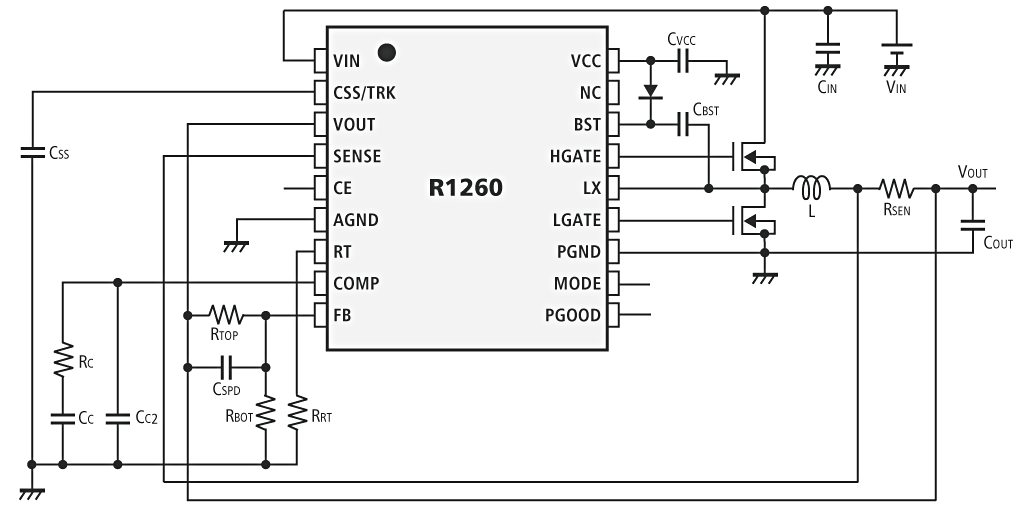
R1260 Series Basic Circuit Example (at 250 kHz) Source: Nisshinbo Microdevices
URL: R1260 Series | Nisshinbo Microdevices
High efficiency under light load
A key feature of the R1260S is its low-load efficiency. The measurement results when the R1260S was operated at 48V → 12V are shown in the figure below.
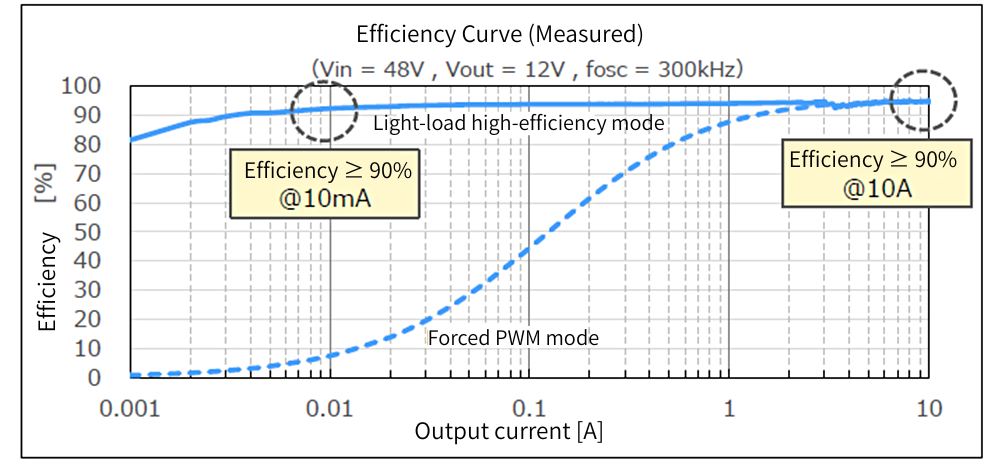
R1260S Series Efficiency Curve (Measured Values)
When using the light-load high-efficiency mode, efficiency is maintained at over 90% even at a 10mA load. In recent years, with the integration of ECUs and the increase in systems with long standby times, such as sentry mode (e.g., parking surveillance), the efficiency in the light-load range is increasingly directly impacting the overall standby power consumption of the vehicle. This measured data demonstrates that practical efficiency can be maintained even under the demanding conditions of a 48V input.
Nisshinbo Microdevices has a long history of developing analog POWER SUPPLIES ICs, and excels at low current consumption design and optimizing light-load efficiency. This design philosophy is reflected in the R1260S series. For designers who want to determine POWER SUPPLIES configuration while comprehensively evaluating "loss, temperature, and efficiency" in a 48V system, the R1260S is a practical and easy-to-use option.
48V input voltage compatible LDOs: R1560x / R1561x series
For low-current applications such as control circuits and monitoring circuits, a 48V input compatible LDO is effective.
Nisshinbo Microdevices' R1560x/R1561x series are voltage regulators that support up to 60V input and 100mA output, featuring ultra-low current consumption and excellent transient response.
48V input compatible LDOs represent a niche market with limited product lineups from other companies, offering the advantage of simplified design in battery-direct connection systems and point POWER SUPPLIES requiring high voltage resistance. Potential applications include auxiliary POWER SUPPLIES for timer ICs and edge devices, where current is limited.
R1560x: Ultra-low current consumption
- My IQ is only around 3μA.
- Ideal for applications where you want to minimize the constant power supply line or sleep current.
R1560 (https://www.nisshinbo-microdevices.co.jp/ja/products/ldo-linear-regulator/spec/?product=r1560)
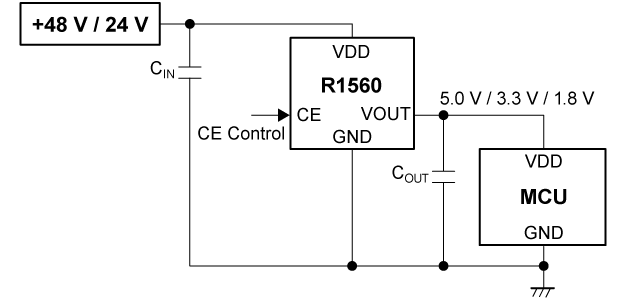
Basic circuit of the R1560 series. Exhibited by: Nisshinbo Microdevices
R1561x: Excellent transient response characteristics
- It has high voltage tracking capabilities and is suitable for stabilizing sensors, analog circuits, etc.
R1561 (https://www.nisshinbo-microdevices.co.jp/ja/products/ldo-linear-regulator/spec/?product=r1561)
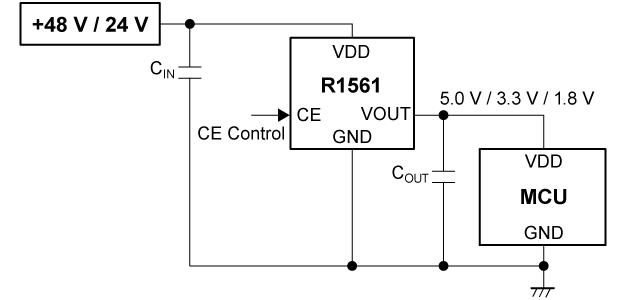
Basic circuit of the R1561 series. Source: Nisshinbo Microdevices.
48V input voltage compatible VD: R3160N series
In a 48V system, a voltage detector (VD) that can directly monitor the battery voltage also plays an important role.
Nisshinbo Microdevices' R3160N series supports inputs up to 60V and can detect voltage drops with high accuracy and low current consumption. A major design advantage is the simplification of external voltage divider circuits when expanding existing 12V ECUs to 24V or 48V environments.
Direct detection of 48V/24V batteries
- High precision and low power consumption for detecting voltage drops.
- Used as a trigger for ECU failsafe or low-voltage reset.
Simplify expansion design
- When expanding an existing 12V ECU to support 24V/48V, the previously complex voltage division and correction circuits can be simplified. This makes it easier for users who want to "make their existing assets 48V compatible."
R3160 (https://www.nisshinbo-microdevices.co.jp/ja/products/reset-voltage-detector/spec/?product=r3160)
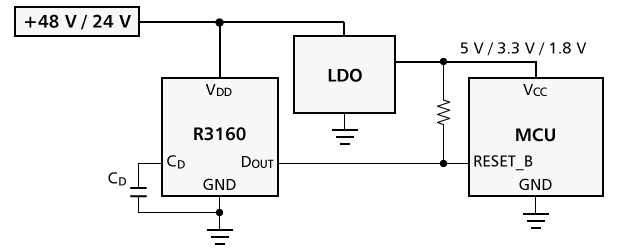
Basic circuit example of the R3160N series. Source: Nisshinbo Microdevices.
Summary
48V in-vehicle POWER SUPPLIES systems are a technology that is increasingly being considered in ECU design as electrification progresses.
This is an unavoidable technique in design. To maximize the wiring and loss-related benefits gained by increasing the voltage, it is important to understand the loss structure unique to 48V and to appropriately combine DC/DC converters, LDOs, and monitoring ICs according to the application.
Nisshinbo Microdevices Corporation offers a lineup of mass-produced products including DC/DC converters, LDOs, and voltage detectors that support 48V input, and is also working on the development of related products. If you are interested in our roadmap beyond mass-produced products, or if you are having trouble selecting products or configuring circuits when considering 48V compatibility, we can support you based on our expertise as a specialized semiconductor trading company.