
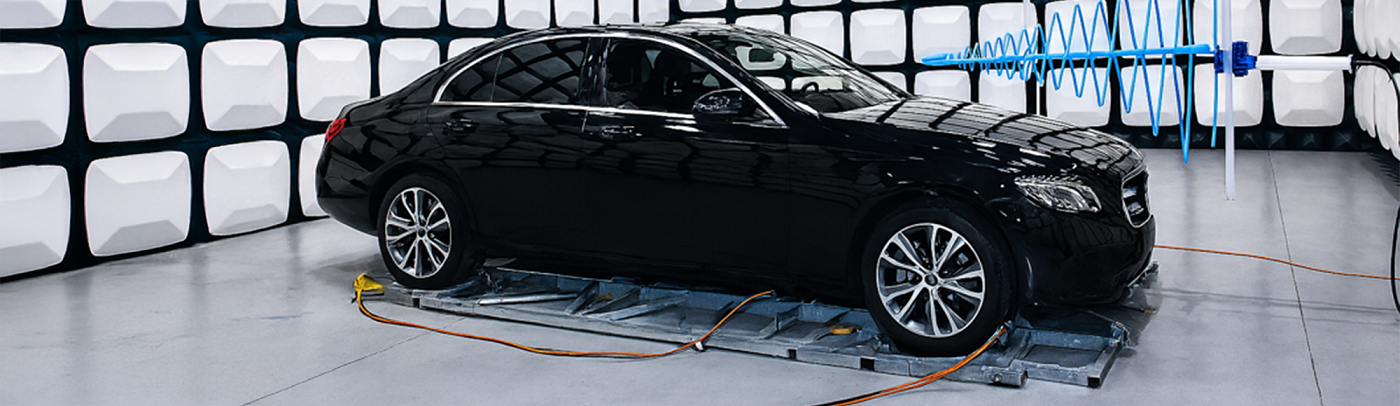
Automotive technology is rapidly evolving due to the spread of autonomous driving and electric vehicles (EVs). As a result, onboard equipment is becoming more sophisticated and high-performance, making it increasingly important to comply with EMC (electromagnetic compatibility) standards.
This column provides engineers with easy-to-understand explanations of the changes in the EMC environment surrounding automobiles, the latest trends in international standards, and actual measurement methods.
Changes in the automotive EMC environment
Examples of changes in the automobile industry
In today's world, the use of wireless communications has expanded rapidly, and automobiles are now subject to a variety of wireless communications and electromagnetic waves while driving. Furthermore, the electronic control technology installed in automobiles is becoming more sophisticated in order to improve environmental performance, safety, and comfort. For autonomous driving, vehicles are now equipped with sensors in all directions, and with the spread of EVs, there are also increasing opportunities to connect vehicles to charging equipment. In order to respond to these technological innovations and environmental changes, automobiles are strongly required to comply with various EMC regulations.
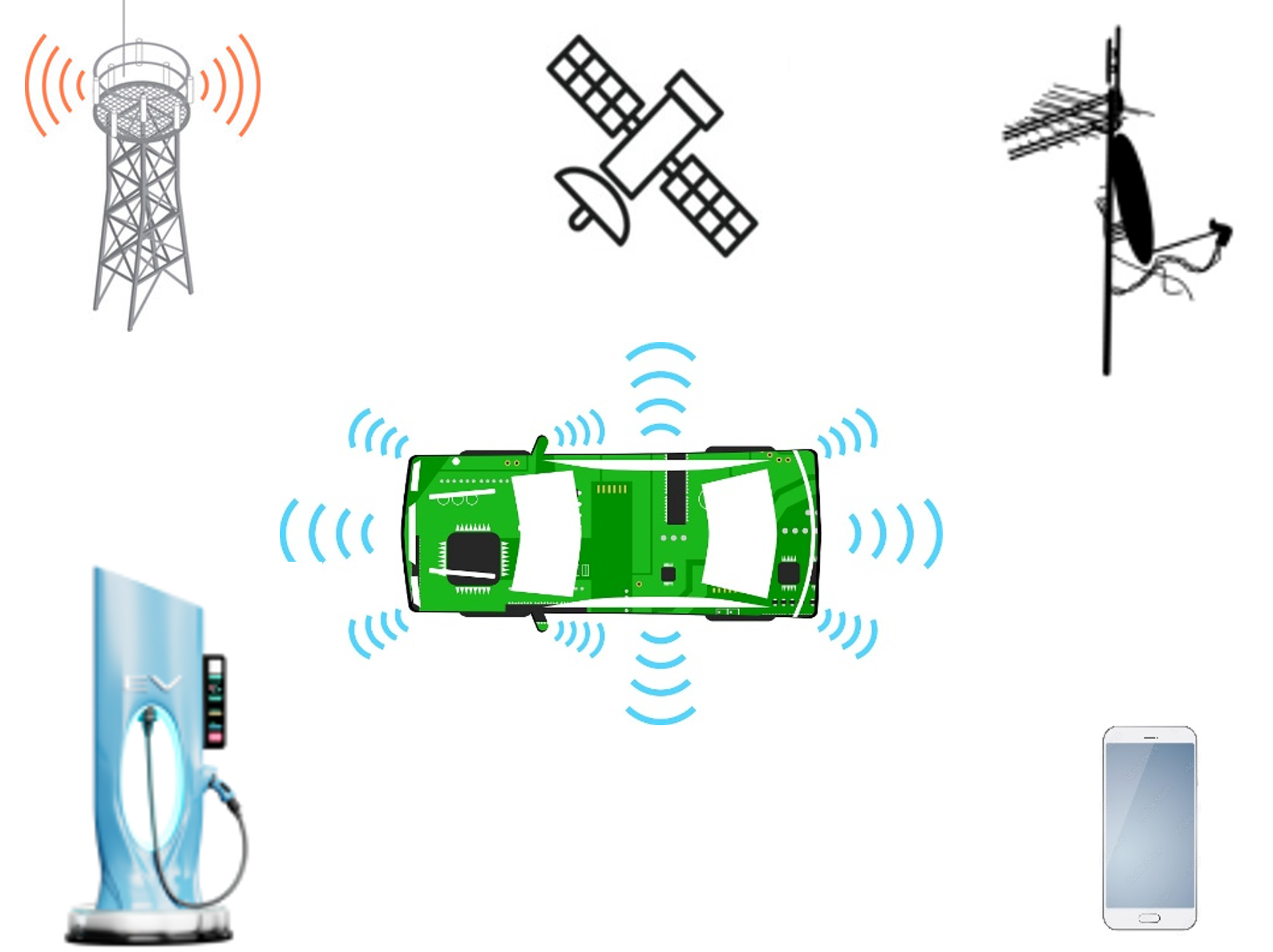
Images of various wireless communications and electromagnetic waves surrounding automobiles
Trends in international EMC standards
Major international EMC standards for automobiles
The main international EMC standards (CISPR *1 and ISO *2) for automobiles and their installed components are summarized below.
| test | International Standards | Application point/measurement point | Test Frequency | ||
|---|---|---|---|---|---|
| Actual vehicle test | EMI | Wideband noise detection | CISPR12 | Electric field measurement at a distance of 10m or 3m | 30MHz~1GHz |
| Narrowband Noise Measurement | Electric field measurement at a distance of 10m or 3m | 30MHz~1GHz | |||
| In-vehicle receiver protection | CISPR25 | Measuring the voltage of your vehicle's ANTENNAS | 150KHz to 2.5GHz | ||
| Low-frequency radiated interference | CISPR36 | Magnetic field measurement at a distance of 3m | 150KHz to 30MHz | ||
| EMS | General vehicle testing | ISO11451-1 | ー | ー | |
| External radiation source method | ISO11451-2 | Externally applied to the vehicle | 10KHz to 18GHz | ||
| Portable Transmitter Act | ISO11451-3 | Applied by a portable transmitter | 1.8MHz~5.85GHz | ||
| BCI method | ISO11451-4 | Apply to harness | 1MHz to 400MHz | ||
| Reverberation Chamber Method | ISO11451-5 | Apply to harness/ECU | LUF (or 10kHz) to 18GHz | ||
| Electrostatic Discharge Test | ISO10605 | Apply to areas that can be touched by humans | ー | ||
| Component Testing | EMI | In-vehicle receiver protection | CISPR25 | Electric field measurement at a distance of 1m Conducted Emission Measurement | 150kHz to 2.5GHz |
| EMS | General component testing | ISO11452-1 | ー | ー | |
| Anechoic chamber method (ALSE) | ISO11452-2 | Apply to harness/ECU | 80MHz~18GHz | ||
| TEM cell method | ISO11452-3 | Apply to harness/ECU | 10KHz to 200MHz | ||
| BCI method/TWC method | ISO11452-4 | Apply to harness | 1MHz~3GHz | ||
| Stripline Method | ISO11452-5 | Applied to harness (and ECU) | 10KHz to 400MHz | ||
| Direct Power Injection (DPI) | ISO11452-7 | Apply to CONNECTORS pin | 250KHz to 400MHz | ||
| low-frequency magnetic fields | ISO11452-8 | Applied to ECU | 15Hz to 150KHz | ||
| Portable Transmitter | ISO11452-9 | Apply to harness/ECU | 26MHz~5.85GHz | ||
| Low-Frequency Conduction | ISO11452-10 | Apply to harness | 0Hz, 15Hz to 150kHz | ||
| Reverberation Chamber Method | ISO11452-11 | Apply to harness/ECU | LUF to 18GHz | ||
| Electrostatic Discharge Test | ISO10605 | Apply to harness/ECU | ー | ||
| General Exams | ISO7637-1 | ー | ー | ||
| transmission | ISO7637-2 | Applying a pulse to POWER SUPPLIES line/measurement | — | ||
List of EMC international standards
*1 CISPR: International Special Committee on Radio Interference
*2 ISO: International Organization for Standardization
Expansion of test frequencies in automotive EMC standards
In recent years, with the advancement of automotive electronics and wireless communication technology, the frequency bands covered by EMC testing have changed significantly. This is because the spread of millimeter-wave radar and 5G communications, as well as the introduction of electrification and wireless charging systems, require electromagnetic compatibility over a wider range of frequency bands than before. Below, we will explain the expansion of high- and low-frequency test frequencies.
◆Expansion of high-frequency test frequencies
・Immunity (EMS) test
With the spread of millimeter-wave radar and 5G communications, the test frequency has been expanded from the previous 1 GHz to 6 GHz.
On the other hand, there is also the issue of longer test times in order to ensure test quality.
・Emission (EMI) testing
Currently, CISPR12 for actual vehicles is limited to 1GHz, but discussions have begun to extend it to 6GHz, as with other product committees.
◆ Expansion of low-frequency test frequencies
・ISO standard trends
In the future, support for even lower frequency bands is expected to progress, with EMC requirements (such as supra-harmonics from power conversion devices and conducted emissions from AC POWER SUPPLIES ports) being added for the frequency range of 2 kHz to 150 kHz.
・Wireless charging system (WPT)
The need for electric field measurement is increasing, and test methods are being reviewed.

Expanded EMC test frequencies (red dotted area)
EMC measurement method
EMC measurement methods in the high frequency range: ALSE method and reverberation chamber method
What is the ALSE method?
ALSE stands for Absorber Lined Shielded Enclosure, and in Japanese it is called the "anechoic chamber method" or "ANTENNAS irradiation method." This is a typical measurement method used for immunity testing of automobiles and in-vehicle equipment (EMS) by irradiating an electromagnetic field from ANTENNAS in an anechoic chamber, and complies with the ISO 11452-2 standard. The frequency range covers high frequencies up to 18 GHz.
The ALSE method can only irradiate electromagnetic waves from one direction.
What is the reverberation chamber method?
The electromagnetic waves in the test area are diffused by the reflection of metal surfaces in the shielded chamber and the rotation of the stirrer, creating a homogeneous test environment in terms of electric field. Instead of the conventional method of irradiating electromagnetic waves from one direction, the electromagnetic waves are irradiated from all directions, enabling tests to be conducted under conditions closer to the real environment. This also significantly reduces test time. It is specified in ISO 11452-11 and other standards. It supports a frequency range up to 18 GHz, a high frequency region.
Both the ALSE method and the reverberation chamber method are EMC measurement methods compatible with the high frequency range (up to 18 GHz). Traditionally, the ALSE method was the mainstream, but in recent years, as automobiles have begun to be equipped with multidirectional sensors, there has been a demand for EMC measurement from all directions.
The ALSE method can only irradiate radio waves from one direction, so a turntable must be used for omnidirectional EMC evaluation, which poses the problem of long test times.To solve this problem, the reverberation chamber method was developed, which allows for more efficient automotive EMC measurements.
-
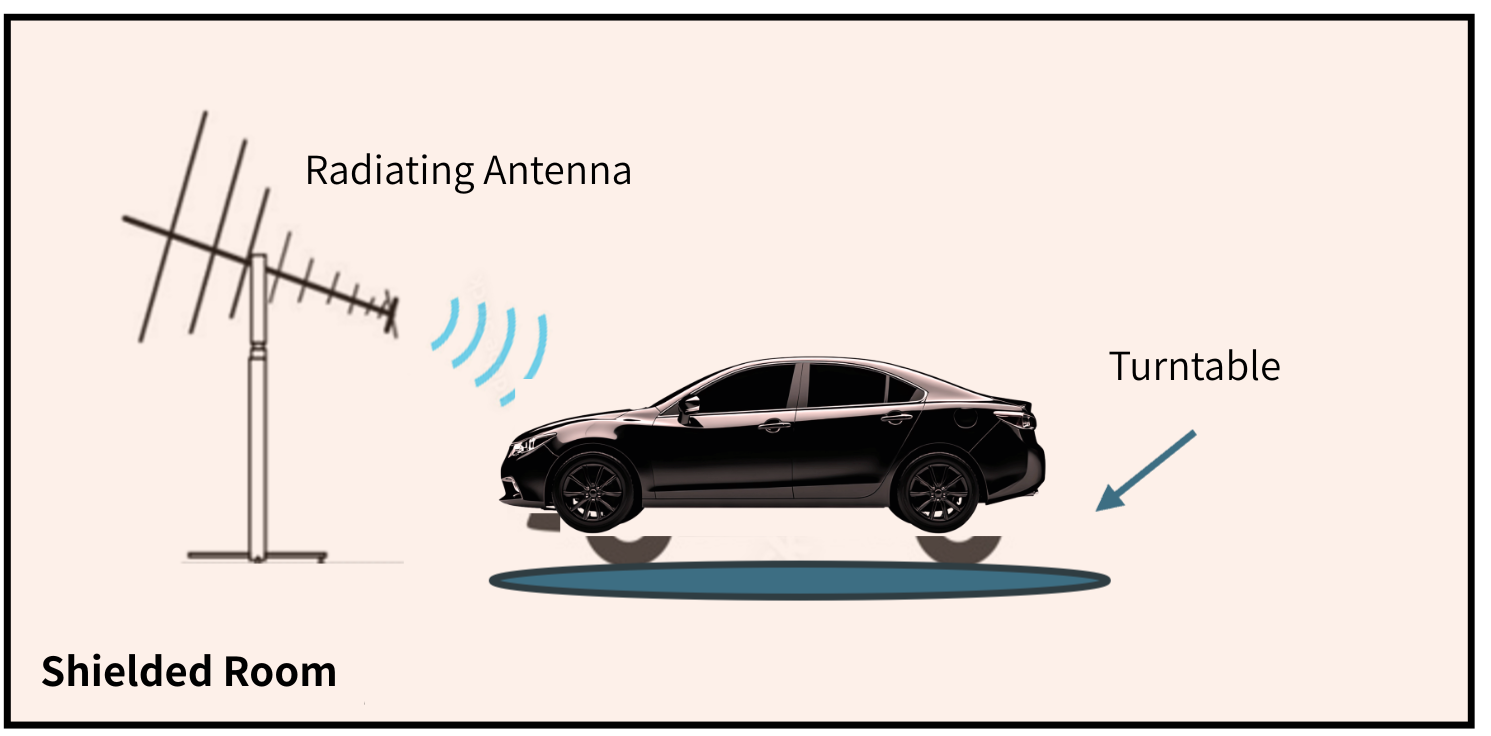
ISO11452-2 ALSE method
(Measurements in each direction are taken by rotating the turntable.) -
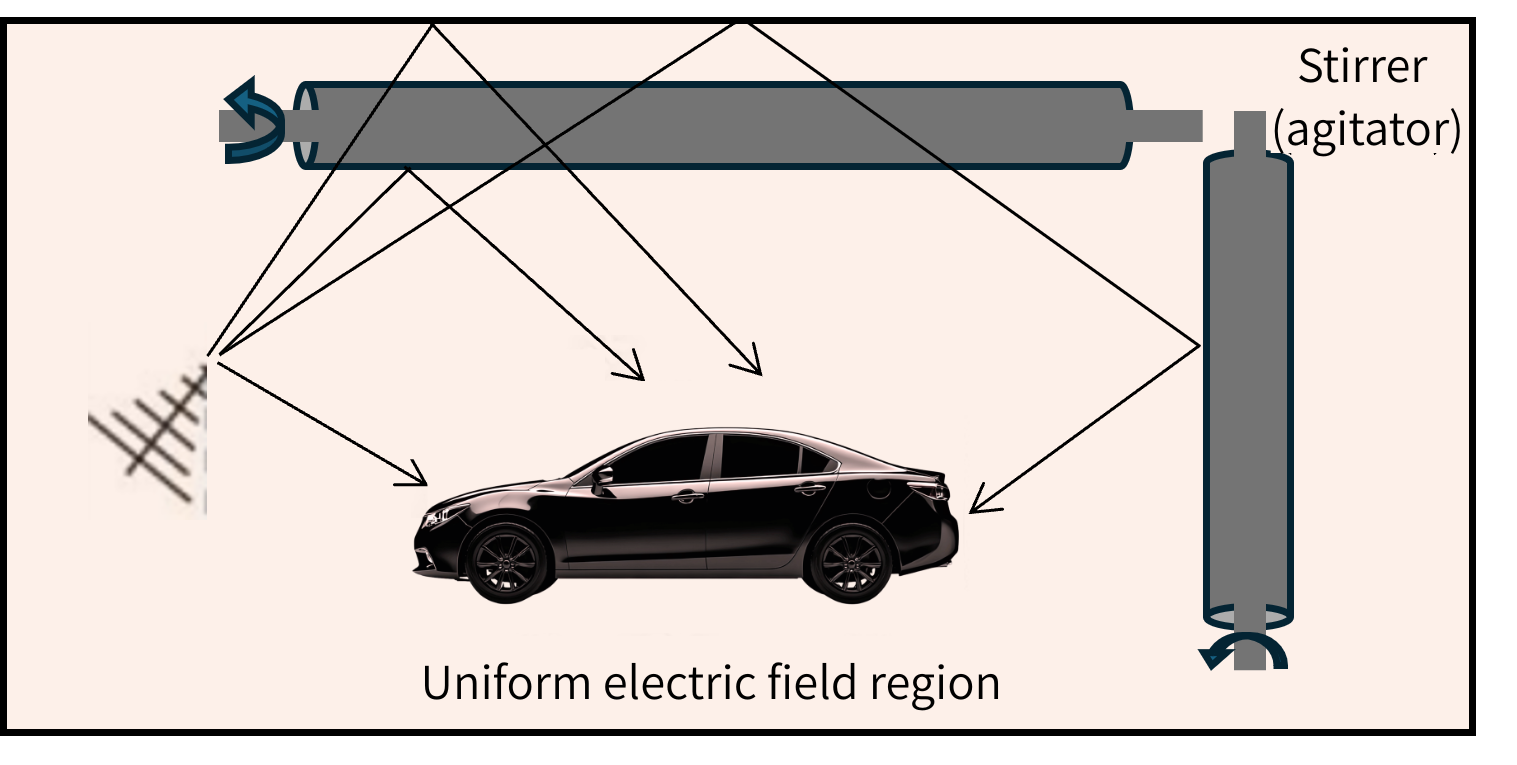
ISO11452-11 Reverberation chamber method
Trends in EMC test standardization in the low frequency range
With the widespread adoption of electric vehicles, wireless charging systems (WPT) are moving from the development stage to the preparation stage for widespread adoption. This has led to an increased importance of EMC evaluation in the low-frequency range. While traditional EMC testing has focused primarily on the high-frequency range, WPT requires electric field measurements in the low-frequency range from a few kHz to several tens of MHz, and international standards are currently being developed. The low-frequency range of 2 kHz to 30 MHz is important for evaluating the power conversion devices used in WPT and the harmonics (supraharmonics) generated by their operation. To accurately measure these effects, CISPR11 is scheduled to standardize monopole ANTENNAS measurements at a distance of 10 m for the low-frequency range of 2 kHz to 30 MHz.
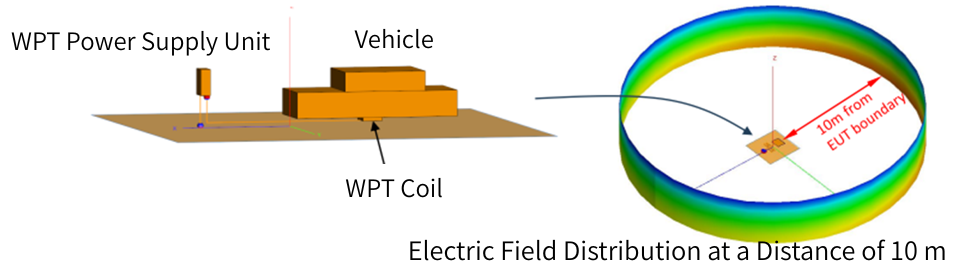
Monopole ANTENNAS measurement system image
Measure the electric field distribution within a circle at a distance of 10m
Summary of automotive EMC standards and measurement methods
In response to the rapid evolution of automotive technology in recent years, EMC countermeasures are becoming increasingly important. The EMC measurement range has expanded widely from low to high frequencies, and test methods are becoming more sophisticated, requiring electromagnetic wave evaluation from all directions. Engineers are required to understand the latest trends and take appropriate measures.
We offer a variety of countermeasure products that meet diverse EMC needs. We can also introduce you to EMC testing sites. If you are interested, please feel free to Inquiry.