

5G RedCap (Reduced Capability) is a new 5G standard designed for IoT devices and industrial equipment, enabling high-performance 5G communications at low cost and with low power consumption. This article provides a clear technical overview of 5G RedCap and examples of its use, as well as introducing key points to consider when considering its adoption.
5G RedCap Overview
5G RedCap is a communications standard that simplifies some of the features of fifth-generation mobile communications (5G), such as high speed, low latency, and multiple simultaneous connections, to achieve lower power consumption and lower costs for IoT devices.
The specification was formalized in 3GPP Release 17 in June 2022.
The background to the development of 5G RedCap is to define simpler NR devices for wearable devices and high-end IoT applications, enabling faster data transmission than low-power wide-area (LPWA) technologies such as NB-IoT and LTE-M.
The communication speed and power consumption of 5G RedCap are positioned between those of 5G NR communication, NB-IoT, and LTE-M. Specifically, it achieves uplink (UL) speeds of approximately 50Mbps and downlink (DL) speeds of approximately 150Mbps.
*For details on NB-IoT and LTE-M, please refer to the related information "An overview of cellular LPWA and communication technologies that achieve low power consumption."
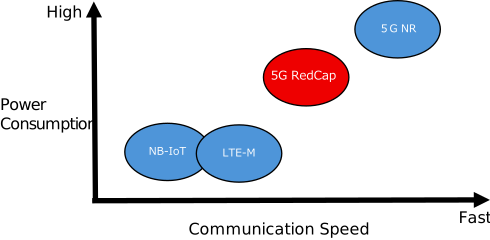
5G RedCap's positioning
5G RedCap vs. other technologies
The table below compares the features of 5G RedCap with NB-IoT, LTE-M, and 5GNR.
Comparison of 5G RedCap features with NB-IoT, LTE-M, and 5GNR
| Item | NB-IoT | LTE-M | RedCap | 5G NR |
|---|---|---|---|---|
| Maximum UL speed* | 62kbps | 1Mbps | 50Mbps | Several Gbps |
| Maximum DL speed* | 26kbps | 1Mbps | 150Mbps | Several Gbps |
| Communication delay | A few milliseconds | A few milliseconds | A few milliseconds | 1ms or less |
| Power consumption** | low | low | Medium | high |
| Bandwidth Usage | 200kHz or less | 1.4MHz | 20MHz | 100MHz*** |
| Network used | LTE | LTE | 5G | 5G |
| cost**** | low | low | Medium | high |
* Speed: Theoretical value
** Power consumption: relative value
*** Bandwidth: 5G NR (Sub-6) assumed
**** Cost: Relative
Four features of 5G RedCap that achieve low power consumption and low cost
To achieve low-power, low-cost communications, 5G RedCap mainly employs the following four technologies:
1. Reduced bandwidth usage
2. Extended DRX interval (eDRX)
3. Transmit and receive timing separation (Half Duplex FDD)
4. Reduced reception function (ANTENNAS /CA not supported)
1. Reduced bandwidth usage
While the maximum bandwidth available for 5G NR is 100MHz, the 5G RedCap is set at 20MHz.
Narrowing the bandwidth used simplifies the terminal's RF circuits and baseband processing, enabling reduced power consumption and costs.
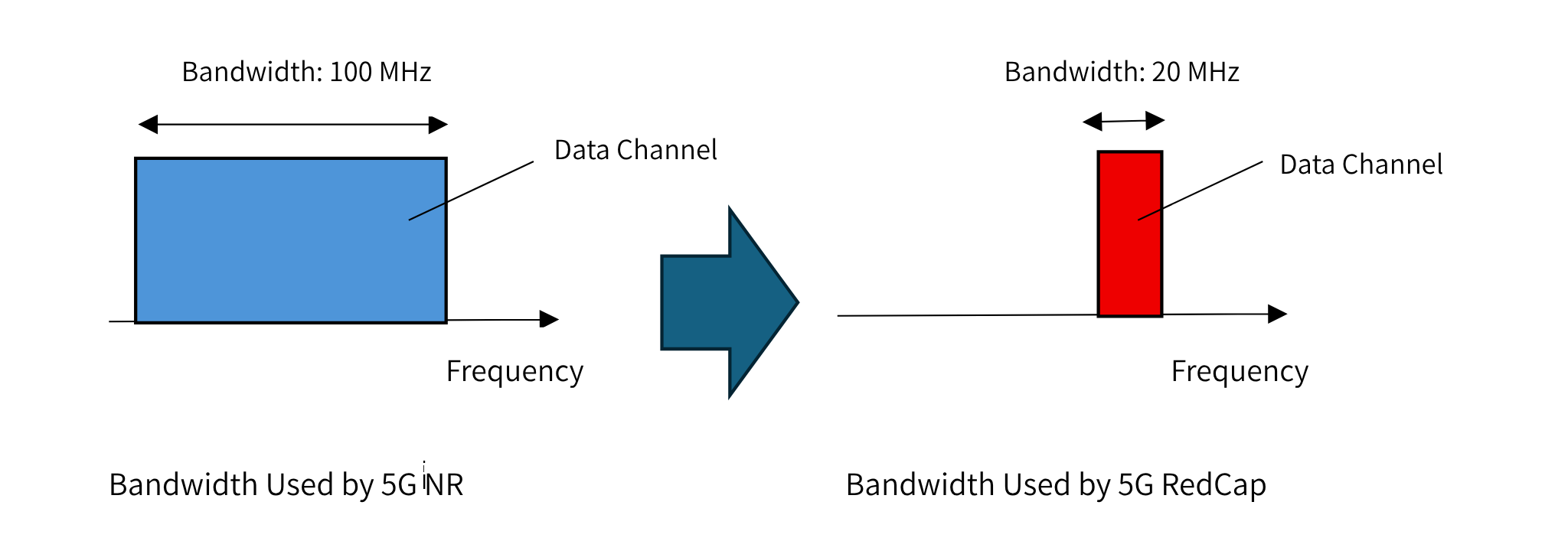
Comparison of 5G RedCap and 5G NR bandwidth usage
2. Extended DRX interval (eDRX)
5G NR employs Discontinuous Reception (DRX) to reduce power consumption during reception. With DRX, the terminal periodically cycles between reception and sleep to support applications that require real-time performance while reducing current consumption. The DRX sleep interval is a maximum of 2.56 seconds, but the eDRX (extended DRX) adopted by 5G RedCap extends this interval to a maximum of 2.91 hours. Extending the sleep time significantly reduces reception processing, enabling operation with even lower power consumption.
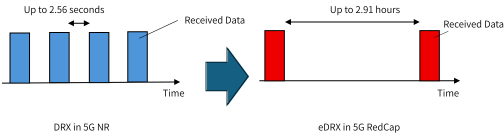
Comparison of sleep intervals between 5G RedCap eDRX and 5G NR DRX
3. Transmit and receive timing separation (Half Duplex FDD)
To achieve high-speed, low-latency communications, 5G NR uses the FDD (Frequency Division Duplex) method, which transmits and receives simultaneously on different frequencies.
On the other hand, 5G RedCap uses HD-FDD (Half Duplex FDD) to separate transmission and reception in time, simplifying the RF configuration and achieving low power consumption and cost.
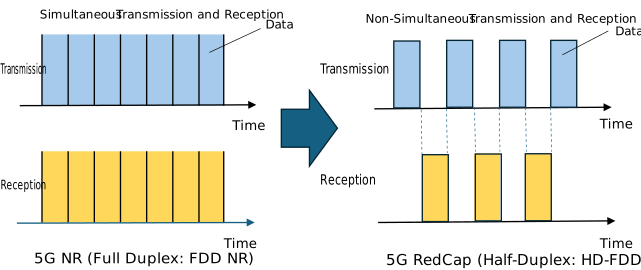
Differences in transmit and receive timing between 5G RedCap and 5G NR
4. Reduced reception function (ANTENNAS /CA not supported)
While 5G NR supports multiple ANTENNAS and carrier aggregation (CA) to increase speeds, 5G RedCap simplifies the RF configuration by limiting ANTENNAS to one and not supporting CA.
This enables low-cost designs optimized for IoT and industrial equipment.
*CA: Carrier aggregation. A technology that uses multiple frequency bands (carriers) simultaneously to improve communication speed and capacity.
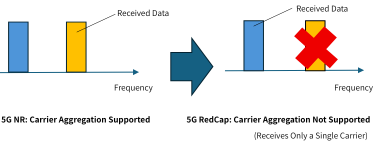
Difference between 5G RedCap and 5GNR CA
Benefits of 5G RedCap
The benefits of implementing 5G RedCap are listed below.
- Migration
The ability to utilize 5G network infrastructure allows for a gradual transition from LTE to 5G. - Operability
RedCap's energy-efficient design reduces the operating costs of battery-powered devices. - Security
RedCap utilizes 5G security FRAMES (encryption, authentication, network isolation, etc.) to enable secure communication. - Connectivity
It can take advantage of 5G's massive simultaneous connection capabilities, enabling large-scale deployment of RedCap devices.
5G RedCap usage examples - 5 selections
5G RedCap is suitable for large-scale deployment in IoT and industrial applications because it can utilize existing cellular infrastructure while achieving both low power consumption and low cost.
Here are five typical use cases.
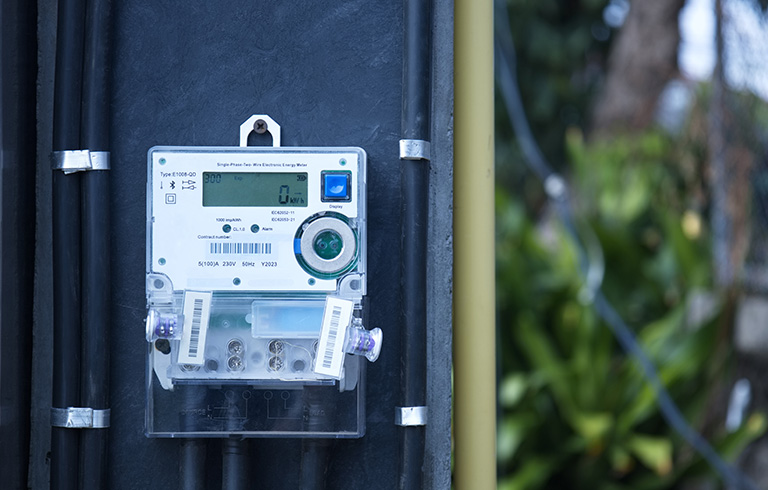
Smart meters
Equipment used for remote meter reading of electricity and water.
Features: Low power consumption is important because long-term operation is required at low data rates.
Benefits of implementation: The low-power consumption design enables long-term operation even with battery power. 5G standard authentication and encryption support secure communications required for meter applications that handle billing information and personal information.
Wearable devices
Small devices such as smartwatches and health management equipment.
Features: Due to limited battery capacity, power saving and stable communication are essential.
Benefits of implementation: Reduced battery charging frequency enables longer operation. Faster communication than NB-IoT and LTE-M enables real-time notifications, voice calls, and emergency alerts.

Industrial Sensors
Used for environmental monitoring in factories and monitoring the condition of equipment.
Features: Stable communication and low power consumption enable long-term operation.
Benefits of implementation: Low latency and medium-speed communication enables more real-time status monitoring and anomaly detection than conventional LPWA. No wiring is required, allowing for greater installation flexibility and reducing maintenance costs.

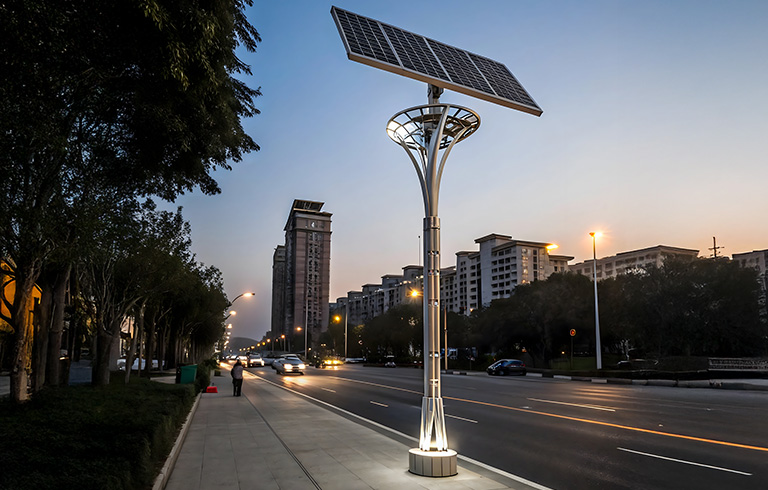
Smart Grid
A system that connects a large number of IoT devices, such as for streetlight control and parking lot management.
Features: Enables large-scale device connectivity at low cost.
Benefits of implementation: Extended battery life reduces on-site replacement work. Utilizing existing 5G networks enables stable operation of multiple simultaneous connections over a wide area.
Package Tracking
Used for obtaining location information and status monitoring in logistics and warehouse management.
Features: Achieves long-distance communication at low cost and low power consumption.
Benefits of the introduction: Existing 5G networks can be utilized, ensuring stable connections over a wide area from urban areas to suburban areas. Faster than LPWA, it can instantly transmit location information plus sensor data such as temperature, humidity, and impact.

5G RedCap compliance status and future outlook
- Current situation in Japan
In Japan, commercial 5G RedCap services are still in the early stages. In September 2025, SoftBank launched the first RedCap commercial service in Japan for Apple Watch. This marks a major step forward in utilizing RedCap in the wearables market. - Overseas trends
Globally, AT&T began supporting RedCap on its standalone (SA) network in June 2024, and adoption is progressing mainly in the North American market. Similar trends are expected to accelerate in Europe and Asia in the future. - Future factors for spread
As the development of 5G RedCap-compatible chipsets, modules, and devices progresses, the product lineup will expand and deployment costs are expected to further decrease. In addition, as network carriers expand their coverage areas, it is expected that operational costs will decrease and service quality will improve.
By considering the introduction of 5G RedCap, now is the perfect time to secure a first-mover advantage. - Next-generation technology: eRedCap
In December 2023, 3GPP Release 18 formulated "eRedCap (enhanced RedCap)," which achieves even greater power savings than 5G RedCap.
eRedCap reduces the data channel bandwidth to 5MHz and limits the communication speed to a theoretical value of 10Mbps for both UL and DL, making it optimized for applications requiring small amounts of data and long life, such as sensor networks and measurement terminals.
The key to future IoT strategies will be to design RedCap and eRedCap to suit different applications.
Summary
5G RedCap is a next-generation communications technology for IoT and industrial equipment that utilizes existing 5G infrastructure while achieving both low power consumption and cost reductions in communications terminals.
Going forward, technological advances and market expansion are expected to accelerate the use of this technology in a wide range of fields, including smart grids, industrial IoT, and wearable devices.
When considering introducing 5G RedCap, please refer to the points introduced in this article and proceed with early PoC development and partner selection.
Related Info
Inquiry
Related Product Information

Introduction to Edge AI Solutions with NXP's NPU-equipped i.MX/MCX
This article explains the rapidly growing edge AI with real device examples and introduces NXP’s processors and microcontrollers equipped with NPUs.
- NXP Semiconductors NV
- NEXT Mobility
- ICT and Industrial
- Smart Factories and Robotics
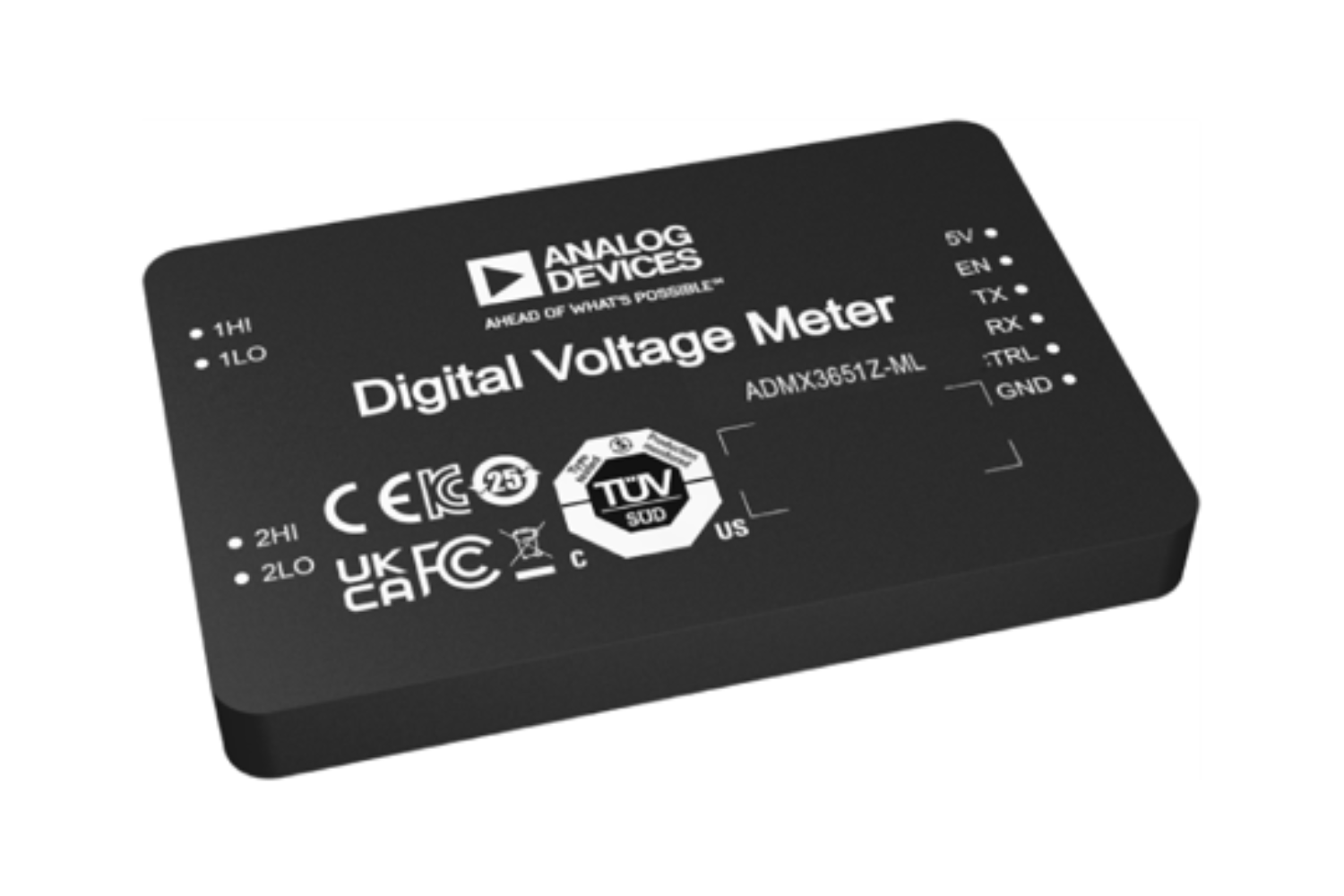
ADMX3651: 6.5-digit, ±10V digital voltmeter
The ADMX3651 is a 6½-digit digital voltmeter that combines high throughput and high-precision measurement, making it suitable for industrial automated testing and high-precision voltage measurement.
- Analog Devices, Inc.
- ICT and Industrial

OSP (Open System Protocol) Overview
The OSP in ams OSRAM is a free, open network technology for connecting in-vehicle LEDs and sensors. This system is ideal for various applications other than automotive applications.
- ams-O STATIC RAMS AG
- NEXT Mobility
- ICT and Industrial

Introduction to Wireless Gesture Sensors (Use Cases for Analog Devices Products)
The wireless gesture sensor developed by NEXTY Electronics enables low-cost remote control of home appliances and display products.
- Analog Devices, Inc.
- NEXT Mobility
- ICT and Industrial
- Smart Factories and Robotics
TMC2241: 65V 2-arm smart built-in stepper motor driver (with S/D and SPI)
The TMC2241 is a high-performance ROTATIONAL STEPPING MOTORS driver IC compatible with 65V. It features quiet operation and current sensing capabilities.
- Analog Devices, Inc.
- ICT and Industrial

Lantronix - System on Module with Qualcomm IoT Application Processors
Lantronix provides SoMs equipped with Qualcomm IoT processors and offers end-to-end solutions utilizing AI and 5G.
- LANTRONIX, INC.
- ICT and Industrial
- Smart Factories and Robotics