
EMC Design Fundamentals: 3 Principles for Avoiding Failure
~For those starting EMC design~
In recent years, devices incorporated into products have become increasingly high-frequency and high-current, and the factors that must be considered in EMC design are increasing year by year. On the other hand, it is also true that the increasing scale of circuits and the accelerating pace of development have made it difficult to adequately consider EMC in the early stages of design.
EMC design, if approached haphazardly without a clear strategy, often leads to repeated additions of countermeasures and layout modifications, resulting in prolonged development periods and increased costs. Therefore, instead of relying on reactive measures in later stages, it is essential to adopt an approach that efficiently ensures EMC from the early design phases.
This column is primarily aimed at designers who are new to EMC design and will explain the basic concepts of EMC design. Rather than introducing special components or advanced countermeasures, we will focus on points that should be kept in mind from the design stage of principle prototypes and initial prototypes, and organize the thinking behind preventing EMC problems.
1. Introduction
What is EMC?
EMC (Electromagnetic Compatibility) refers to the ability of equipment and systems to reliably perform their intended functions in the surrounding electromagnetic environment, and to avoid causing electromagnetic interference to other equipment beyond acceptable limits.
EMC is primarily comprised of the following two aspects:
- EMI (Electromagnetic Interference)
Electromagnetic noise radiated or conducted from the equipment to the outside. - EMS (Electromagnetic Susceptibility)
The ability of equipment to maintain normal operation without being affected by external electromagnetic interference.
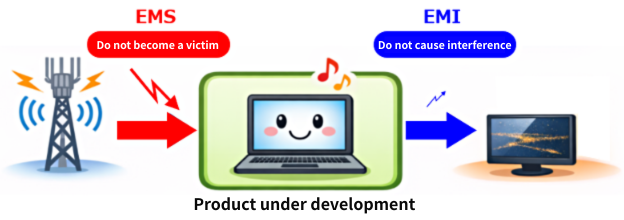
Figure 1
Product Category and EMC Requirements Level
EMC requirements vary depending on the product category, application, and sales region, and are defined by various laws, regulations, and standards.
For example, consumer electronics, industrial equipment, and automotive equipment are subject to different EMC standards, requiring different design considerations for each. Therefore, in EMC design, it is crucial to thoroughly understand the standards and requirements applicable to the target product from the initial design stage before establishing a design policy.
Design process from an EMC perspective
While everyone understands the importance of EMC design in product development, in reality, constraints such as functional realization, ensuring general performance, cost, and prototyping schedules often take priority, and EMC considerations tend to be put on the back burner. As a result, it is not uncommon for EMC problems to only become apparent in the later stages of the development process.
EMC countermeasures may involve fundamental design changes, such as altering the layer configuration of the circuit board or reviewing the enclosure structure. Depending on the nature of these changes, additional prototyping steps may be required, significantly impacting design effort, cost, and schedule.
Therefore, it is no exaggeration to say that how well EMC (Electromagnetic Compatibility) is considered from the initial design stages is a crucial factor in determining the success or failure of product development.
This column explains the fundamental concepts of EMC design that should be understood in the early stages of design.
2. Basic Concepts of EMC Design
EMC design is not about adding countermeasures during evaluation testing; it's about consciously incorporating EMC elements from the early stages of design, including circuitry, board layout, and enclosure structure.
Even seemingly complex EMC issues can actually be summarized into the following three points when viewed from a design perspective.
① Do not generate noise.
② Prevent the generated noise from leaking to the outside.
③ Attenuate the generated noise.
This order has a clear meaning.
The approach is to first suppress the generation of noise itself, then create a structure that prevents any remaining noise from spreading externally, and finally weaken any remaining noise with countermeasures components and circuits.
In the following sections, we will explain the key points to keep in mind regarding these three perspectives, especially during the initial stages of design.
① Prevent noise generation (source control measures)
In source control, it is crucial to design the circuits and wiring that generate noise in a way that minimizes noise generation.
- In electronic circuits, current always has both a "forward" and a "return" path, so it is especially important to be clearly aware of the "return" path when designing circuits and layouts.
If this return path is interrupted or separated, the closed-loop area formed by the current's "forward" and "return" flows increases, leading to an increase in electromagnetic noise generation. Therefore, care must be taken to keep the loop area as small as possible from the initial design stages.
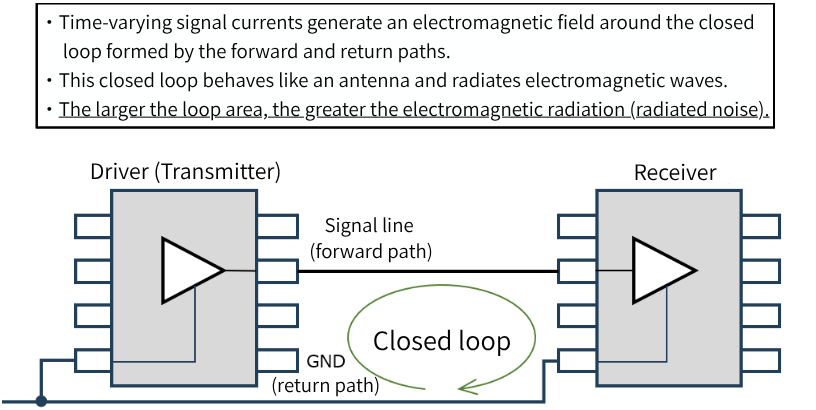
Figure 2
In multilayer substrates, by designating the adjacent layer to the signal layer as a GND plane layer, an environment is naturally created where the return current flows directly beneath the signal via the shortest path.
If a GND plane cannot be secured in an adjacent layer due to layer configuration constraints, a similar effect can be achieved by running a return GND trace parallel to the signal line.
- Particular caution is needed in circuits with large current fluctuations, such as SWITCHING POWER SUPPLIES.
During the component placement stage, consider arranging components so that high-current loops close within the smallest possible area. Many IC manufacturers provide recommended layout patterns, so actively utilizing these is effective. - When wiring, we aim for a straightforward and continuous routing, avoiding abrupt changes in wire width and unnecessary branching.
Furthermore, right-angle wiring should be avoided as it can unintentionally cause variations in wiring width. Instead, aim for smoother routing using 45-degree or curved wiring.
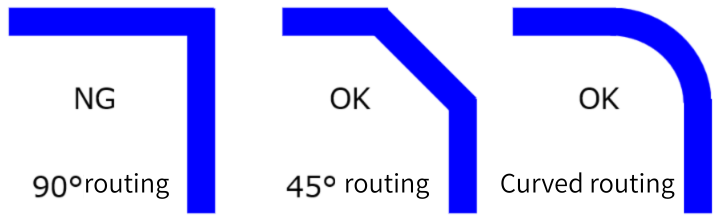
Figure 3
These are important design concepts that can be effectively implemented simply by being aware of the basic principles of circuit board structure and wiring. By ensuring these are firmly established during the initial prototyping stage, a significant reduction in the amount of additional work required in later stages can be expected.
② Prevent the generated noise from leaking to the outside (containment measures)
Gaps in the enclosure, CABLES, and I/O CONNECTORS are places where noise is easily leaked to the outside, so it is important to design the system to structurally contain the noise to prevent it from spreading from these areas.
- The metal casing eliminates gaps, including at joints and mounting points, suppressing noise leakage.
- CABLES shields are generally recommended to be connected to the chassis ground of the enclosure to suppress noise radiation.
- Around the I/O CONNECTORS, CAPACITORS or similar devices are used to ensure that noise carried on the internal wiring does not spread to the outside, thus providing a path to GND.
These containment measures are particularly difficult to modify later in development, and depending on the measures taken, they can significantly increase man-hours and costs. Therefore, thoroughly considering them from the early stages of design and ensuring they are reflected in the structure and layout will lead to a reduction in overall development man-hours and costs.
③ Attenuate the generated noise (attenuation measures)
Source control and containment measures alone may not be sufficient to meet the noise level requirements specified by the equipment.
The solution applied in this case is attenuation to reduce residual noise.
- POWER SUPPLIES line: An LC FILTERS or similar device is placed at POWER SUPPLIES input to effectively attenuate internally generated noise.
- Signal lines: For differential signals, common-mode noise is suppressed using a common-mode choke. For single-ended signals, the optimal configuration is considered by combining damping resistors, FERRITE BEADS, and ground-to-ground CAPACITORS while checking the signal quality.
However, since it is often difficult to reduce noise to standard levels through attenuation measures alone, the basic policy is
① Source control measures → ② Containment measures → ③ Attenuation measures
It is appropriate to develop countermeasures in the order listed above, and to position attenuation countermeasures as merely supplementary.
3. Summary
EMC design is difficult to fully achieve by simply adding countermeasures in the later stages of development, and in some cases, it can lead to significant rework in the design process.
Therefore, in product design, it is important to proceed with a thorough understanding of the fundamental principles of EMC countermeasures from the initial design stages.
In particular,
① Suppress the noise generation itself by taking measures to address the source,
② Containment measures will prevent leakage to the outside,
③ Suppress any remaining noise after attenuation measures.
It is effective to incorporate these elements into the design in this order.
By being mindful of this order, you can avoid a reactive approach of hastily implementing EMC countermeasures after a problem is discovered, and instead systematically incorporate EMC countermeasures from the initial design stage, minimizing the need for corrections and additional measures in later stages.
We hope that the concepts presented in this article will be helpful in promoting efficient and reliable EMC design.
In addition to proposing various countermeasures products tailored to our customers' required EMC performance and product characteristics, providing technical support for noise countermeasures, and offering a scheme to support product development launches in collaboration with ODM/EMS partners, we also offer a range of solutions.
If you have any questions or concerns regarding these matters, please feel free Inquiry.