
In this column, we will explain "board mounting," an important elemental technology in manufacturing electronic circuit boards, which are essential for electrical and electronic devices.
We will provide information that even beginners can easily understand, such as "What is board mounting in the first place?"
We will introduce the main methods of board mounting and the process flow.
What is board mounting?
First of all, what is "board mounting"?
This is the process of attaching electronic components (resistors, CAPACITORS, semiconductors such as ICs, etc.) to a printed wiring board (substrate) to manufacture an electronic circuit board.
This is a key process that determines the mass production, quality, and reliability of electronic devices.
We will explain the typical implementation methods and provide an overview.
Surface mounting (SMT: Surface Mount Technology)
Components are placed on the pads of the board, and solder paste is melted in a reflow oven to join them all at once.
Typical process flow
A stencil (metal mask) and squeegee are used to apply solder paste to the pads on the board.
②Solder Paste Inspection (SPI)
Automatically inspects the amount and position of solder printing.
3. Pick-and-place
Chip components, ICs, etc. are placed in the designated positions on the board using an automated machine.
④Reflow soldering
The solder paste is heated in a reflow oven to melt and join the components to the board.
⑤Cooling
Allow the solder to cool until it hardens.
⑥ Visual inspection (AOI: Automated Optical Inspection) / X-ray inspection
AOI is used to detect bridges, opens, and misalignments, and X-rays are used to evaluate voids and missing connections in BGA/QFN and other bonding that cannot be seen externally.
Key point: This is advantageous for boards that require high-density mounting using a large number of components, and automation is progressing.
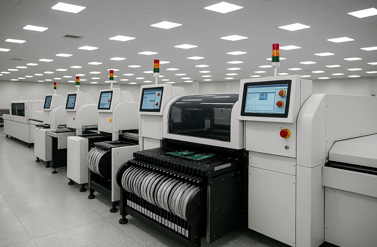
Surface Mount Line
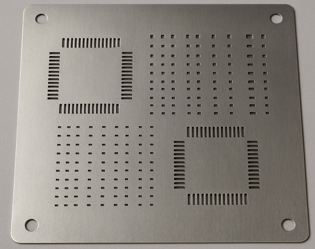
Stencil (metal mask)
Flow mounting (flow/wave soldering)
This method involves inserting leaded components into holes in a through-hole board and passing the underside of the board through the solder "waves" to join them all at once.
Typical process flow
Parts are inserted manually or by an automated machine.
②Flux application
A chemical that increases the solder's wettability (its ability to spread over a metal surface) and removes the oxide film is applied to the board surface.
3. Wave/Flow soldering
The underside of the board is passed through a wave of molten solder (solder bath) to solder the leads.
④Cooling
Allow the solder to cool until it hardens.
⑤ Visual inspection (AOI: Automated Optical Inspection) / X-ray inspection
AOI checks for bridges, unsoldered parts, and misalignment, and X-ray inspection evaluates the filling status of through-holes.
Key point: The solder has high mechanical strength and is suitable for heavy components or areas where reliability is important, but it is difficult to arrange components at high density.
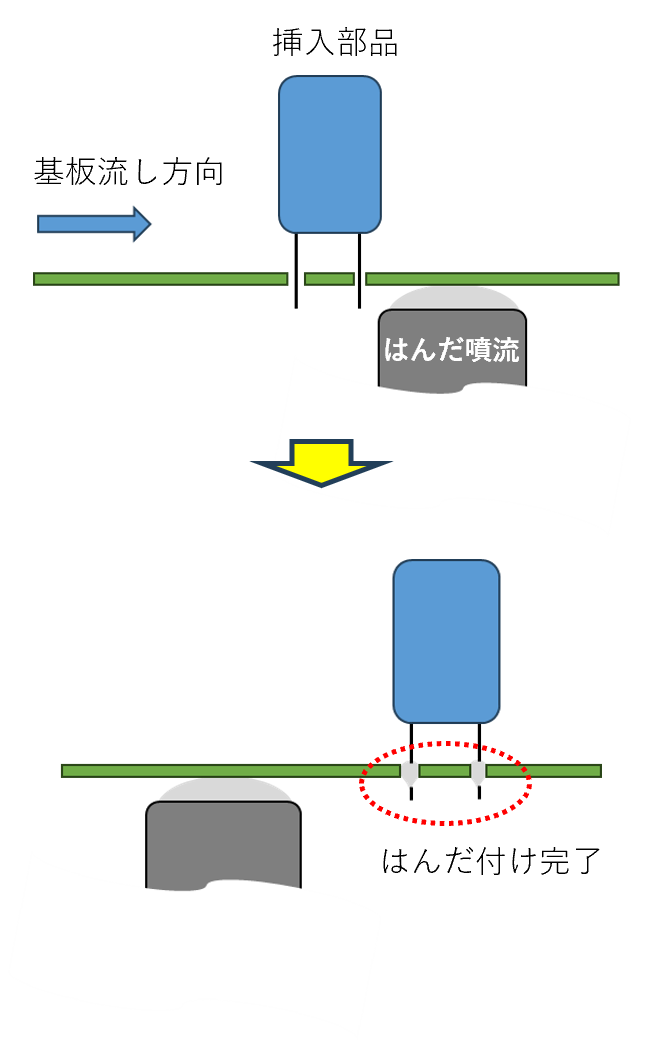
Flow implementation image
Local flow (selective/point DIP)
A method of soldering by locally heating only specific areas of the board.
Typical process flow
Parts are inserted manually or by an automated machine.
②Flux application
A chemical that increases the solder's wettability (its ability to spread over a metal surface) and removes oxide films is applied only to the necessary areas.
③Preheat
Preheat using a heater or hot air.
④Selective soldering
Solder at points (local areas) using a nozzle or similar.
⑤Cooling
Allow the solder to cool until it hardens.
⑥ Visual inspection (AOI: Automated Optical Inspection) / X-ray inspection
AOI checks for bridges, unsoldered parts, and misalignment, and X-ray inspection evaluates the filling status of through-holes.
Key point: There is no need to pass the entire board through the flow tank, which reduces thermal damage to the board and mounted components.
Hand Soldering
A method in which soldering is performed manually using a soldering iron and solder wire.
The parts are inserted manually or by an automatic machine.
②Flux application
Flux is applied to improve solder penetration (wettability).
3. Hand soldering
Use a soldering iron and solder wire to solder.
④Visual inspection/X-ray inspection
We visually check for solder defects and, if necessary, inspect the solder ripples with X-rays.
Key point: It can be flexibly adapted, but the work requires skill and is not suitable for mass production.
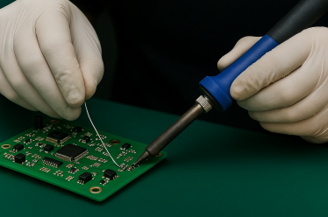
Hand soldering
Many electronic circuit boards are manufactured using a combination of these processes depending on their function.
What should I pay attention to when mounting on a board?
It is important to select an appropriate mounting method by taking into consideration the type and characteristics of the components to be mounted, mounting density, component placement, board shape, etc.
It is necessary to consider not only the quality control aspects of soldering, such as process management during the mounting process, but also production efficiency.
The pad design of the board and the metal mask opening design are also important factors in improving quality.
In addition, thorough inspection after mounting can help reduce the occurrence of defective products.
In recent years, surface mounting has become mainstream due to the trend toward smaller and higher density devices, but at the same time, mixed mounting is also essential, and consideration must be given to component spacing and jigs for efficient mass production in each process.
From this perspective, it is necessary to take into consideration quality, production efficiency, and process design at the board design stage.
This requires a wide range of specialized knowledge and expertise.
Key points for improving quality
Board design (pad/land shape, pitch, clearance, through-hole placement, etc.)
- Appropriate land shape and spacing improve solder wettability and self-alignment, preventing defects such as bridges, opens, and misalignment of mounting positions.
Metal mask opening design (opening shape, thickness, surface treatment, etc.)
- The amount of transfer and hole gaps are controlled by the hole shape, thickness, and surface treatment, improving the stability of solder joints and preventing defects.
In-process inspection
- By using SPI, AOI, visual inspection, ICT, FCT, etc. appropriately, early detection and prevention of defects can be achieved.
-
It is also possible to improve detection rates by placing test pads in the board design.
SPI: Solder Paste Inspection
AOI: Automated Optical Inspection
ICT: In-Circuit Test
FCT: Functional Test
Setting and managing component selection and implementation profiles that comply with specifications
- By selecting components (packages) that are easy to mount, we can prevent deterioration of mounting quality.
- By setting and managing processes that meet heat resistance specifications, we can prevent defects caused by heat degradation.
Storage management of boards and components (humidity and dryness control)
- We manage the storage environment according to the part, prevent defects caused by moisture absorption (popcorn phenomenon, oxidation, etc.), and maintain and improve quality.
Anti-static measures
- By taking appropriate measures against static electricity during the mounting manufacturing process, electrostatic damage can be prevented within the process.
In addition, it is also important to select a manufacturing facility that can carry out detailed quality control, such as standardization of work, equipment maintenance, and quality control systems (traceability).
NEXTY Electronics Initiatives
NEXTY Electronics Corporation works with ODM/EMS partners with a wealth of experience, primarily engineers with extensive experience in elemental manufacturing technologies, to build schemes to support the launch of a wide variety of industries and products.
We utilize the experience and know-how we have cultivated in a wide range of fields, including automobiles and industrial equipment, to meet the needs of our customers and society and provide new value in manufacturing.
I want to manufacture a circuit board like this!
I'm having trouble with the implementation of ○○!
I would like you to procure parts and mount them on the board!
We would like you to handle prototyping with an eye toward mass production!
If you have any requests, please feel free to contact us.