

The dramatic evolution of AI technology is supported by high-performance memory, which can process massive amounts of data quickly and efficiently. In AI development, memory performance is a key factor that determines the performance of the entire system. What memory technology will hold the key to paving the way to the future? In this article, we will thoroughly explain, from an engineer's perspective, the features and evolutionary key points of the latest memory standards, such as LPDDR, HBM, and GDDR, which determine the performance of AI platforms.
Memory technology that will accelerate the evolution of AI
High-performance, high-bandwidth memory technology is essential for the evolution of AI. Understanding and adopting the latest memory standards is especially important for maximizing the performance of GPUs and processors. This article explains the features of each standard and the latest memory technologies that are best suited for AI platforms.

Overview and comparison of memory standards
There are various standards for memory technology depending on the application and performance requirements. In the fields of AI and high-performance computing, the choice of DYNAMIC RAMS memory determines the performance of the entire system. First, we will compare the characteristics of the major memory standards, "DYNAMIC RAMS," "NAND FLASH MEMORIES," and "NOR FLASH MEMORIES," and explain their respective features and applications.
DYNAMIC RAMS
- Volatile memory is widely used as the main memory in PCs and smartphones.
- In recent years, DYNAMIC RAMS has become faster and larger in capacity for AI and HPC applications.
- Since data disappears when POWER SUPPLIES is turned off, it is suitable for temporary data storage.
- It allows for high-speed read/write and works well with the CPU, but requires a constant power supply.
NAND
- Non-volatile memory used in SSDs, USB memory, SD cards, etc.
- It is ideal for data storage because it has a large capacity and is inexpensive.
NOR
- Non-volatile memory used to store firmware in embedded devices and microcontrollers.
- High reliability and excellent read speed.
- Although the capacity is small, it has high rewrite resistance and is suitable for long-term storage.
We have organized the main types of DYNAMIC RAMS, which are important for AI and high-performance computing, in a comparison table.
Table 1 Comparison of major DYNAMIC RAMS standards
| Types | Features | Purpose |
|---|---|---|
| S-DYNAMIC RAMS | Clock synchronous type. High speed because it operates in sync with the CPU | Old PCs and embedded devices |
| DDR S DYNAMIC RAMS | Data transfer on both rising and falling edges of the clock | General PC or laptop |
| LPDDR | Low-power DDR for mobile devices | Smartphones and TABLETS |
| HBM | High speed, high bandwidth, space saving. 3D stacked structure | For high-end GPUs and AI processing |
| GDDR | GPU-optimized high-speed memory | Graphics card |
In the next section, we will take a closer look at the three latest memory standards in this comparison table: LPDDR, HBM, and GDDR, which are particularly relevant to the development of AI.
What is LPDDR?
LPDDR (Low Power Double Data Rate) is a low-power DYNAMIC RAMS standard widely used in mobile devices such as smartphones, TABLETS, and laptops. Each generation of LPDDR has seen improvements in speed, power consumption, and signal quality, with the latest generation achieving both significant performance improvements and power savings compared to previous generations.
Table 2 Comparison of LPDDR standards by generation
| Year of publication | name | JEDEC standard | Data rate |
|---|---|---|---|
| 2006 | LPDDR | JESD209 | ~533Mb/s |
| 2009 | LPDDR2 | JESD209-2 | ~1066Mb/s |
| 2012 | LPDDR3 | JESD209-3 | ~2133Mb/s |
| 2014 | LPDDR4 | JESD209-4 | ~4266Mb/s |
| 2017 | LPDDR4X | JESD209-4 revised edition | ~4266Mb/s |
| 2019 | LPDDR5 | JESD209-5 | ~6400Mb/s |
| 2021 | LPDDR5X | JESD209-5 revised edition | ~8533Mb/s |
| 2025 | LPDDR6 | JESD209-6 | 10667Mb/s and up |
The current mainstream standards are LPDDR5 and LPDDR5X, with a maximum data rate of 8533Mbps. This has led to their widespread adoption in the latest smartphones and AI edge devices, which require high-speed data transfer for AI processing and video processing. In 2025, the semiconductor standards organization JEDEC officially announced the next-generation standard, LPDDR6, which promises even faster speeds and lower power consumption. LPDDR6 expands the data bus width from the previous 16 bits to 24 bits, significantly improving data transfer efficiency. Furthermore, the reduced pin count saves board space, contributing to higher-density mounting and further miniaturization of devices. Going forward, it is expected to be adopted in a wide range of fields, including AI edge devices and IoT equipment.

low power consumption devices
What is HBM?
HBM (High Bandwidth Memory) is a next-generation memory that stacks multiple DYNAMIC RAMS chips (dies) vertically to enable ultra-fast, high-bandwidth data communication. Compared to conventional DDR memory, HBM achieves several times the memory bandwidth and high-density packaging, helping to eliminate memory bandwidth bottlenecks in the fields of AI and high-performance computing (HPC). Each generation of HBM has significantly improved bandwidth and capacity, and standards such as HBM2, HBM2E, HBM3, and HBM4 have now emerged.
Table 3 Comparison of HBM standards by generation
| Year of publication | name | JEDEC standard | Data rate |
|---|---|---|---|
| 2013 | HBM1 | JESD235 | 128GB/s |
| 2016 | HBM2 | JESD235A | 256GB/s |
| 2019 | HBM2E | JESD235B | 410GB/s |
| 2022 | HBM3 | JESD238 | 819GB/s |
| 2025 | HBM4 | JESD270-4 | 2TB/s |
The latest HBM4 standard, announced by JEDEC in April 2025, achieves an overwhelming bandwidth and large capacity of 2TB/s, delivering high performance for applications that require high-speed processing of massive amounts of data, such as AI model training and large-scale data analysis, and significantly improving overall system processing efficiency.
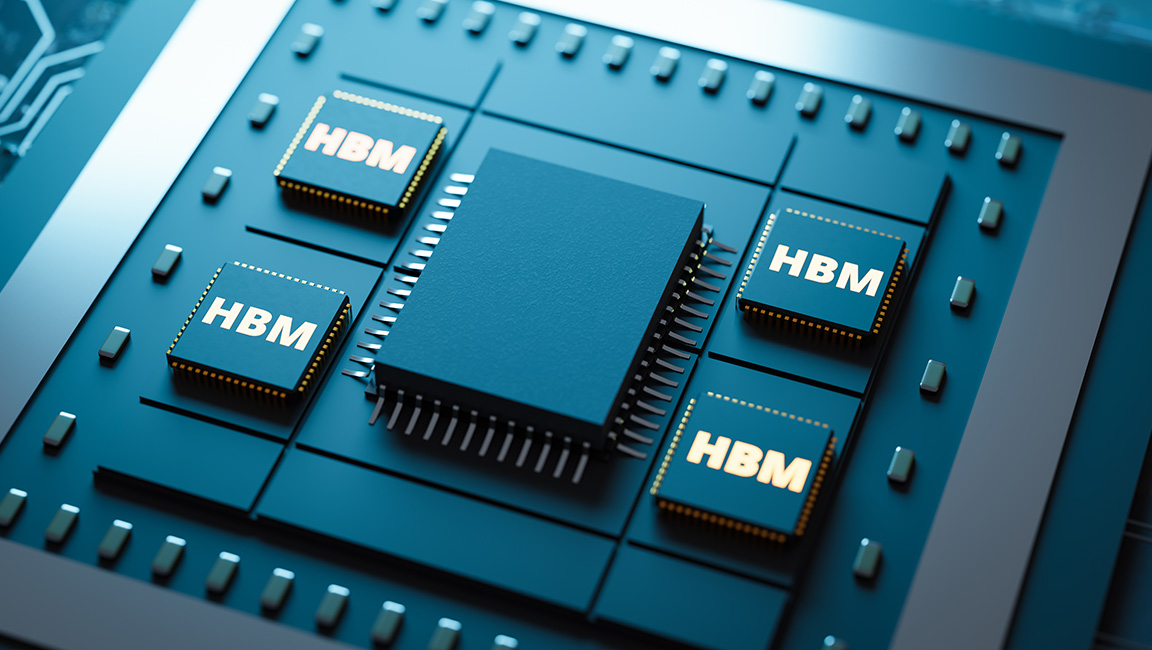
HBM stacking image
What is GDDR?
GDDR (Graphics Double Data Rate) memory is widely used in graphics cards, game consoles, HPC, and AI applications. Its high-speed data transfer capabilities and low latency make it suitable for real-time processing and high-resolution video processing.
Table 4 Comparison of GDDR standards by generation
| Year of publication | name | JEDEC standard | Data rate |
|---|---|---|---|
| 2003 | GDDR3 | JESD79C | 4Gbps |
| 2005 | GDDR4 | JESD79D | 4.5Gbps |
| 2007 | GDDR5 | JESD212 | 8Gbps |
| 2016 | GDDR5X | JESD232 | 14Gbps |
| 2018 | GDDR6 | JESD250 | 16Gbps |
| 2024 | GDDR7 | JESD239 | 36Gbps |
Each generation of GDDR has seen significant improvements in data transfer speeds and efficiency, with the latest generation providing performance sufficient to meet the demands of AI and next-generation gaming consoles. Announced by JEDEC in March 2024, GDDR7 is the latest GDDR memory standard, offering significantly improved data transfer speeds and efficiency compared to the previous GDDR6. GDDR7 more than doubles the data transfer speed of GDDR6, achieving higher bandwidth and efficiency. This makes it ideal for applications requiring massive data processing, such as next-generation gaming consoles, AI inference, and high-performance PCs.

Application examples and implementation examples
Currently, high-performance memory is helping to solve issues such as improving system processing power and ensuring real-time performance in a wide range of fields, including AI, the automotive industry, and games. Here we will introduce some representative examples of its use.
Data centers: Server equipment that accelerates AI model learning and inference
To speed up the learning and inference of AI models, servers equipped with high bandwidth and large memory capacity are being introduced, which has significantly improved the response speed and processing efficiency of large-scale AI services.

ADAS (Advanced Driver Assistance System): In-vehicle equipment that processes massive amounts of sensor data in real time
High-speed memory is essential for processing the huge amount of data obtained from various sensors in automobiles in real time, enabling advanced functions such as collision avoidance and autonomous driving.

Graphics card: A card equipped with a GPU for accelerating high-resolution video processing and AI inference
GPU cards equipped with high-speed memory such as GDDR and HBM are used to accelerate high-resolution video processing and AI inference, enabling high performance in areas such as gaming, video editing, and AI inference processing.

Summary
To maximize the performance of AI and next-generation devices, it is essential to select the optimal memory standard for each application.Memory standards such as LPDDR, GDDR, and HBM will continue to evolve and play an important role in AI and large-scale data analysis.
However, each memory standard has its own strengths, such as data transfer speed, power efficiency, and capacity expandability, so it is important to select the optimal one based on your application and system requirements.
We handle a wide range of memory products. Please feel free to Inquiry if you would like more information, such as advice on product selection or a request for a specific product introduction.
Inquiry
Related Product Information

License control via CodeMeter soft files
CmActLicense, which allows license control using software files, effectively prevents illegal copying and use without the need for hardware.
- WIBU-SYSTEMS AG
- ICT and Industrial
- Smart Factories and Robotics
- Software

Qualcomm IoT Application Processors for the Connected Intelligent Edge
Qualcomm's IoT Application Processors leverage AI and 5G to deliver a variety of IoT solutions, including robotics and smart cameras.
- Qualcomm Technologies, Inc.
- NEXT Mobility
- ICT and Industrial
- Smart Factories and Robotics

DYNAMIC RAMS
Micron's DYNAMIC RAMS products offer high-speed, low-power, and versatile memory components and modules.
- Micron Technology, Inc.
- NEXT Mobility
- ICT and Industrial
- Smart Factories and Robotics

Introduction to Edge AI Solutions with NXP's NPU-equipped i.MX/MCX
This article explains the rapidly growing edge AI with real device examples and introduces NXP’s processors and microcontrollers equipped with NPUs.
- NXP Semiconductors NV
- NEXT Mobility
- ICT and Industrial
- Smart Factories and Robotics
Software encryption and license control with CodeMeter USB dongles
Introducing CmDongle, a USB dongle that prevents illegal copying and unauthorized use of software. No drivers are required, allowing for easy license management.
- WIBU-SYSTEMS AG
- ICT and Industrial
- Smart Factories and Robotics
- Software
NOR Flash
NOR Flash is a non-volatile memory characterized by high read speed and high reliability, and is used in a wide range of fields, including automotive and industrial applications.
- Micron Technology, Inc.
- ICT and Industrial
- Smart Factories and Robotics