
- ams-O STATIC RAMS AG
- NEXT Mobility
- ICT and Industrial
- Smart Factories and Robotics
In recent years, Time of Flight (ToF) sensors, which enable non-contact, high-precision distance measurement, have come to play an important role not only in smartphones and home appliances, but also in industrial equipment and robotics. The performance of ToF sensors is greatly influenced by differences in distance measurement methods and light-receiving devices, making selection according to the application crucial in system design.
ams O STATIC RAMS, a manufacturer of OPTO ELECTRONIC DEVICES, provides ToF sensor products that enable high-precision, long-distance measurements using the direct ToF method. This document will cover the basics of ToF sensors and introduce the technical features and product lineup of ams O STATIC RAMS 's ToF sensors.
What is a ToF sensor?
What is a ToF sensor (Time of Flight sensor) IC?
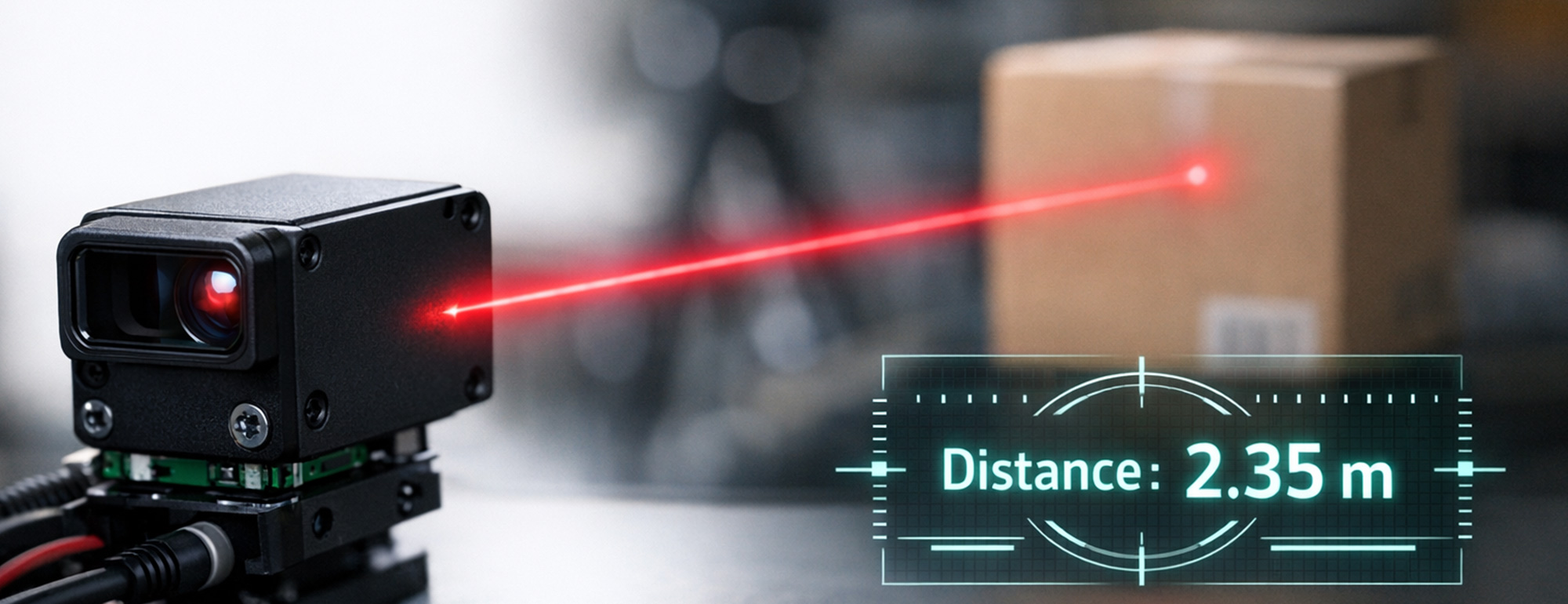
→ A ToF (Time of Flight) sensor is a sensor that utilizes the fact that the speed at which light propagates through space is constant, and calculates distance from the time it takes for light to shine on an object and return (time of flight).
Unlike conventional contact-based and visual measurement methods such as measuring tapes and rulers, ToF sensors can acquire distance information non-contact, quickly, and with high accuracy.
- Smartphone camera autofocus and facial recognition
- Distance, height, and step detection in industrial equipment
- Obstacle detection in robots and automated guided vehicles (AGVs)
- Gesture recognition for home appliances and IoT devices
It is used in a wide range of fields, such as those mentioned above.
Main use cases

Obstacle detection and fall prevention

Object detection

Obstacle detection and collision avoidance

Person detection

Focus adjustment and keystone correction

Person detection
dToF (direct time of flight) basic principle
amsO STATIC RAMS ToF devices use the dToF method.
Distance sensing using the dToF method is mainly measured in the following three steps:
1. Laser light is emitted from the VCSEL. Reference: https://www.nexty-ele.com/technical-column/laser_03/
2. Receiving light reflected from the object.
3. Measure the time of flight of light from illumination to reception.
The basic formula for calculating distance is as follows:
Formula: Distance = Speed of light x Flight time / 2
*Since light travels "back and forth," it needs to be divided by 2.
In addition to the dToF method, another method for measuring distance using light is the iToF (indirect Time of Flight) method.
The iToF method does not directly measure the "time itself" it takes for light to reach an object and return, but rather calculates the distance from the "phase shift" between the emitted light and the reflected light. See the table below for a simple comparison of each method.
| Item | dToF | iToF |
|---|---|---|
| Ranging principle | Direct measurement of the time it takes for light to arrive | Measuring the phase difference |
| Long distance performance | ◎ | △ |
| Resolution | Very high | Relatively low |
| Circuit difficulty level | Expensive | Relatively low |
Comparison of dToF and iToF methods
*For more information on semiconductor lasers, including VCSELs, please refer to the following technical column.
Features of ToF sensors offered by amsO STATIC RAMS
A key feature of the ToF sensors offered by ams O STATIC RAMS is their adoption of the direct ToF (dToF) method.
By directly measuring the time it takes for light to travel to and from an object, we achieve high distance accuracy and stable measurement performance.
Although specifications vary by product, a lineup is available that can measure distances of up to approximately 11m with extremely fine resolution of 0.25mm increments, making it suitable for a wide range of applications, from consumer to industrial.
Furthermore, the light-receiving side employs SPAD (Single Photon Avalanche Diode).
SPAD is a highly sensitive PHOTO DETECTORS capable of detecting even weak reflected light at the single-photon level, ensuring a high signal-to-noise ratio even when measuring objects with low reflectivity or over long distances. Thus, ams O STATIC RAMS 's ToF sensors are characterized by their combination of high-precision, long-distance measurement performance and high light detection capability, making them ideal products for system designs requiring distance detection.
*For more information on SPAD, please refer to the following technical column.
Technical Column: Basic Guide to PHOTOSENSORS | PHOTO DIODES, TRANSISTORS, and Photo ICs
The difference between Single-zone ToF (1D ToF) and Multi-zone ToF (3D ToF)
ams-O STATIC RAMS 's dToF (direct Time of Flight) sensors are classified into two types depending on the application: Single-zone ToF (1D ToF) and Multi-zone ToF (3D ToF). The difference between the two lies in whether distance is measured at a single point or across a surface (multiple zones).
Single-zone ToF (1D ToF)
Single-zone ToF (Time-of-Flight) technology treats the area in front of the sensor as a single distance-measuring zone, enabling high-precision detection of changes in distance to an object. Its simple configuration minimizes power consumption and system load, making it suitable for applications requiring precise measurement of proximity, presence, height, and elevation changes—in short, applications where accurate determination of "how close" something is is crucial.
Multi-zone ToF (3D ToF)
Multi-zone ToF is a method that divides the light-receiving area into multiple zones, both vertically and horizontally, and measures the distance for each zone.
This allows us to simultaneously grasp not only distance but also positional information, making it possible to detect the direction of movement, such as left/right and up/down.
Because it can perform spatial motion recognition that is difficult with single-zone technology, it is suitable for applications that want to capture "where and how someone moved," such as gesture recognition, human movement detection, and touchless UI.
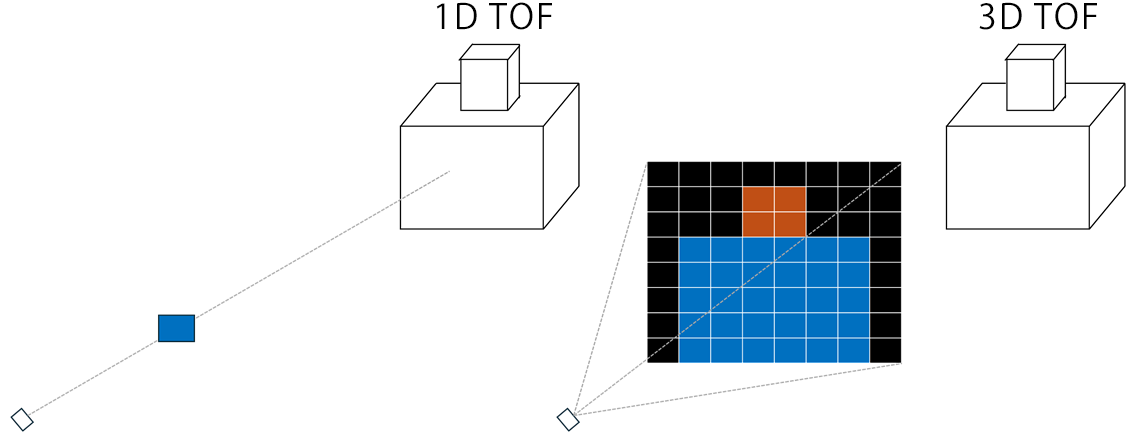
Detection images of Single-zone ToF (left) and Multi-zone ToF (right).
⇒ Click here for the lineup of ToF sensors offered by amsO STATIC RAMS.
Summary
amsO STATIC RAMS 's ToF sensors meet a wide range of needs, from consumer to industrial applications. If you are interested, please inquire Nexty Electronics.
Related Info
Inquiry
Related Product Information

Introducing the amsO STATIC RAMS Optical Force sensor
This article introduces the AS7100 optical force sensor from amsO STATIC RAMS, outlining its non-contact press detection mechanism and features for HMI applications.
- ams-O STATIC RAMS AG
- NEXT Mobility
- ICT and Industrial
- Advanced Technology Solutions

Introducing the SYNIOS P1515 product
ams O STATIC RAMS 's SYNIOS P1515 is a high-brightness, high-efficiency LED for automotive applications, offering uniform light emission and greater design flexibility in a compact package, while also meeting AEC-Q102 standards for high reliability.
- ams-O STATIC RAMS AG
- NEXT Mobility

OSP (Open System Protocol) Overview
The OSP in ams OSRAM is a free, open network technology for connecting in-vehicle LEDs and sensors. This system is ideal for various applications other than automotive applications.
- ams-O STATIC RAMS AG
- NEXT Mobility
- ICT and Industrial

Ambient Light
amsO STATIC RAMS 's RGBi (Intelligent Ambient Light) offers dynamic color control and animation.
- ams-O STATIC RAMS AG
- NEXT Mobility
- ICT and Industrial
- Smart Factories and Robotics

LEDs for lighting
ams OARAM's lighting LEDs deliver industry-leading performance and reliability with high-power LEDs, enabling smart indoor lighting solutions and commercial outdoor lighting.
- ams-O STATIC RAMS AG
- NEXT Mobility
- ICT and Industrial
- Smart Factories and Robotics