We use cookies in order to enable visitors to use this website more comfortably.
It is also possible to disable cookies' by adjusting the settings for the Internet browsing software (the browser).Privacy Policy


NXP products
IVN (In-Vehicle Networking)
Introducing NXP's In-Vehicle Networking (IVN) products.
New automotive network technology enables faster, safer, and more secure communication for future software-defined vehicles.
Strengths of NXP Products
NXP is a world-classIVN product manufacturer with major advantages in the following 5 areas.
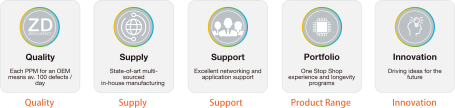
- Quality:
- We constantly work to reduce defect rates with a zero-defect mindset.
- Supply:
- We promote multi-source (production at multiple factories). We support your business from a BCP perspective.
- Support:
- Technical support bases worldwide enable quick and flexible support.
- Product Range:
- A wide product lineup delivers products that meet customer needs.
- Innovation:
- Quick response to new technologies and standards delivers timely products to meet market needs.
NXP CAN Recommended Parts
|
CAN Bus Robustness
Low Power Mode
| CAN FD | CAN SIC | ||||
|---|---|---|---|---|---|---|
| Standard | + Secure | + Isolation | Standard | |||
| <42 V | 58 V | 40 V | 58 V | 58 V | 40 V | |
| Basic | TJA1057B|C (SO) TJA1057G(/3) (HVSON) | TJA1051(/3) | ||||
| Standby Mode | TJA1044B|C (SO) TJA1044G(/3) (HVSON) | TJA1042B|C (SO) TJA1042(/3) (HVSON) | TJA1152A|B | TJA1052i | TJA1052i | |
| Dual Channel Standby Mode | TJA1448A|C (w/ VIO) TJA1046 (w/o VIO) | TJA1059 | ||||
| Sleep Mode | TJA1443A | TJA1043 | TJA1153A | TJA1463A|B | ||
| Partial Networking | TJA1445A|B TJA1446A|B|C | TJA1145A | TJA1465A|B TJA1466A|B|C | |||
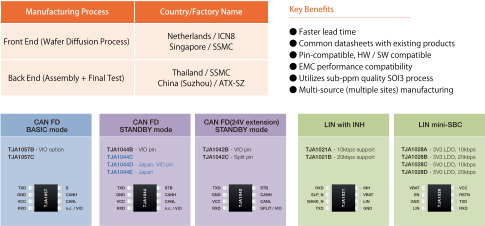
Introducing SOI3+ Products
New SOI3+ added to NXP's IVN product lineup
Drop-in replacement for existing IVN products.
Improved production capacity using established quad-source SOI3 manufacturing facilities.
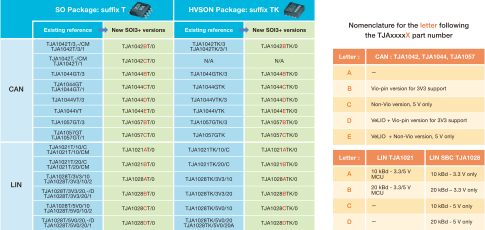
SOI3→SOI3+ Product Replacement Table
Customers already using NXP products (SOI3) can easily replace with drop-in.
CAN Transceiver with Signal Improvement Capability (SIC)
CAN FD communication, now mainstream in automotive networks, is an extended specification of conventional CAN communication.
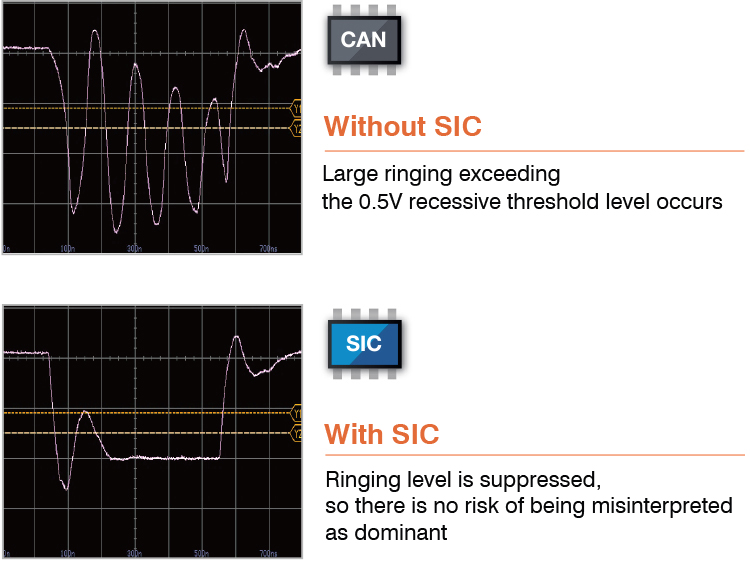
CAN FD enables high-speed transmission of large data volumes compared to conventional CAN, but signal ringing may occur on the bus line causing communication errors.
SIC (Signal Improvement Capability) solves this and is defined by ISO11898-2:2024.
As SIC is a transceiver function, no settings are required and it can be drop-in replaced with existing non-SIC CAN transceivers.
■CAN Bus Line Signal Comparison

■TJA146X SIC Product Lineup
| Product Name | Package | Function | Replacement Target |
|---|---|---|---|
| TJA1462AT (K) | SO8 and (HVSON8) | Standby Mode with VIO | TJA1042T (K)/3,TJA1044GT (K)/3 |
| TJA1462BT (K) | SO8 and (HVSON8) | Standby Mode | TJA1042T, TJA1044GTK |
| TJA1463AT (K) | SO14 and (HVSON14) | Sleep Mode with VIO | TJA1043T (K) |
Partial Networking CAN Transceiver
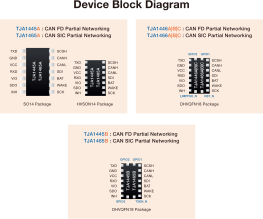
TJA144x/6x are CAN transceivers for partial networking with selective wake-up function and low power consumption.
Features
- Selective ECU power switching with on/off control based on CAN ID recognition
- Signal Improvement Capability (SIC) equipped
- ISO26262 ASIL-B compliant
- Watchdog, power-on reset equipped
- GPIO equipped
Product Overview
- TJA1445A is pin-compatible replacement for TJA1145A
- Data rate up to 8Mbps operation
- Low power consumption 22uA (sleep mode)
- 1.8V VIO support
- SOIC14, HVSON14, DHVQFN18 packages
Introducing LIN Product Line
■Single Channel LIN Transceiver
| Function | TJA1027 | TJA1029 | TJA1021(A/B) | MC33662(B) |
|---|---|---|---|---|
| INH | - | - | YES | YES |
| Local Wake | - | - | YES | YES |
| Wake-up Source Recognition | n/a | n/a | YES | - |
| TxD Dom. TO | - | YES | YES | YES |
| High-Speed LIN | - | - | - | YES |
| MCU Voltage | 3 V 3 & 5 V | 3 V 3 & 5 V | 3 V 3 & 5 V | 3 V 3 & 5 V |
| K-line compatible | YES | YES | YES | - |
| Package Options | SO8 & HVSON8 | SO8 & HVSON8 | SO8 & HVSON8 | SO8 |
| Multi Sourced | Quad Sourced (SO8) | Quad Sourced (SO8) | Quad sourced SOI3+ TJA1021A/B | - |
■Multi-Channel LIN Transceiver
| Function | TJA1022 | TJA1024 | TJA1124 | SJA1124 |
|---|---|---|---|---|
| # LIN channels | 2 | 4 | 4 | 4 |
| Wake-up Source Recognition | YES | YES | YES | YES |
| TxD Dom. TO | YES | YES | YES | YES |
| INH | - | - | YES | YES |
| High-Speed LIN | - | - | - | YES |
| SPI-to-LIN bridge | - | - | - | YES |
| LIN controller (integrated) | - | - | - | YES |
| MCU Voltage | 3 V 3 & 5 V | 3 V 3 & 5 V | 3 V 3 & 5 V | 3 V 3 & 5 V |
| Int. commander Termination | - | - | YES | YES |
| Package Options | SO14 & HVSON14& DHVQFN24 | DHVQFN24 | DHVQFN24 | DHVQFN24 |
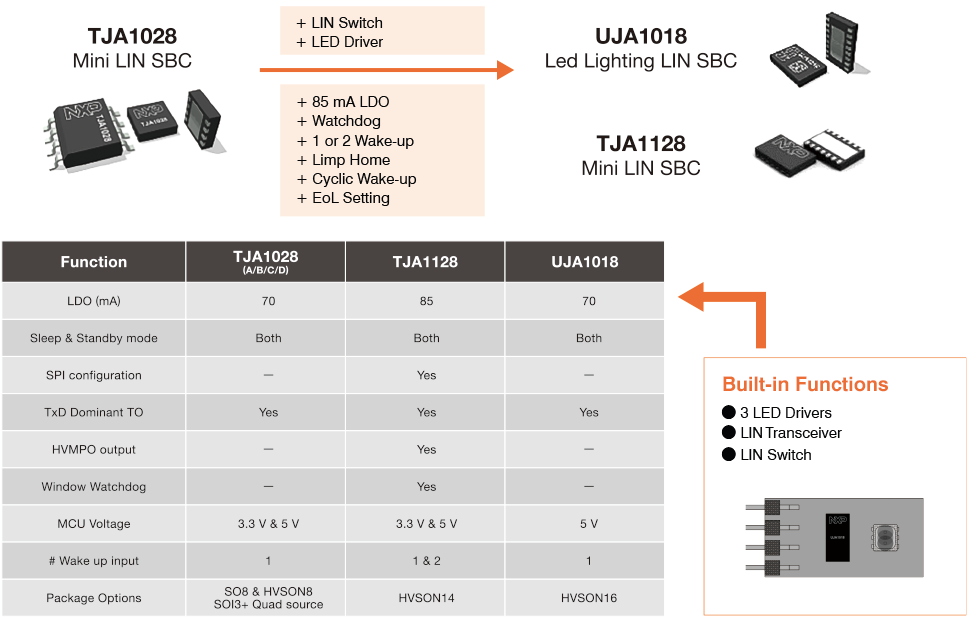
LIN Built-in SBC
Introduction of Automotive Ethernet
Background
-
Recently, autonomous driving and EV adoption are accelerating, increasing communication data. Countermeasures are needed for in-vehicle network bandwidth shortage.
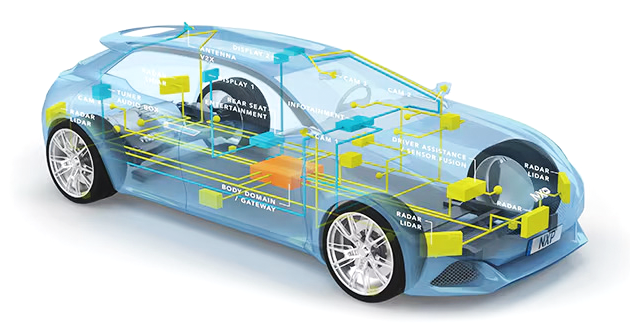
Network architecture is also changing with vehicle sophistication. - Ethernet, widely used worldwide, is being introduced to automotive networks and is expected to increase further.
Automotive Network Trends
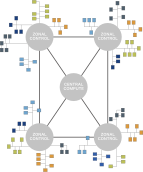
The zone architecture diagram below shows the network communication layout when viewing a vehicle from above. Each zone divided by physical area communicates at high speed with the central ECU via Ethernet.
Automotive Ethernet Portfolio
Automotive Ethernet Switch
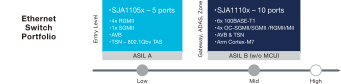
Safe and secure automotive Ethernet switch with AVB and TSN functions. NXP provides comprehensive solutions including SDK, Linux and AUTOSAR® drivers, plus extensive evaluation boards and reference designs.
Automotive Ethernet PHY
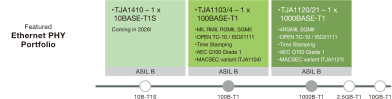
Reliable high-speed data communication, IEEE 100BASE-T1 compliant, single and dual port, 100Mbps transmit/receive, full duplex over unshielded twisted pair (UTP) cable. 10BASE-T1S to be added to the lineup!