About quantization
In the previous AD converter technology column, we introduced sampling, which divides analog data along the time axis.
This time, we will explain "quantization," which divides the voltage direction into fixed voltages and converts it into digital data.
When digitizing voltage, the AD converter configuration divides it into parts that are 2 to the Nth power, where N is called the number of bits.
This time, we will look at how the output data changes when we change the number of bits.
The sampling period is unified to 1/8 of the analog data period.
When quantized at 1 bit
Let's assume that the target analog data fluctuates between 0 and 5V, and that the AD converter can also input the same range.
The range that can be entered is called the full scale.
It is digitized in 1 bit, 2 stages, so 5V is divided into 2. 0 to 2.5V → 0, 2.5 to 5V → 1.
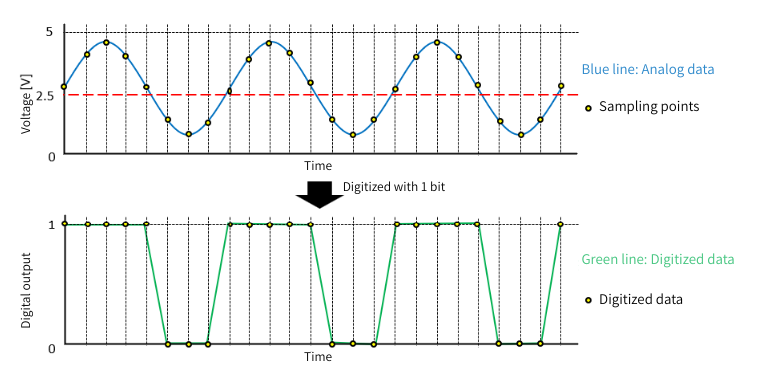
The period information of the original data is correct, but the fine voltage and duty (the ratio of "1" to "0" intervals) have changed, resulting in a different waveform. Therefore, we will try increasing the number of bits.
When quantized at 2 bits
It is digitized in 2 bits and 4 stages, so 5V is divided into 4 parts in 1.25V increments.
0 to 1.25V → 00, 1.25 to 2.5V → 01, 2.5 to 3.75V → 10, 3.75 to 5V → 11.
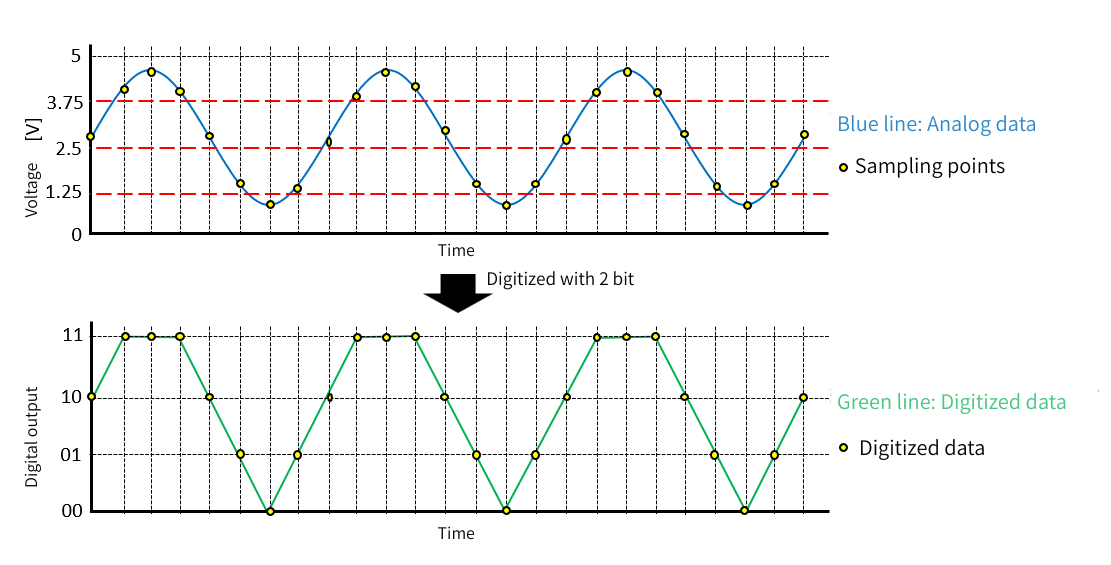
By increasing the bit count from 1 to 2, we have come much closer to the original waveform. Let's add another bit.
When quantized at 3 bits
It is digitized in 3 bits and 8 steps, so 5V is divided into 8 parts in 0.625V increments.
0~0.625V → 000, 0.625~1.25V → 001, 1.25~1.875V → 010, 1.875~2.5V → 011, 2.5~3.125V → 100
3.125 to 3.75V → 101, 3.75 to 4.375V → 110, 4.375 to 5V → 111.
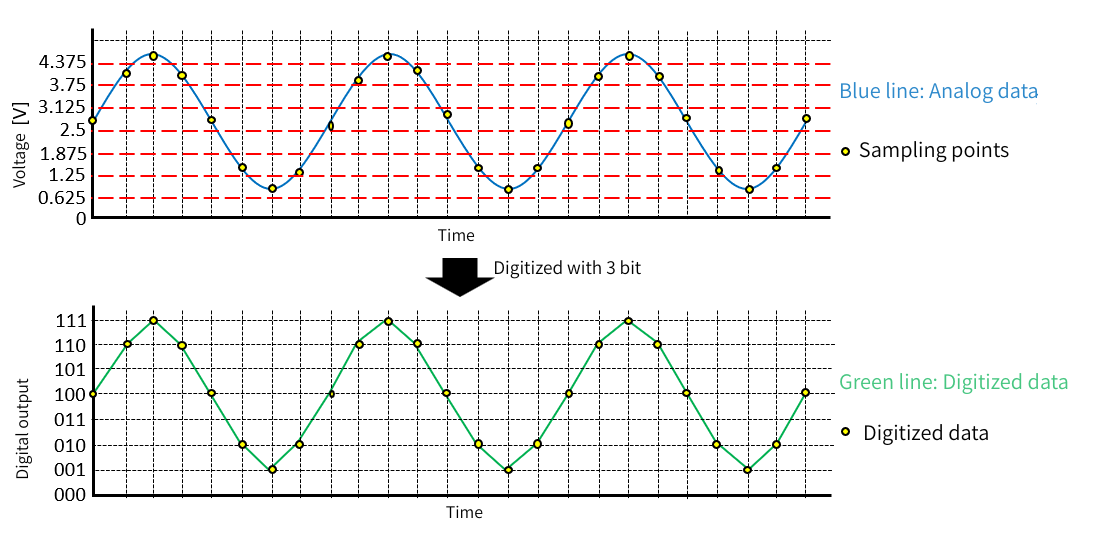
The result is very close to the original data.
As you can see, the more bits you add, the closer you get to the original analog data.
Resolution and LSB (Smallest Change)
The number of bits used to represent digital data is called resolution, and the larger the number, the more accurately the data can be reproduced.
In the case of 3 bits, 5V is divided by 8, so the minimum change is 5V/8=0.625V.
Digital data can express a minimum change of 0.625V compared to continuous analog data, and any change below this is treated as the same data. This minimum change is called the LSB (Least Significant Bit).
Actual AD converter resolution example
For the purposes of explanation, we have shown an example of a low resolution, but in reality, even low-precision ADCs are around 8 bits, with the majority of products being around 12 to 16 bits, and there are also high-precision products with 24 or 32 bits.
If the full-scale voltage is 5V, the following is a typical example of the LSB relative to the number of bits. It is calculated as 5/(2^number of bits).
| Resolution [bit] | LSB[V] |
|---|---|
| 8 | 19m |
| 12 | 1.2m |
| 16 | 76u |
| 20 | 4.8u |
| 24 | 298n |
| 36 | 73p |
You can see that increasing the resolution decreases the LSB exponentially. Simply put, higher resolution is preferable, but just like with sampling frequency, increasing the resolution increases the number of digits that represent one piece of data, which increases the amount of data. This leads to increased costs, such as an increase in the circuit scale of the AD converter itself and faster communication speeds.
Relationship between resolution and sampling frequency
It is also important to note that the amount of data acquired per unit time is the product of the resolution and sampling frequency.
Here is an example of allocating resolution and sampling frequency.
| resolution [bit] | sampling Frequency [ksps] | per second Data volume [bit/s] |
|---|---|---|
| 12 | 10 | 120000 |
| 12 | 100 | 1200000 |
| 24 | 10 | 240000 |
| 24 | 100 | 2400000 |
With high resolution and high sampling frequency, you can see that you get a lot of data.
Types and selection of AD converters
There are various types of AD converters, each with their own unique characteristics, such as those that are specialized for sampling frequencies and can be made faster depending on the circuit configuration, and those that can easily increase the number of bits and achieve higher resolution.
It is important to select an AD converter that is suitable for your application.
Inquiry
Link to Related Technical Columns
Related Product Information

Key points of GMSL2 design
This article explains the features and design key points of Analog Devices' next-generation GMSL, GMSL2.
- Analog Devices, Inc.
- NEXT Mobility
LT80602/3: 3V to 65V, 2.5A/3.5A/ SWITCHES synchronous rectification step-down Silent Switcher with 8μA quiescent current.
The LT80602/3 is a synchronous buck regulator with a quiescent current of 8μA. It offers low EMI, high-efficiency operation, and supports a wide input voltage range. An evaluation board is also available.
- Analog Devices, Inc.
- NEXT Mobility
- ICT and Industrial
- Smart Factories and Robotics
LT83401/2: 42V, 1A/2.5A Step-Down Silent Switcher 3 with Ultralow Noise Reference
The LT83401/2 are 42V synchronous step-down regulators with an ultralow noise internal reference. Utilizing Silent Switcher 3 technology, they deliver both high efficiency and low EMI.
- Analog Devices, Inc.
- ICT and Industrial

LITIX™ Automotive LED DRIVER ICHighly efficient and reliable LED DRIVER IC optimized for automotive lighting. Supports a wide range of applications, from animation lamps to matrix headlamps.
LITIX™ is a family of automotive LED DRIVER ICs that features constant current control and diagnostic and protection functions, making it highly efficient, reliable, and compatible with a wide range of lighting control applications.
- Infineon Technologies AG
- NEXT Mobility

Gate Driver Infineon's gate drivers deliver high efficiency and reliability, accelerating the next generation of power electronics.
Infineon's gate drivers control high-power devices with high precision and safety, and their high insulation voltage and diverse functions support reliability in automotive and industrial applications.
- Infineon Technologies AG
- NEXT Mobility
- ICT and Industrial
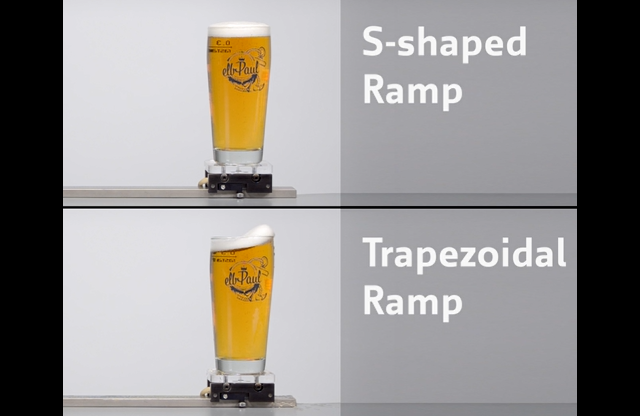
Motion Controllers and Motor Drivers for Stepping Motors
Our industry-leading motion control products improve energy efficiency, prevent loss of synchronization, and reduce motor noise and vibration, making them ideal for fields requiring advanced control.
- Analog Devices, Inc.
- NEXT Mobility
- ICT and Industrial