With the spread of IoT and wearable devices, microcontrollers are now required to offer both "power saving" and "security" more than ever before.
The new STM32U3 series from STMicroelectronics (hereafter referred to as ST) is a next-generation microcontroller that incorporates near-threshold technology and advanced security features to address these challenges head-on.
In this column, we will explain the appeal of the STM32U3 in an easy-to-understand manner, including its architecture, features, and usage scenarios.
The appeal of the STM32U3 series of ultra-low power microcontrollers
The spread of IoT and wearable devices has created a need for microcontrollers to simultaneously meet three key requirements: low power consumption, high performance, and security. These devices are expected to operate stably over long periods of time on battery power, making minimizing power consumption a top priority in design. Furthermore, modern IoT devices, which require network connectivity, require advanced security features to prevent unauthorized external Access and data tampering. Furthermore, to support a diverse range of applications, such as AI processing, complex sensing, and real-time control, even greater computing performance than before is required.
Against this background, ST has launched the new STM32U3 series, a next-generation low-power microcontroller that balances these requirements with cost efficiency and other factors.
STM32U3 Series Features
The STM32U3 series has three main features: low power consumption, high performance, and security.
From here, we will introduce the features of each in detail.
Power saving
The STM32U3 is the first STM32 series to adopt "near-threshold design," a technology that reduces power consumption by lowering the operating voltage of TRANSISTORS to the limit, significantly reducing dynamic power consumption. In addition to improving efficiency during normal operation (RUN mode), it achieves static current consumption of less than 2µA in STOP mode, making it ideal for applications that require long periods of power-saving operation, such as battery-powered IoT equipment and wearable devices.
What is near-threshold design?
Near-threshold operation occurs when a voltage close to the threshold voltage (VT) is applied between the gate and source of TRANSISTORS, which for many devices is approximately 500 mV.
Therefore, typical near-threshold designs use a VGS (gate-source voltage) of approximately 700mV or higher.
Furthermore, near-threshold operation imposes strict limits on the operating voltage and temperature of TRANSISTORS itself, as current flows due to leakage current diffusing under the gate oxide. Many products cannot withstand temperatures above 85°C, and are therefore not commonly used in industrial applications.
On the other hand, the STM32U3's near-threshold design, thanks to ST's proprietary technology and optimized manufacturing process, allows it to operate at a lower voltage of 650mV. This brings VGS closer to VT, allowing the VCORE (core voltage) to be further reduced, down to 0.65V and typically 0.75V.
Furthermore, with significantly lower leakage current than competing products, the STM32U3 can withstand operating voltages up to 3V and temperatures up to 105°C, making it suitable for use in more extreme environments.
high performance
The latest ARM Cortex-M33 core (operating at up to 96MHz) is used. Compared to the previous STM32 series, it achieves over five times the power efficiency in terms of CoreMark/mW while also significantly improving computing performance. This allows for stress-free implementation of complex algorithms and multitasking while reducing power consumption.
It also comes equipped with up to 1MB of dual-bank Flash and 256KB of RAM, allowing for flexible support for larger firmware volumes and secure OTA updates. Support for an FPU (floating-point unit) and DSP instruction set ensures high performance even in applications that make heavy use of signal processing and numerical calculations.
Security
We implement thorough security measures at the hardware level to ensure high levels of product authenticity, confidentiality, and tamper resistance.
It comes standard with multi-layered defense mechanisms that are essential in the IoT era, such as Trust Zone, a hardware encryption engine, and physical tamper detection functions, allowing developers to flexibly design security levels according to the requirements of their applications.
What is a Trust Zone?
This security technology, developed by ARM, creates two execution environments within a single processor: a "secure" area and a "normal" area. This strengthens security by performing highly confidential processing such as encryption and authentication in the secure area, while running normal applications in the normal area.
The two are separated at the hardware level, so that information in the secure world cannot be directly Access from the normal world, and the processor can use special modes to quickly switch between the two worlds.
Trust Zone is used in a variety of fields, including biometric authentication and payment functions on smartphones, firmware protection for IoT devices, and safety control for in-vehicle systems.
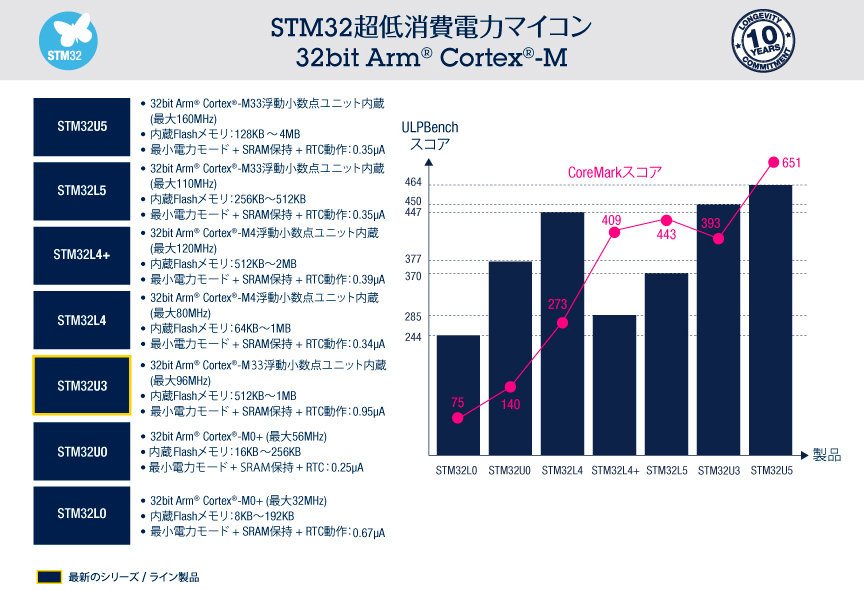
STM32 Ultra Low Power Microcontroller ULPBench Score
This chart compares ST's ultra-low power microcontroller "STM32" series. All of the microcontrollers are equipped with a 32-bit ARM Cortex-M core, and the chart lists specifications for each series, such as the core type, FLASH MEMORIES capacity, and current consumption when operating in minimum power mode.
In terms of performance, the ULPBench score (power-saving performance) and CoreMark score (processing performance) are compared in a graph, visually illustrating the characteristics of each series. The STM32U3 in particular is equipped with a Cortex-M33 core and up to 1MB of flash. With a ULPBench score of 450 and a CoreMark score of 393, it delivers sufficient processing performance while maintaining low power consumption, making it suitable for applications that require a balance between power saving and performance, such as battery-powered IoT devices and sensor nodes.
Product lineup and specification comparison
The main technical specifications of the STM32U3 series are summarized in the table below. Equipped with up to 1MB of dual-bank Flash, 256KB of RAM, and a 96MHz Arm Cortex-M33 core, it combines processing performance with scalability. All models achieve industry-leading low power consumption and also come standard with the security feature Trust Zone and a high-performance FPU.
| Item | STM32U3 Series |
|---|---|
| core | Arm Cortex-M33 |
| Operating frequency | 96MHz |
| FPU | 〇 |
| Flash | Maximum 1MB |
| STATIC RAMS | Maximum 256KB |
| Operating Voltage Range | 1.71V ~ 3.6V |
| Operating temperature range | -40℃ ~ +105℃ |
| Current consumption (RUN) | Minimum 10uA/MHz |
| Current consumption (STOP) | Approximately 1.6uA |
| Current consumption (Shutdown) | Approximately 200nA |
Key technical specifications of the STM32U3 series
The STM32U3 series mainly consists of two product lines: STM32U375 and STM32U385. The main difference between the two is whether or not security features are included. The STM32U385 is characterized by its advanced security features as standard.
The abbreviations in the table are as follows:
- CCB: Coupling & Chaining Bridge (key protection mechanism)
- HUK: Hardware Unique Key
- PKA: Public Key Accelerator
| Product name | STM32U375 | STM32U385 |
|---|---|---|
| Flash | 512~1024KB | 1024KB |
| RAM | 256KB | 256KB |
| ULP COMP | 2 | 2 |
| ULP TIM | 4 | 4 |
| I3C | 〇 | 〇 |
| CCB | × | 〇 |
| HUK/PKA | × | 〇 |
| AES-128/256 | × | 〇 |
Difference between STM32U375 and STM32U385
Expected applications and benefits of implementation
The STM32U3 excels in power-constrained applications such as:
Wearable devices
It is ideal for applications that require long battery life and a compact housing, such as heart rate monitors and activity trackers. The STM32U3's low power consumption and compact package support a comfortable user experience.

Examples of wearable devices
Portable Medical Devices
Reliability and security are important for portable medical devices such as blood glucose monitors and portable electrocardiograms. The STM32U3 provides a secure processing environment with the Cortex-M33 and Trust Zone, enabling the safe handling of medical data.
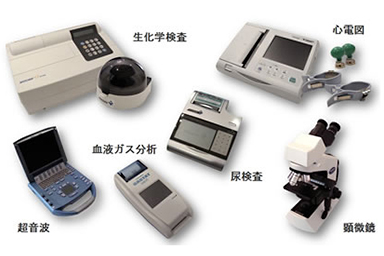
Portable medical device examples
Smart meters/environmental sensors
Long-term stable operation and low power consumption are essential for smart meters for electricity, gas, and water, as well as environmental sensors for temperature, humidity, CO₂, etc. The low power consumption of the STM32U3 series helps extend the frequency of maintenance such as battery replacement.
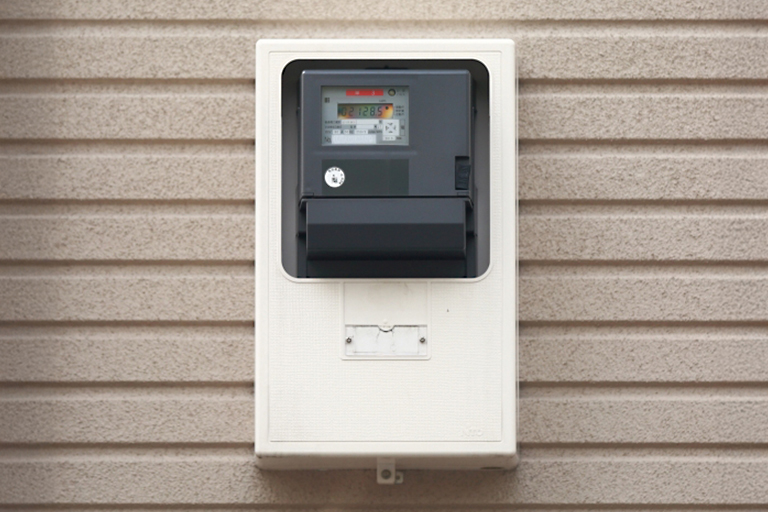
Smart meter example
Evaluation board
The NUCLEO-U385RG-Q is an evaluation board equipped with ST's ultra-low power microcontroller STM32U385RGT6Q, making it the ideal platform for developing next-generation low-power, high-security applications.
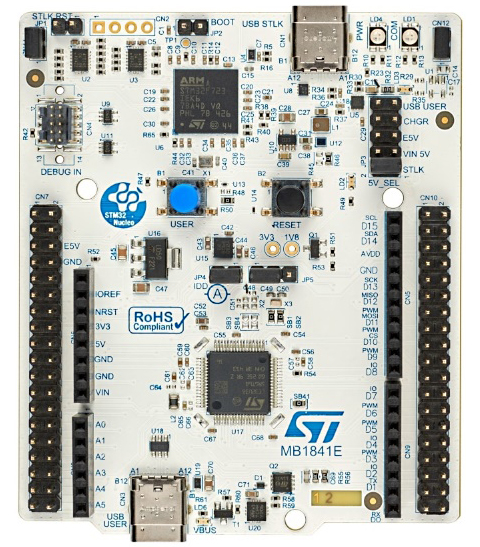
NUCLEO-U385RG-Q
On-board microcomputer
STM32U385RGT6Q
Development Environment and Support
The NUCLEO-U385RG-Q is compatible with genuine ST tools such as STM32CubeIDE and STM32CubeMX, and comes with a wide range of HAL/LL drivers, middleware, security libraries, etc. Sample code for FreeRTOS and secure firmware updates is also available, allowing for a smooth start to development.
Summary
The STM32U3 series is a next-generation microcontroller that achieves a high level of compatibility between the three major requirements for IoT and wearable devices: ultra-low power consumption, high security, and high performance. It combines significant reductions in standby current with near-threshold technology, hardware-level security with Trust Zone, and scalability and computational headroom with up to 1MB of dual-bank Flash and 256KB of RAM.
As longer lifespans and stronger security become increasingly important for IoT devices in the future, the STM32U3 will be the ideal choice for "long-lasting, safe, and smart battery operation." Please feel free Inquiry if you have any questions about the latest product information, evaluation board lineup, or other information you are interested in.