Demand for edge devices using sub-GHz wireless bands, such as IoT devices, smart meters, and industrial wireless sensors, is growing year by year. For these applications, key design challenges include low power consumption and compact size, as well as RF design, wireless certification, and reducing development time. The STM32WL series is a wireless SoC from STMicroelectronics (hereinafter referred to as ST) that integrates a microcontroller and sub-GHz wireless transceiver on a single chip. Its strengths include its ease of achieving both wireless and application functionality, and its ease of designing from the early stages with an eye toward low-power operation, mass production, and certification. This column provides a clear explanation of the technical features and product advantages of the STM32WL series.
Articles about the STM32WB/WBA series can be found here
Why the STM32WL series?
The greatest feature of the STM32WL series is the integration of a sub-GHz wireless transceiver and an Arm Cortex-M4/M0+ core on a single chip. By integrating wireless functions and a microcontroller at the system level, the STM32WL series efficiently meets the low power consumption, small size, and reliability requirements of IoT edge devices.
In conventional wireless devices, it was necessary to individually select and design the microcontroller, sub-GHz wireless IC, and RF front-end components surrounding ANTENNAS. This required a large number of man-hours for circuit design, evaluation, and wireless certification. In particular, adjustments to achieve both low-power operation and wireless performance, and verification that takes into account variations during mass production, tended to be processes that tended to be concentrated in the latter half of the design process.
By optimizing the radio and MCU sections on a single chip, the STM32WL makes it easier to reduce the overall system's power consumption while also reducing the burden of RF design. Furthermore, because the radio and application can be designed as a single unit, it also facilitates authentication and software asset reuse. This enables wireless systems to be designed with a simpler configuration, from evaluation to mass production, shortening development time and reducing risk.
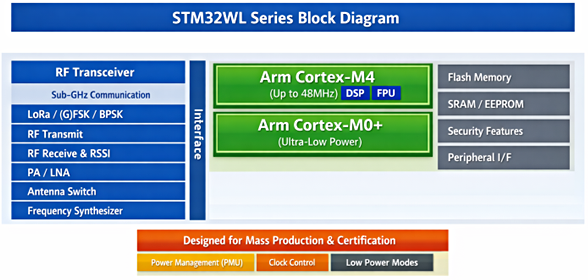
STM32WL Series Block Diagram
STM32WL Series: Product Advantages
The STM32WL series is a wireless SoC designed for IoT edge devices that require sub-GHz wireless. It integrates a sub-GHz wireless transceiver and a microcontroller (Arm Cortex M core) on the same chip, providing a configuration that makes it easy to simultaneously optimize wireless implementation, power consumption, and development efficiency, which are often challenges in devices that require long-distance, low-power communications.
The product lineup is divided into multiple categories based on differences in frequency band, core configuration (single/dual), memory, package, etc., allowing you to select the product that best suits your requirements. We will explain the advantages of each in detail.
Built-in Sub-GHz wireless transceiver (LoRa compatible)
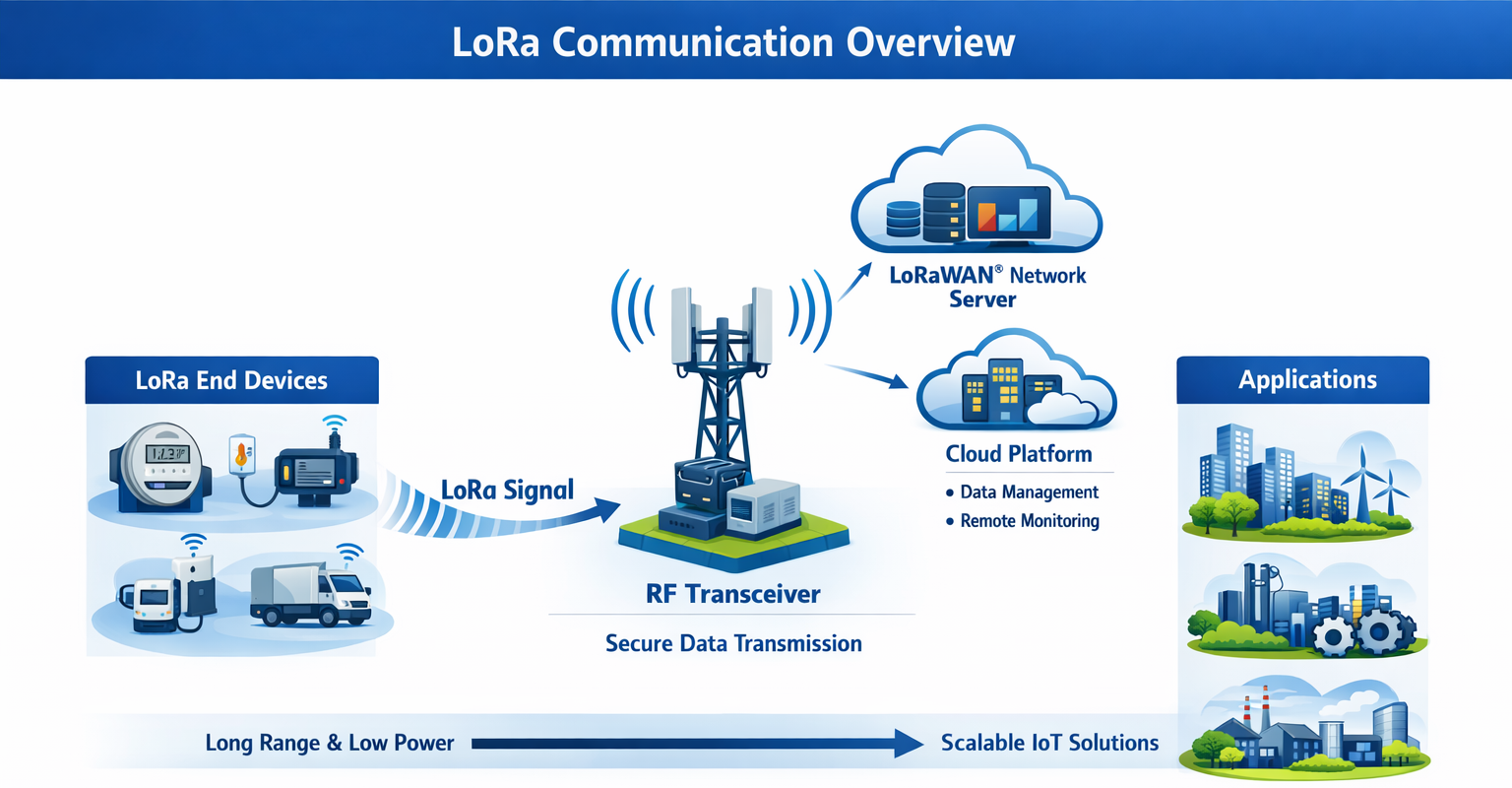
The STM32WL series supports multiple modulation methods, including LoRa, for wireless communications in the sub-GHz band (150 to 960 MHz).This makes it easy to deploy not only LPWAN devices using standard networks like LoRaWAN, but also configurations that incorporate proprietary protocols according to requirements.
The benefits of having a built-in wireless transceiver go beyond reducing the number of components and board area. It also reduces the number of coupling points that often arise with an external wireless IC configuration, such as "interface design between the MCU and wireless IC," "timing adjustment between wireless events and application processing," and "separation during evaluation (RF/ POWER SUPPLIES /control)," making it easier to see the overall system from the early stages of design.
Ultra-low power design
Sub-GHz edge devices often cycle through a cycle of "measurement → processing → transmission → standby." Here, battery life depends not only on simple low standby current, but also on how much the active time associated with transmission, reception, and data processing can be reduced, and whether sleep transitions and wake-ups work smoothly. The STM32WL series inherits the low-power technology cultivated in the STM32L series, and is organized as a series that combines an ultra-low-power platform with energy-efficient wireless, demonstrating a design philosophy premised on low-power modes and wireless operation.
Typical examples where this feature is useful are applications where the frequency of maintenance needs to be kept to a minimum, such as smart meters, applications where it is difficult to secure POWER SUPPLIES, such as outdoor sensors, and applications where it is difficult to replace batteries, such as built-in equipment. In these cases, "communication stability (reduced retransmissions)" and "reliability of low-power transitions" are directly linked to the lifespan, so a configuration that can handle wireless and MCU together is very effective.
High development efficiency through the STM32 ecosystem
STM32WL is a member of the STM32 family and is designed to make it easy to utilize existing development environments and assets such as STM32CubeIDE, STM32CubeMX, and STM32CubeWL (wireless stack/samples).
In actual evaluation, problems such as "wireless doesn't work," "wireless becomes unstable when set to low power," and "timing becomes disrupted when an app is installed" tend to occur simultaneously. An effective approach here is to first establish the "minimum configuration that enables wireless" early on using a CubeWL sample, etc., and then gradually add peripheral functions, app processing, and low-power transitions. Rather than building the wireless and app simultaneously, designing a verification order makes it easier to separate them, which ultimately leads to shorter development times.
STM32WL Series: Features of each product line
The STM32WL series is divided into four product lines based on differences in CPU configuration and functionality.
Here we will summarize the characteristics of each.
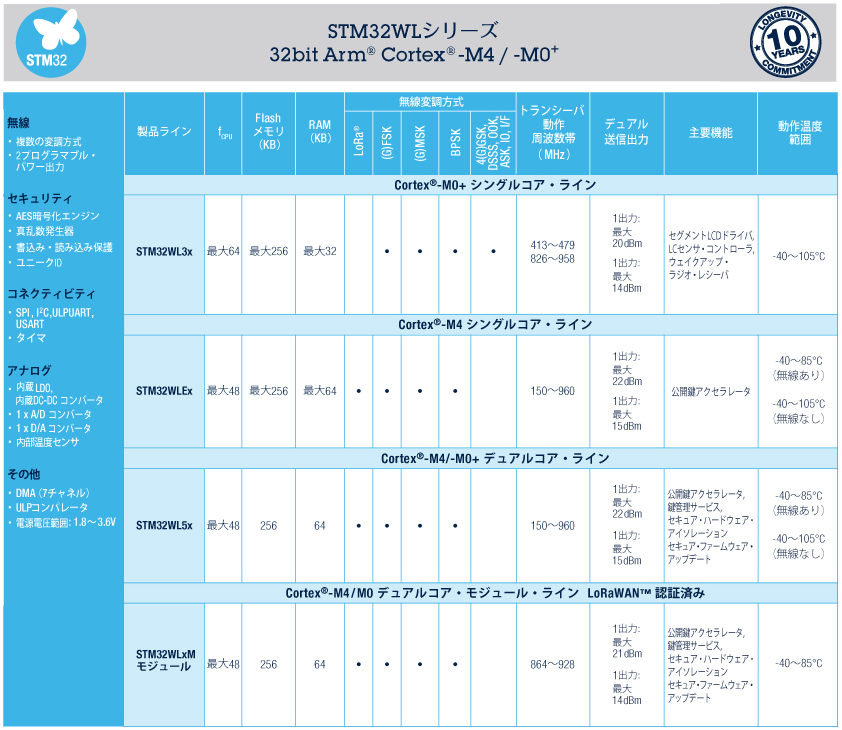
STM32WL Series Product Portfolio
(reference: https://www.stmcu.jp/stm32/stm32wl/)
Cortex M0+ single-core line (STM32WL3x)
The STM32WL3x is a line that features an Arm Cortex M0+ processor that operates at up to 64MHz and has a built-in sub-GHz transceiver.
The wireless side supports modulation methods such as (G)FSK, (G)MSK, and BPSK, and is positioned as an "open platform" that supports not only LPWAN but also legacy and proprietary methods. It also features a segment LCD (16x4/12x8), TRNG, AES, and other features, and product numbers can be selected based on memory capacity such as Flash and RAM, and package.
Cortex M4 Single Core Line (STM32WLEx)
The STM32WLEx line uses the Arm Cortex M4, which operates at up to 48MHz, and has a built-in sub-GHz transceiver.
The radio section is a transceiver derived from Semtech SX126x, and can be used as an "open" configuration that can handle multiple modulation methods including LoRa (LoRa/(G)FSK/(G)MSK/BPSK).
The feature of this product line is that it is based on the premise that wireless control and application processing will be integrated into the M4 alone, and peripheral functions and POWER SUPPLIES designs are provided, allowing you to determine the configuration according to I/O and implementation conditions.
Cortex M4 / Cortex M0+ dual-core line (STM32WL5x)
The STM32WL5x is a line that uses dual cores, Arm Cortex M4 and Cortex M0+, and while it inherits the functionality of single-core processors, it has a configuration that strengthens the concept of security and isolation.
Compared to the single-core line, the dual-core line offers more advanced security features, such as "hardware isolation between M4 and M0+" and "secure boot, secure firmware update, and secure debug control."
Cortex M4/Cortex M0+ Dual-Core Module Line (STM32WLxM)
The STM32WLxM is configured as a pre-certified, "ready-to-use" module (SiP) to simplify long-range, low-power wireless implementations.
The STM32WL5MOC module incorporates a programmable, dual-core LoRa-enabled STM32WL5 SoC and integrates a TCXO, RF matching FILTERS, and Rx/Tx SWITCHES in an LGA92 (10mm x 10mm) package, simplifying implementation and reducing R&D efforts.
Compared to a standalone SoC, it has the great advantage of being able to handle RF peripheral component selection, mounting variations, frequency stability (TCXO), etc. all at once (however, the certification and performance of the final product may depend on the housing, ANTENNAS, and board conditions, so confirmation before mass production is necessary).
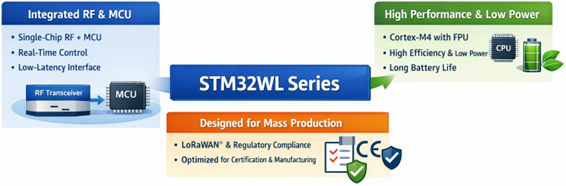
Key Features of the STM32WL Series
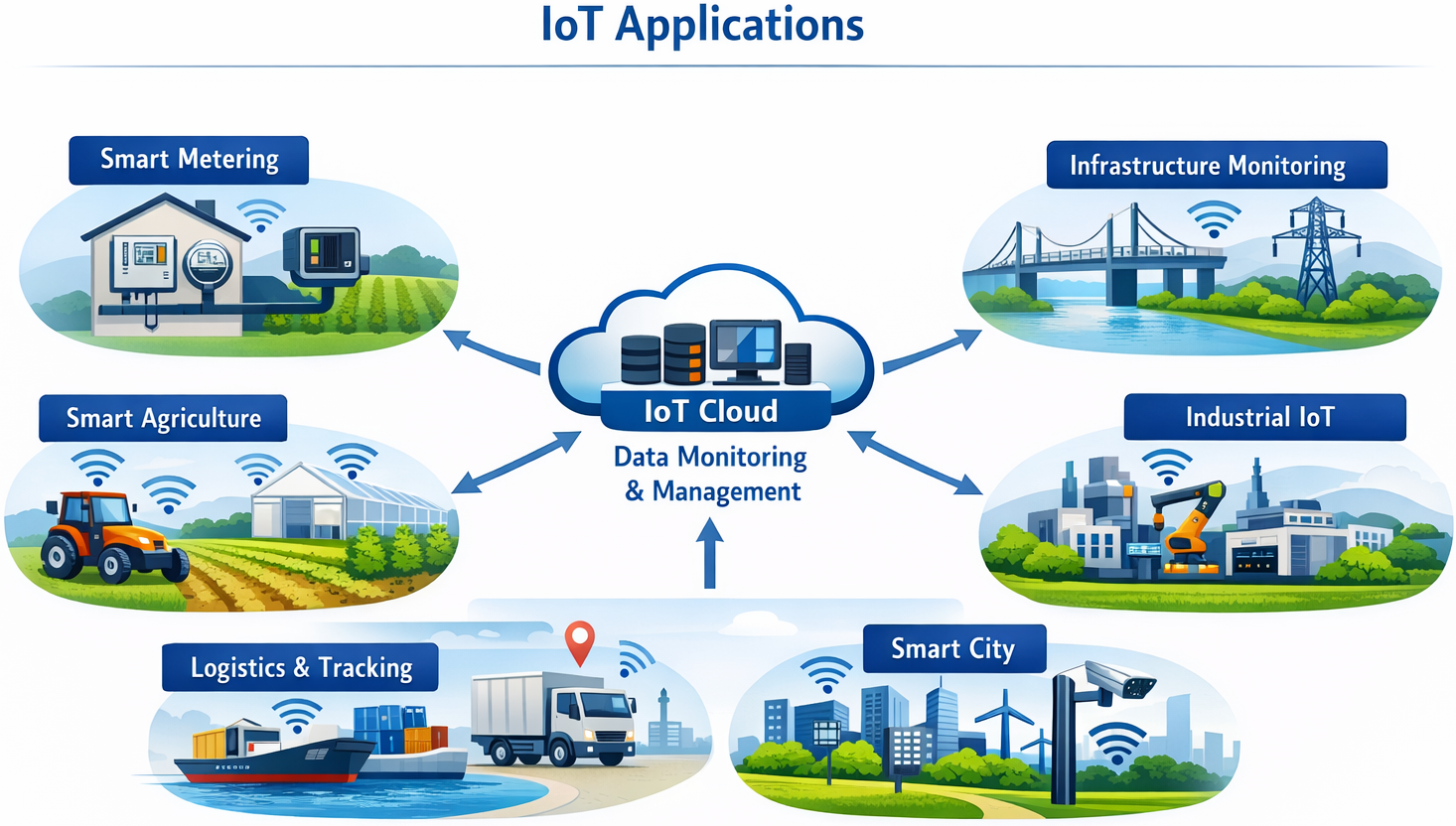
STM32WL series application examples
As explained above, the STM32WL series is a wireless SoC that integrates a low-power microcontroller and a long-range, energy-efficient sub-GHz radio on a single chip, and can be applied to a wide range of edge devices, primarily for LPWAN applications. Below are some example applications.
Smart meters
To minimize the number of maintenance operations required after installation, smart meters require a power consumption design that takes into account long-term operation over a period of 10 years, as well as a wireless design that can maintain connectivity even in indoor installations or metal enclosures. While the sub-GHz band often offers advantages in terms of reachability, in actual operation, its lifespan is determined by the cumulative effect of transmission frequency, number of retransmissions, and standby current. The STM32WL is organized as a series that combines a low-power platform with energy-efficient wireless, making it suitable for use with periodic transmissions, as it makes it easy to create a power budget.
Additionally, the STM32WL3x metering line features meter-specific features such as an internal LCD segment driver, which may help reduce the number of external components and streamline wiring.
Wireless sensors for infrastructure monitoring
In infrastructure monitoring, sensors are often installed outdoors, underground, or in remote locations, making replacement difficult, so in addition to power saving and reachability, robustness in the field, including temperature changes and noise environments, is important.The STM32WL series is an SoC that integrates sub-GHz wireless and an MCU, making it easy to simplify the overall system configuration and facilitate the separation of RF evaluation and application evaluation.
Agricultural IoT (Smart Agriculture)
In agricultural applications, fields span large areas and communications infrastructure is often limited, making it key to design a system that covers a large area with minimal equipment. Data such as soil moisture, temperature and humidity, and solar radiation often requires low volume and low frequency communication, making it a suitable fit for sub-GHz LPWANs. The STM32WL series is designed to accommodate both applications including LoRaWAN and proprietary protocols, making it easy to first evaluate link quality and power budgets in the field and then determine the method that best suits your operational requirements.
Furthermore, in long-term operation, not only battery life but also the "measurement cycle," "number of transmissions," and "retransmission conditions" directly affect operational costs. Therefore, a configuration that allows wireless and application processing to be designed as an integrated unit has the advantage of being easy to use when optimizing the profile (wake-up → processing → transmission → sleep).
Remote monitoring of factory equipment
In factories, the noise environment is severe due to the influence of motors, INVERTERS, welding equipment, etc., and communication quality is prone to fluctuate depending on the location. However, equipment monitoring cannot be stopped, so stable and reproducible evaluation is important. The STM32WL series supports multiple modulation methods, ensuring a wide range of protocol options depending on the application.
Another advantage of a configuration that integrates wireless and MCU is that it makes it easier to carry out verification, including retry design and log acquisition, in environments where communication quality fluctuates.
Sensor nodes for smart cities
The number of sensor nodes in smart cities is likely to increase and they are installed in a variety of locations, and during the operation phase, the "labor hours required for battery replacement and inspection" tend to dominate the overall cost. For this reason, it is important to standardize configurations that take into account not only power saving on the terminal side but also operation and maintenance. The STM32WL series is an SoC that integrates a low-power MCU and sub-GHz wireless, and is flexible enough to support multiple methods such as LoRaWAN, making it easy to select the method and configuration that suits the operational policy of local governments and businesses.
Furthermore, since the development environment (Cube ecosystem) for the STM32 family can be used, assets can be easily reused for model expansion and derivative development, and the more units a project involves, the more effectively "development reproducibility" can be utilized.
STM32WL series development resources
A wealth of resources are available to support your STM32WL series development.
Evaluation board
A representative evaluation board that supports development of the STM32WL series is the NUCLEO WL55JC (STM32WL Nucleo 64). Its unique feature is that it allows wireless evaluation and application development to be carried out in parallel on a single board.
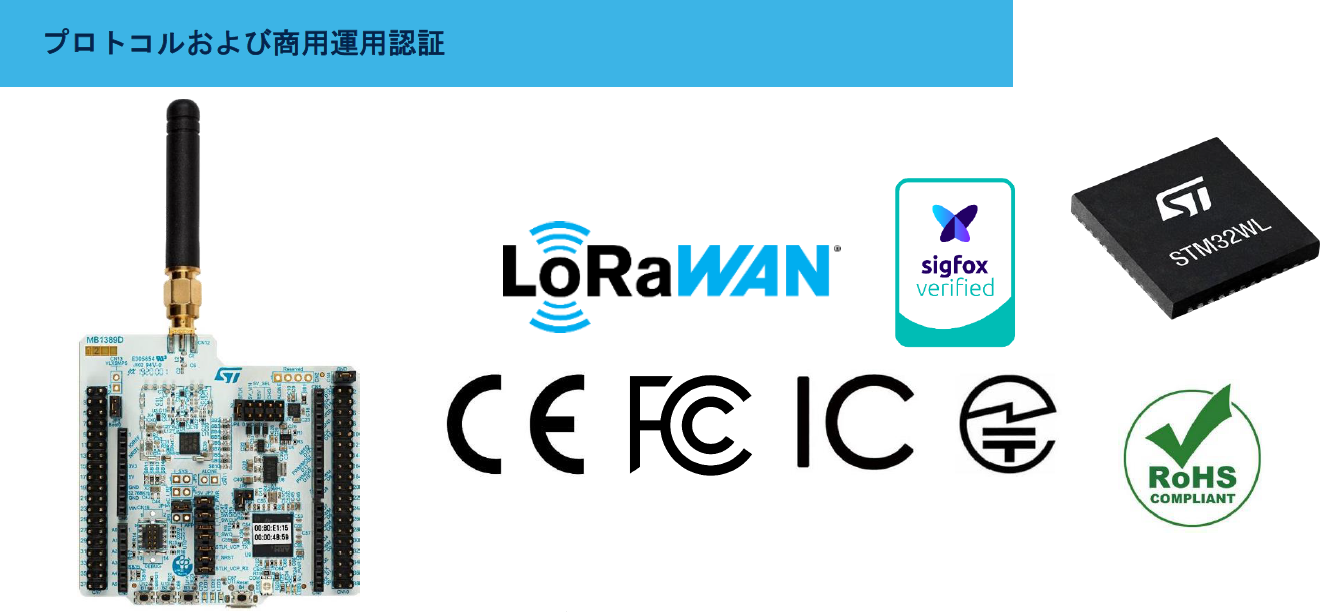
STM32WL - Certified Evaluation Board (NUCLEO-WL55JC)
Software Development Tools
The STM32WL series provides a software development environment that consistently supports everything from evaluation to mass production design.
STM32CubeMX
This tool uses a GUI to configure clock settings, pin assignments, and wireless settings such as BLE and IEEE 802.15.4. Wireless-related initial settings, which tend to be complicated, can be visually organized, preventing configuration errors and streamlining project launch.
STM32CubeIDE
It is an integrated development environment that includes code editing, building, and debugging.
Starting with the sample code running on the evaluation board, application processing can be added in stages, allowing wireless functions and applications to be verified simultaneously.
STM32CubeWL
This MCU package for the STM32WL series includes wireless stacks (LoRaWAN, Sigfox), RTOS, drivers, and various sample code. Wireless communication and applications can be built on the same FRAMES, making it easy to evolve from evaluation samples to mass production code.
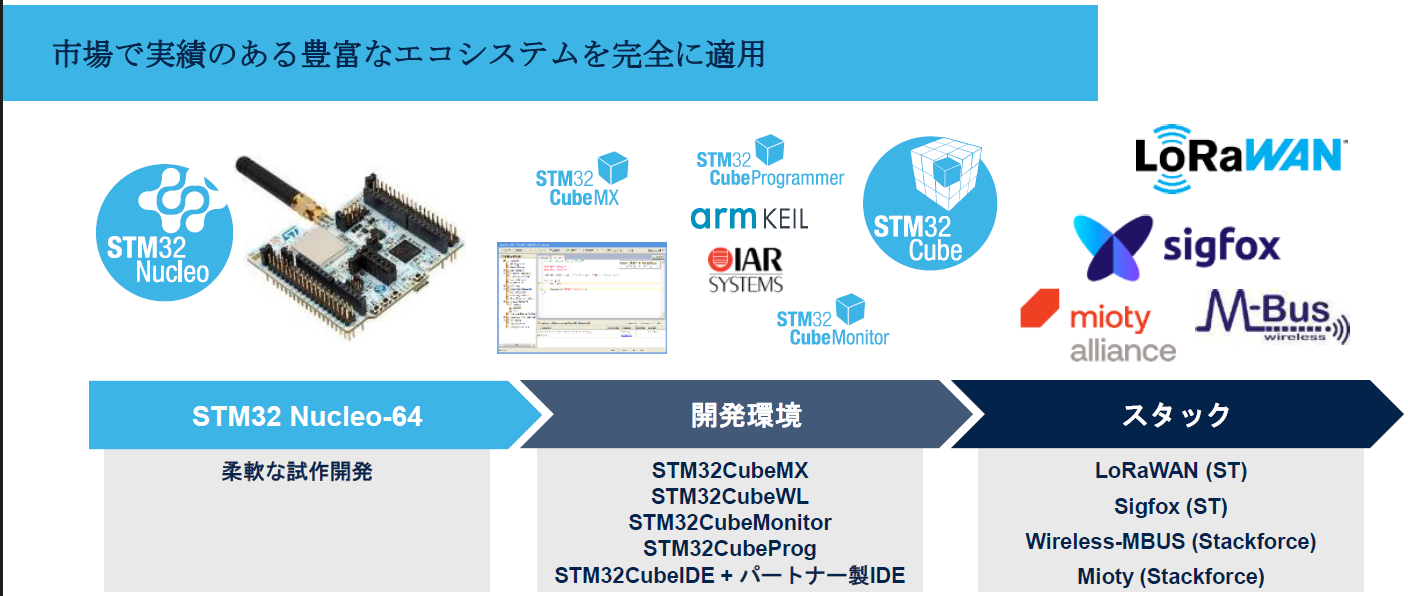
STM32WL series development ecosystem
Summary
The STM32WL series is an IoT SoC that achieves low power consumption, compact size, and high reliability by integrating sub-GHz wireless and a microcontroller on a single chip. Because wireless and applications can be designed on the same device, it is easy to configure a system that assumes low-power operation, which also leads to optimization of implementation scale and ensuring system feasibility.
If you are considering developing edge devices that utilize wireless functionality, we encourage you to consider using the STM32WL series.
If you are interested, please Inquiry Nexty Electronics.