When designing IoT devices, smart homes, and industrial equipment that require wireless connectivity, it is becoming necessary to simultaneously satisfy demands such as support for multiple wireless standards such as Bluetooth Low Energy (BLE), Zigbee, Thread, and Matter, advanced security requirements, and long-term operation through low power consumption. While the conventional configuration typically involved combining an "MCU main unit" with an "external wireless module," in recent years there has been a growing demand for "MCUs with built-in wireless" that integrate these and can simultaneously control applications and wireless processing.
The STM32W series from STMicroelectronics (hereinafter referred to as ST) is a wireless SoC that balances all of these requirements on a single chip. It combines features such as multi-protocol support, robust hardware security, large memory capacity, and low power consumption in a single package. This article explains the key technologies and product features of the STM32W series, and how to select the right one for your application.
Why choose STM32W series products?
With the evolution of IoT and edge devices, microcontrollers are no longer just a "control CPU" but are now playing the role of a core device that simultaneously performs wireless communication processing, security management, and power saving control.
In particular, smart homes and industrial IoT require constant connection to the cloud and smartphones, and are required to communicate securely, be updated wirelessly as needed, and operate for long periods on batteries.
However, in actual design situations, it is easy for rework to occur, such as when the wireless standard selection changes midway, security requirements are added just before mass production, or the battery life is shorter than expected, making it necessary to review the configuration. This is beginning to show the limits of a design that considers the application, wireless, and security separately.
The reason the STM32W series was chosen is that it addresses these challenges by integrating application processing, wireless communication, and security functions into a single chip, adopting a design philosophy that assumes overall optimization.
As the diagram shows, the STM32W series
- CPU and memory for application processing
- Wireless connectivity features such as BLE, Zigbee, Thread, and Matter
- Security features include TrustZone, crypto engine, secure boot/OTA
These are integrated into a single chip in a way that allows them to work together.
This configuration allows optimization of power consumption control during wireless communication, the timing of encryption processing, and the operation of returning from sleep mode, as a whole system rather than individually. This makes it easier to predict the design compared to an external wireless module configuration, and also makes the architecture more resilient to post-production maintenance and function additions.
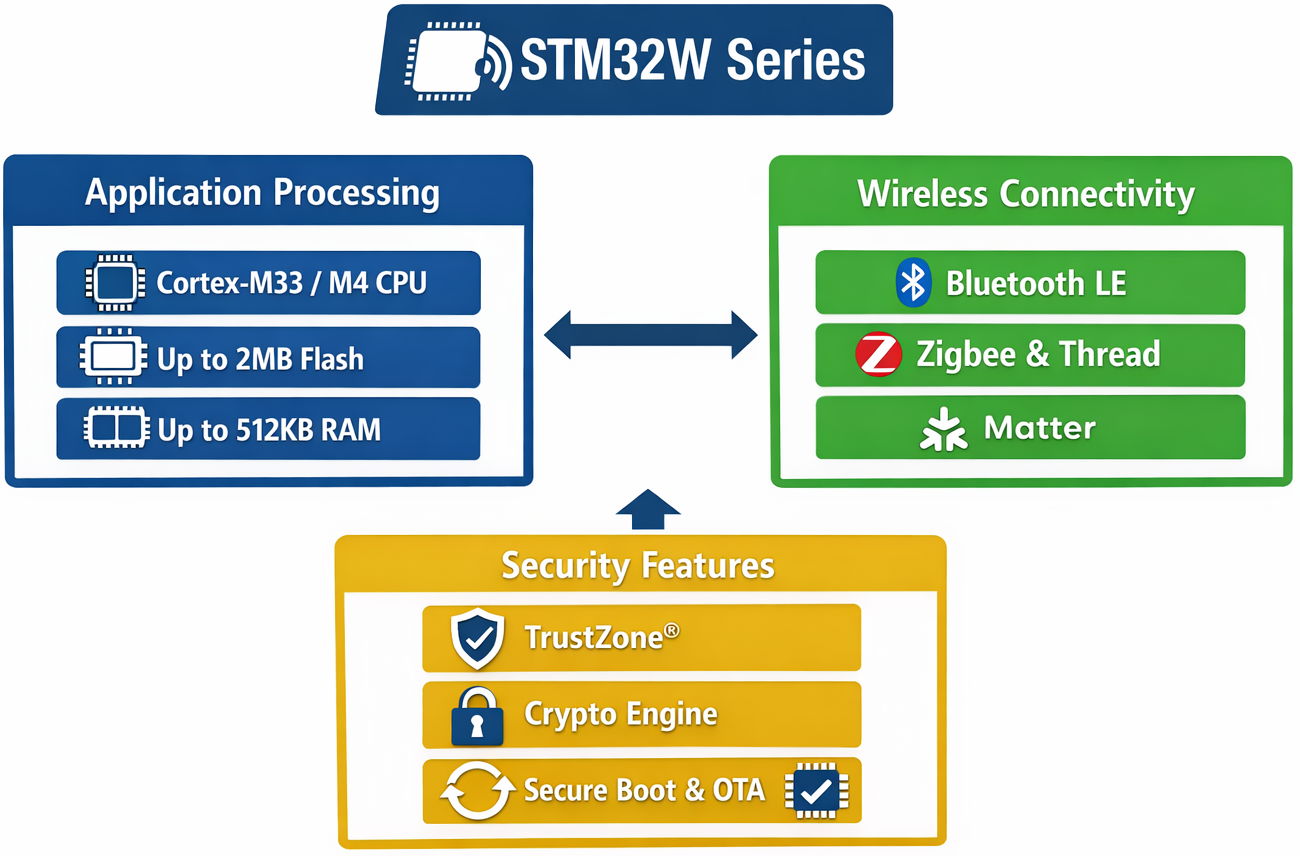
Wireless SoC Block Diagram
(Image of application/wireless/security integration)
STM32W Series: Product Overview
The STM32W series is an SoC with built-in wireless communication functions that belongs to STMicroelectronics' 32-bit microcontroller "STM32" family. System designs that assume wireless connections are becoming the norm for IoT devices, smart homes, and industrial wireless devices. The STM32W series is designed to balance the often-conflicting requirements of scalability, security, and low power consumption in a single device.
The reason this series has been adopted in many development sites is because of the following three technical features that take into consideration everything from the initial design stage to mass production and long-term operation.
- Multi-protocol support for high flexibility
- Strong hardware-based security features
- Designed to combine low power consumption with large memory capacity
Below we will explain in detail the features of the STM32W series.
Point 1: High flexibility thanks to multi-protocol support
The STM32W series supports major wireless protocols such as Zigbee, Thread, and Matter, which are based on BLE and IEEE 802.15.4.
IEEE 802.15.4 is a wireless standard suitable for low-power consumption and mesh communications, with communication methods such as Zigbee and Thread implemented on top of it. Matter is a common specification that uses these wireless technologies to improve interoperability between devices from different manufacturers. As the conceptual diagram shows, the STM32W series is configured to handle these multiple wireless protocols in an integrated manner around a single SoC, and can cover everything from smartphone connectivity using BLE to mesh networks using Thread or Zigbee, and even deployment to Matter-compatible devices, all on the same platform.
In particular, the STM32WBA can handle multiple wireless standards on a single chip, making it possible to design in cases where the communication method cannot be fixed at the product planning stage or with an eye toward future standard additions.
This allows for flexible software updates without changing the hardware, even for IoT devices with long product lifecycles.
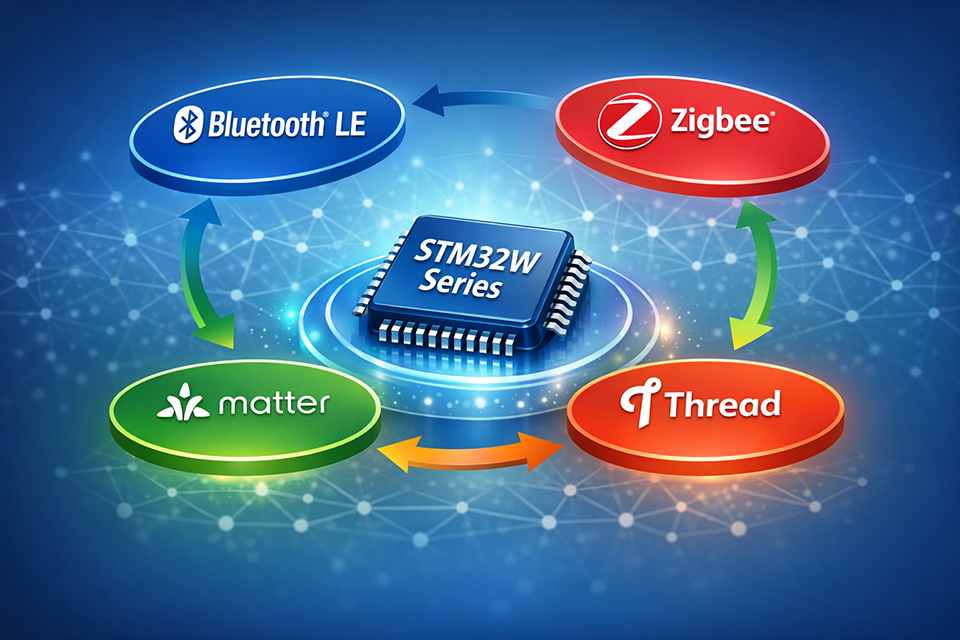
Conceptual diagram of STM32W series compatible wireless protocols
Point 2: Strong security implemented at the hardware level
For IoT devices that rely on wireless connections, data protection and measures to prevent unauthorized Access are design prerequisites, along with convenient communications. The STM32W series does not rely on added software measures to meet these requirements, but instead incorporates hardware-based security functions as standard.
The STM32WBA supports Arm TrustZone, allowing it to be configured with separate secure and non-secure areas. By storing data with a high risk of leakage, such as encryption keys and authentication information, in the secure area, and running normal application processing in the non-secure area, it becomes easier to protect important information even in the unlikely event that a vulnerability is found on the application side.
This separation of domains contributes to data protection, prevention of unauthorized Access, and ensuring device reliability, which are required in smart home devices and industrial applications.
Point 3: Long-term operation design with low power consumption and large memory capacity
The STM32W series is designed with an emphasis on low power consumption, making it suitable for battery-powered wireless devices. It reduces power consumption during sleep mode while still providing sufficient performance when wireless communication is required, making it easier to predict battery life, even in sensor nodes and IoT devices that require constant connectivity.
The STM32W inherits the design philosophy of the low-power MCUs STM32L4 series and STM32U5 series, and is equipped with up to 2MB of Flash memory and large-capacity RAM. The Flash memory is the area for storing programs and firmware update data, while the RAM is the working area for the wireless stack and applications. With ample space for both, the wireless stack and applications can be easily implemented on the same chip.
As a result, the configuration is easy to accommodate product designs that assume long-term operation, such as repeated firmware updates and function additions via OTA (Over-The-Air).
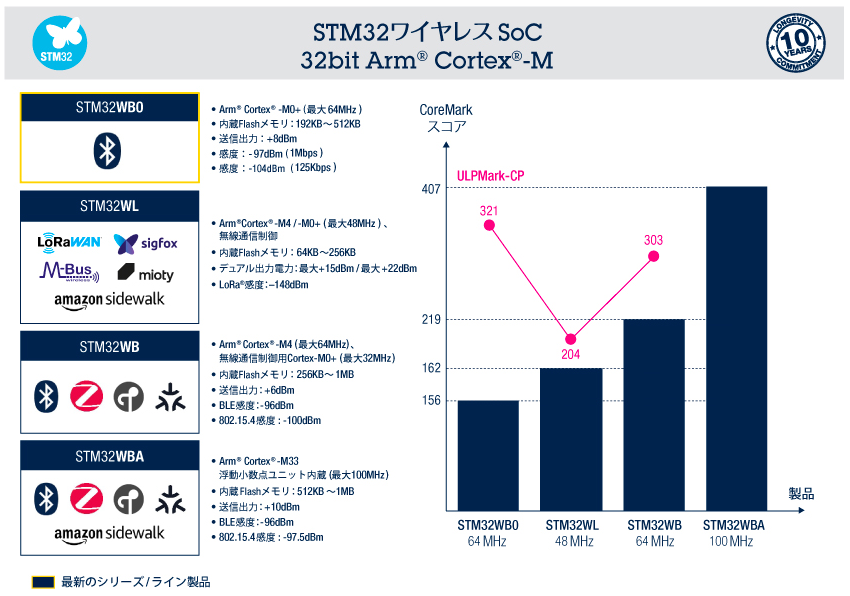
STM32 Wireless SoC Product Portfolio
(reference: https://www.stmcu.jp/stm32-wireless-mcus/)
STM32W Series: Features by Lineup
This time, we will explain the two main products in the STM32W series: STM32WB and STM32WBA.
Both the STM32WB and STM32WBA are wireless SoCs that cover short-range wireless in the 2.4GHz band (BLE and IEEE 802.15.4 series), but their design concepts are not the same.
The STM32WB can be selected as the direction for "separating wireless processing to a dedicated core for stable operation and utilizing existing assets," while the STM32WBA can be selected as the direction for "integrated enhancement of multi-protocol and security with the latest generation single core + TrustZone."
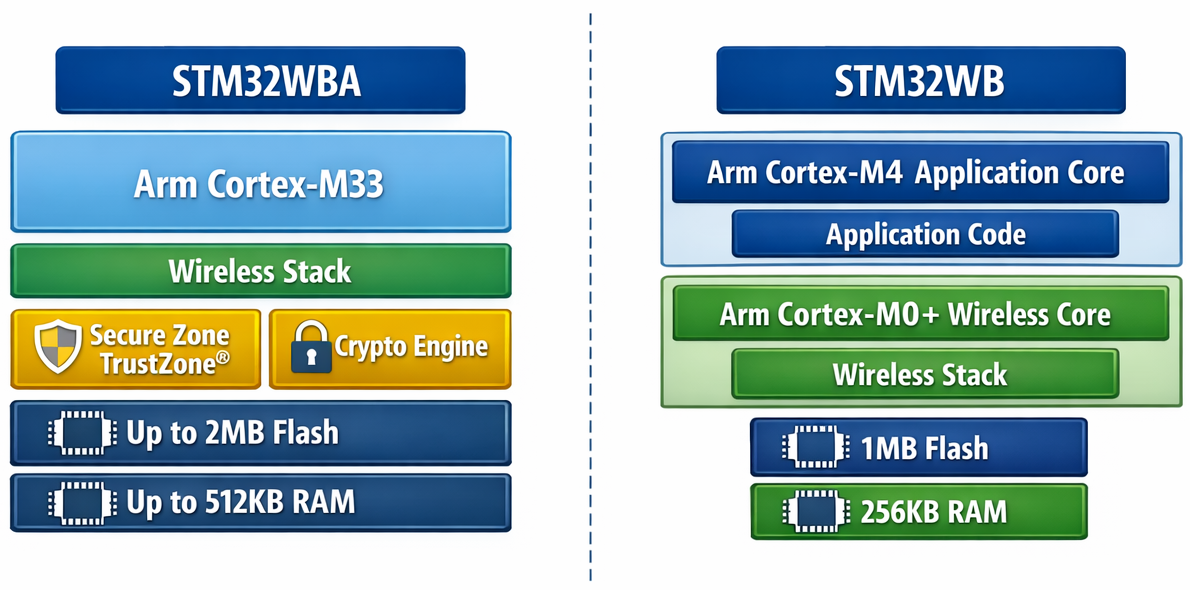
STM32WBA / STM32WB architecture comparison diagram
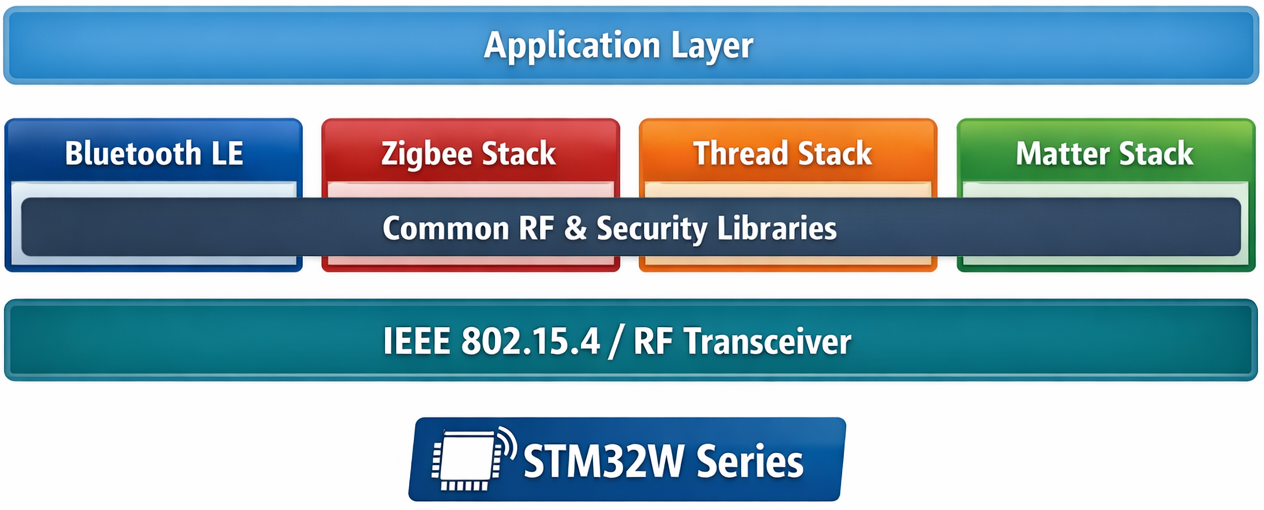
Application layer and wireless layer structure diagram
STM32WB
The STM32WB is a dual-core multi-protocol wireless SoC that supports BLE and IEEE 802.15.4 (Zigbee/Thread/Matter) and is a product family that covers a wide range of IoT applications.
Its distinctive feature is that it is made up of three lines with clearly defined roles, allowing selection according to the application and design phase. We will explain the features and suitable applications of each of the three lines: the Dual Core Line, the Value Line, and the Module Line.
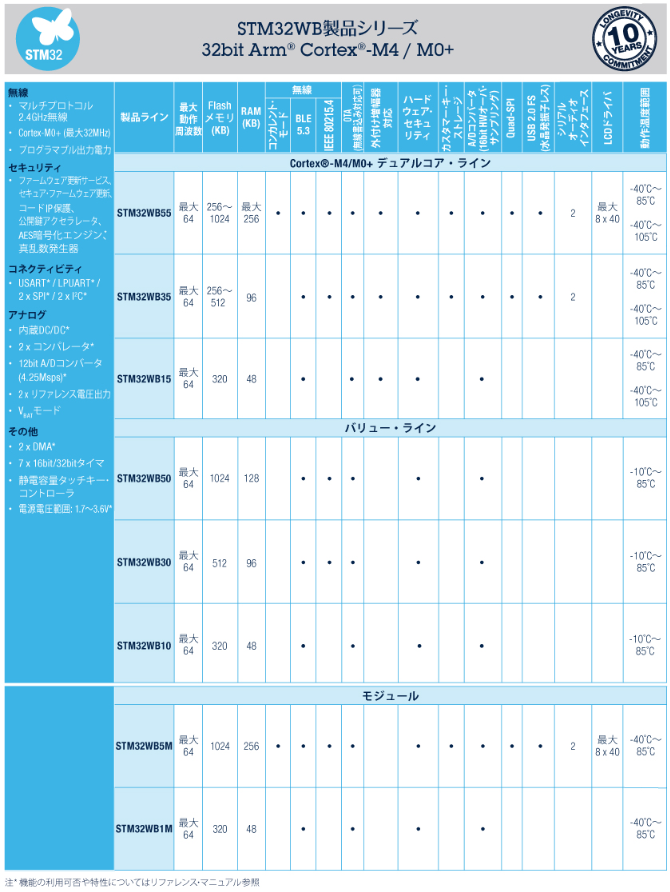
STM32WB Series Product Portfolio
(reference: https://www.stmcu.jp/stm32/stm32wb/)
Dual Core Line
The dual-core line, represented by the STM32WBx5, is the core product group of the STM32WB series.
The dual-core configuration, which combines an Arm Cortex-M4 (for applications) and a Cortex-M0+ (dedicated to wireless) on a single chip, enables clear separation of application processing and wireless communication processing.
In this configuration, the wireless stack runs in real time on a dedicated core, making it easy to maintain communication quality and connection stability even when application load increases. It also supports concurrent operation, which allows BLE and IEEE 802.15.4 protocols to be handled simultaneously, making it suitable for designs that combine smartphone connectivity with mesh networks.
With a full range of peripheral functions and memory configurations, it is suitable for high-performance smart home devices and industrial IoT devices that require a variety of I/O, including USB, LCD, touch sensing, etc. If you prioritize wireless stability, functional expandability, and long-term operation, this dual-core line is the key to your selection.
Value Line
The Value Line, represented by the STM32WBx0, is an entry-level product group that maintains the dual-core configuration of the STM32WB series while optimizing the balance between functionality and cost. While sharing the basic wireless functionality and low power consumption characteristics with the higher-end line, it enhances cost efficiency by optimizing peripheral functions, temperature ranges, etc. according to the application.
It is suitable for simple wireless configurations centered around BLE and relatively small-scale mesh network applications, and offers an excellent balance of RF performance and power consumption.
The Value Line, which has all the necessary and sufficient functionality, is particularly effective for IoT devices intended for mass production, such as beacons, asset tracking devices, wearable devices, and simple sensor nodes.
Packages that are pin-compatible with the dual-core line are also available, making it easy to scale up to higher-end models in the future, providing peace of mind for designers.
Module Line
The module line, represented by the STM32WBxM, is a wireless module based on the STM32WBx5, integrating a reference design including radio circuits, ANTENNAS, and peripheral components.
The greatest feature of this line is that it significantly reduces the burden of RF design and wireless certifications in various countries (FCC, CE, etc.). Developers can simply incorporate the STM32WB's wireless functions into their systems without having to delve deeply into ANTENNAS design and high-frequency evaluation. This makes it particularly effective for projects that prioritize shortening development time and smoothly transitioning from PoC to mass production, as well as development systems with limited RF design resources. It is an ideal choice for startup products, prototype development, and low-volume, high-mix industrial equipment, where "you want to quickly bring working wireless devices to market."
The STM32WB series lineup is not just about different specifications, but is structured to allow designers to choose based on their situation and the phase of their project.
If you prioritize wireless stability and functional expansion, choose the Dual Core Line; if you want to balance cost with sufficient functionality, choose the Value Line; and if you prioritize shortening development time and reducing the burden of certification, choose the Module Line. This will make it easier to decide which line to choose.
This portfolio structure, which allows for both design freedom and realistic development requirements, is one of the reasons why the STM32WB series is used in so many IoT devices.
STM32WBA
The STM32WBA series is ST's next-generation wireless SoC equipped with Arm Cortex-M33 and TrustZone.
In addition to BLE5.4, the portfolio supports IEEE 802.15.4 (Zigbee/Thread/Matter) and is designed with security and multi-protocol compatibility in mind. This series is comprised of multiple categories with clearly defined roles, allowing selection based on functionality level, application, and mass production requirements. This article divides the products into five categories: high-function products, pin-compatible products, basic products, value line, and module line, and explains the design philosophy and suitable applications for each.
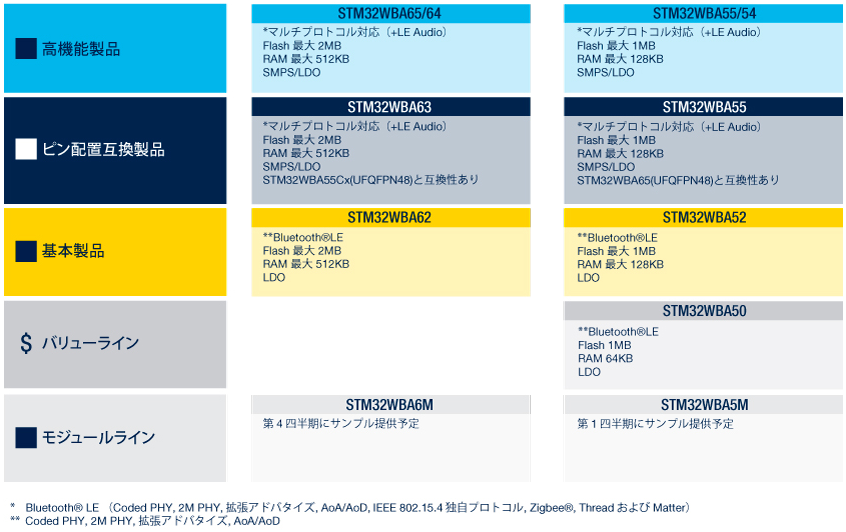
STM32WBA Series Product Portfolio
(reference: https://www.stmcu.jp/stm32/stm32wba/)
High-performance products
The high-performance product group, represented by the STM32WBA64/65, is the most scalable and future-proof line in the STM32WBA series. It supports multi-protocol operation, simultaneously handling BLE and IEEE 802.15.4, enabling designs based on the latest smart home standards, including Matter. In addition to the Cortex-M33 (up to 100 MHz), it also features relatively large Flash/RAM capacity, allowing for ample implementation of wireless stacks, applications, and OTA update functions on the same chip. Advanced security features, centered around TrustZone, including key management and secure boot, make it suitable for products that require long-term operation and standard updates.
This category is chosen for applications that require the ability to accommodate future function additions and standard changes, such as smart home devices, building management systems, and industrial IoT devices.
Pin-compatible products
Pin-compatible products such as the STM32WBA63 offer design flexibility by allowing you to switch between different features and protocols within the same package.
Since it is possible to switch from a BLE-only configuration to a multi-protocol configuration without changing the pin layout, it is easier to avoid redesigning the hardware even if requirements are not yet solidified at the product planning stage. This is a major advantage when moving from prototyping to mass production or when developing derivative models.
This category is suitable for IoT devices with a product series development model that allows you to expand your lineup in response to changes in market demands.
Basic product
The basic product represented by the STM32WBA62 is the standard line that forms the core of the STM32WBA series.
It focuses on BLE communication, and has a good balance of security features by TrustZone, sufficient computing performance, and memory capacity. It has just the right configuration for many IoT devices, making it an easy first choice for new designs.
This is a highly versatile category that can be used for a wide range of applications, including smart home devices, industrial sensors, and building facilities.
Value Line
The Value Line, represented by the STM32WBA50, maintains the basic architecture and security philosophy of the STM32WBA while focusing on a balance between functionality and cost. By limiting peripheral functions and memory configuration to the bare minimum, component costs and power consumption can be easily optimized, making it suitable for product designs intended for mass production. This line is effective for applications where BLE-based communications or limited wireless functionality is sufficient.
This is a suitable option for products that are sold in large quantities and have a large cost impact, such as sensor nodes and simple IoT devices.
Module Line
The STM32WBAxM module is a certified wireless module that incorporates a radio circuit, ANTENNAS, resonator, and other components into an STM32WBA device. It significantly reduces the burden of RF design and wireless certification, ensuring reliable implementation of wireless functions even in PoC development and short-term projects. Even if you don't have specialized RF resources in-house or are developing a multiprotocol product for the first time, this module is easy to adopt with confidence.
It is suitable for applications where speed and reliability are important, such as start-up products, prototype development, and small-lot, high-mix industrial equipment.
The STM32WBA series portfolio is not simply a mix of different specifications, but is structured to reflect differences in design philosophy, i.e., "how far into the future we want to look."
It's easier to choose a device that meets your requirements if you organize your thinking into categories: Value series for cost-conscious BLE-centric IoT devices, Access series for simple BLE-based connectivity, and Stretch series for multi-protocol support, long-term operation, and enhanced security. This tiered lineup is the reason the STM32WBA series is positioned as the core of next-generation IoT wireless SoCs.
STM32W Series Development Resources
The STM32W series is compatible with the STM32Cube ecosystem, an integrated development environment provided by ST.
A major advantage is that the wireless stack, middleware, and development tools are provided in a pre-organized format, allowing for smooth design progress from the initial evaluation stage.
Evaluation board
Evaluation boards such as the Nucleo board and the Discovery board are available for the STM32W series.
These boards allow you to start evaluating wireless communications such as BLE, Thread, and Matter with little or no additional circuitry.
The evaluation board is pre-installed with the basic POWER SUPPLIES circuit and debug interface required for wireless evaluation, and sample code operation can be confirmed simply by connecting it to a PC. This allows initial verification, such as establishing a wireless link, checking communication quality, and understanding power consumption trends, to be performed in a short amount of time.
Additionally, since you can switch between multiple protocols, it is also useful when you want to compare communication methods at the product planning stage.
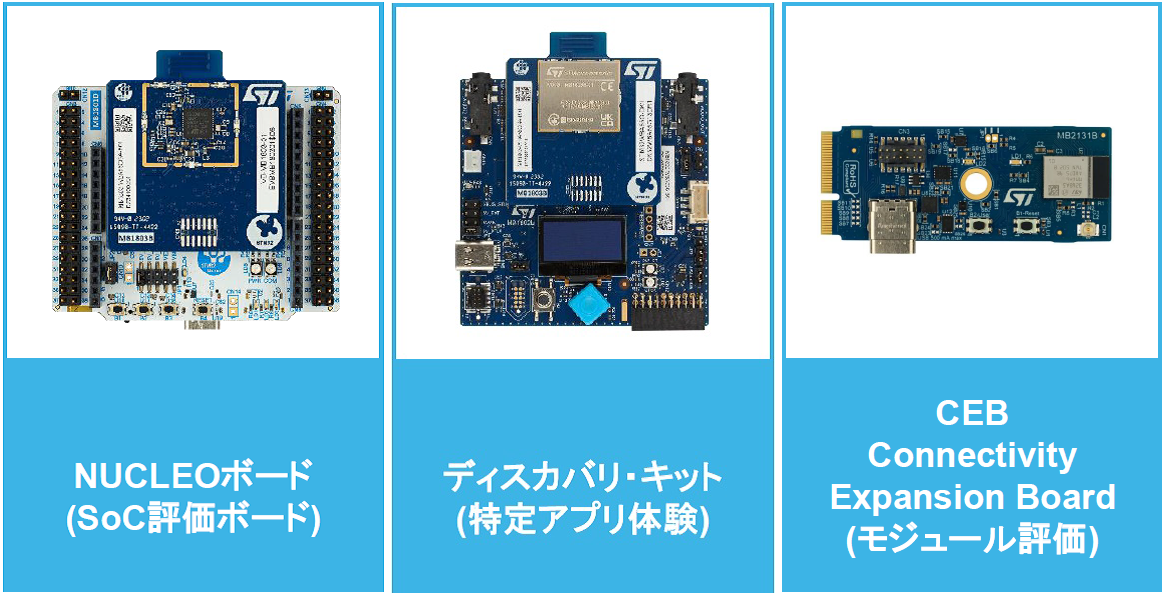
Development support HW tools
Software Development Tools
Software development for the STM32W series can be carried out primarily within the STM32Cube ecosystem.
STM32CubeMX
This tool uses a GUI to configure clock settings, pin assignments, and wireless settings such as BLE and IEEE 802.15.4. Wireless-related initial settings, which tend to be complicated, can be visually organized, preventing configuration errors and streamlining project launch.
STM32CubeIDE
It is an integrated development environment that includes code editing, building, and debugging.
Starting with the sample code running on the evaluation board, application processing can be added in stages, allowing wireless functions and applications to be verified simultaneously.
STM32CubeWBA / STM32CubeWB
It includes wireless stacks, RTOS, middleware, and sample code for the STM32WBA/STM32WB series.
Implementation examples for each protocol, such as BLE, Zigbee, Thread, and Matter, are provided, making it easy to take the steps of "getting it running," "understanding how it works," and "deploying it to your own specifications."
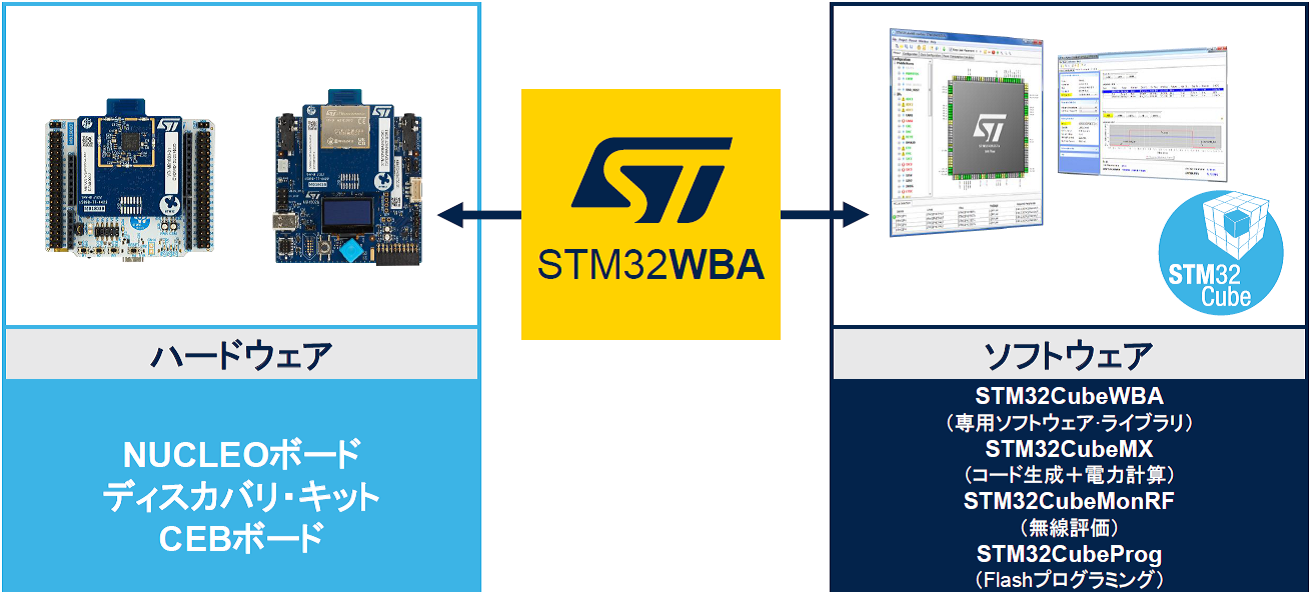
STM32W Series Application Examples
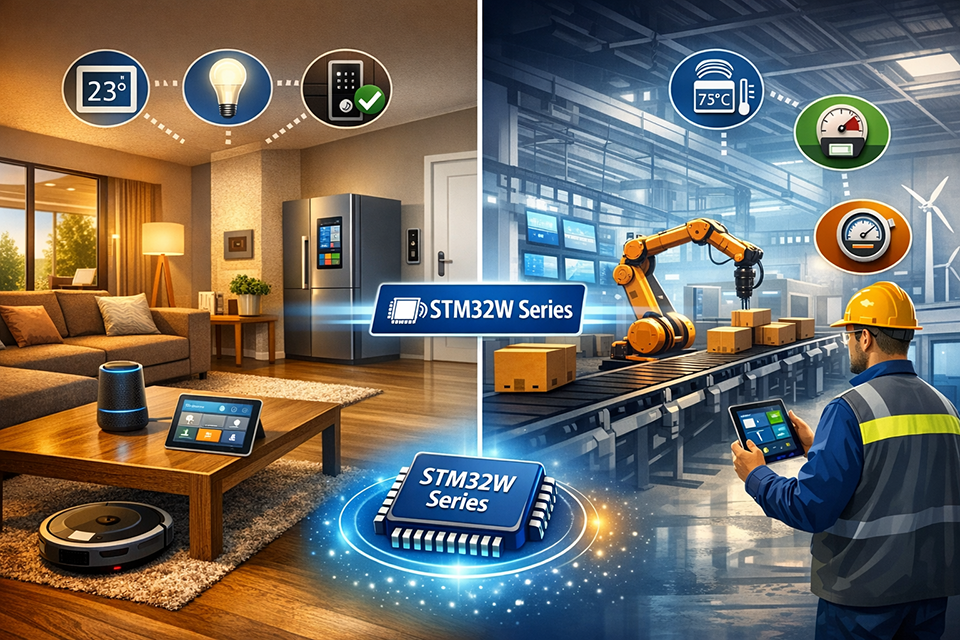
The STM32W series is a wireless SoC that integrates wireless communication, security, and low power consumption on a single chip, and is used in a variety of IoT fields. Here, we will explain from a design perspective why the STM32W series is chosen for each representative application field.
Smart home devices (lighting, sensors, smart locks)
In the smart home field, multiple wireless standards such as BLE, Thread, and Matter coexist, making interoperability and future scalability important design requirements.
The STM32W series can handle both BLE and IEEE 802.15.4 protocols on the same chip, allowing it to flexibly cover everything from smartphone connectivity to mesh networks. For example, lighting and sensors require designs that are constantly on standby with low power consumption, communicating only when necessary. The STM32W's power-saving modes and integrated design of the wireless stack make it easier to achieve stable connections while preserving battery life. Furthermore, for devices with strict security requirements, such as smart locks, the ability to support encryption processing and key management at the hardware level provides significant peace of mind.
Industrial Wireless Sensor Networks
In industrial wireless sensor networks, communication reliability and long-term operation are of the utmost importance.
The STM32W series supports IEEE 802.15.4 protocols, which are suitable for mesh configurations, enabling efficient connection of sensor nodes distributed throughout factories and facilities.
In industrial environments, it is often difficult to replace batteries after installation, and battery operation is required for periods of several years.The STM32W series is designed for low power consumption, reducing current consumption during sleep while providing sufficient processing performance when transmitting data, making it an ideal platform for predictive maintenance and condition monitoring.
Furthermore, the memory configuration makes it easy to support firmware updates via OTA, allowing for flexible function additions and bug fixes after mass production.
Building management and energy management systems
Building management and energy management systems require integrated control and monitoring of lighting, air conditioning, and various sensors.
This field requires scalable wireless networks that can stably connect a large number of nodes and maintainability that supports long-term operation.
The STM32W series supports wireless standards suitable for mesh networks, such as Thread and Zigbee, enabling efficient connection of devices throughout a building. In addition, the integration of wireless communication, application processing, and security functions on a single chip makes it easy to keep the system configuration simple, offering benefits in terms of both design and maintenance.
For applications such as visualization and control of energy usage, data reliability and security are important, so the hardware-based security features of the STM32W series are useful.
In-vehicle peripherals and wireless HMI
In-vehicle peripheral devices and wireless HMIs are increasingly becoming wireless in order to reduce wiring and increase design freedom.
For example, steering SWITCHES, seat sensors, auxiliary display units, etc. require low-latency and stable wireless communication.
The STM32W series is suitable for short-distance communication using BLE, ensuring a stable link with relatively low power consumption.
Furthermore, thanks to its configuration that allows both application processing and wireless processing, it also demonstrates sufficient performance for HMI applications such as input processing and display control. In automotive applications, products have long lifespans, and it is not uncommon for specifications to change or functions to be added later. The STM32W series' OTA-compatible design also makes it effective as a platform for supporting updates after mass production and the development of derivative models.
Summary
The STM32W series is a wireless SoC that combines wireless communication, security, and low power consumption, all essential elements for IoT devices, all on a single chip. Because these can be considered simultaneously from the early stages of design, a major advantage is that it helps to minimize the complexity of wireless IoT device configurations and the need for rework after mass production.
Choose the STM32WB if you prioritize proven performance and stability, or the STM32WBA if you prioritize future scalability and security requirements with next-generation wireless standards and Matter compatibility in mind.
If you are considering IoT or smart device development, please Inquiry NEXTY Electronics.
In the next issue, we will explain the STM32WL series, which belongs to the same STM32W series and has built-in SubGHz radio.
Please refer to this as well.
Next article:
SoC for IoT with Sub-GHz Wireless on a Single Chip - STM32WL Series Enables Low-Power, High-Reliability Wireless Design -