


- Infineon Technologies AG
- NEXT Mobility
Product overview
XENSIV™ angle sensors are a comprehensive lineup of automotive angle sensors using Infineon's xMR (AMR/GMR/TMR) magnetic technology. They are available in single and dual channel configurations and with a variety of interfaces, including analog Sin/Cos, SENT/SPC, PWM, and SPI-compatible SSC, enabling stable angle detection from 0 to 360° even with low-cost magnets.
The portfolio includes AMR, which has excellent stability over temperature and aging, GMR, which is suitable for high-speed response and 360-degree detection, and TMR, which has high sensitivity and low power consumption, and is suitable for a wide range of applications such as EPS, steering angle, motor 6-step/FOC control, pedal/valve position detection, etc. In addition, dual sensors, which have two independent sensors stacked vertically (top/bottom) in the same TDSO package, achieve a more uniform magnetic field distribution and a small footprint, making them ideal for applications with high safety requirements.
Infineon has a track record of achieving the highest functional safety grades for single-chip magnetic angle sensors (product/requirements dependent) and also offers derivatives with ASIL-compliant/documented readiness.
Features:
0 to 360° absolute angle
Various I/F SENT/SPC, PWM, SSC, Sin/Cos
Automotive grade AEC-Q100/ASIL compliant
Dual configuration redundancy/diverse redundancy (AMR+GMR)
Product group
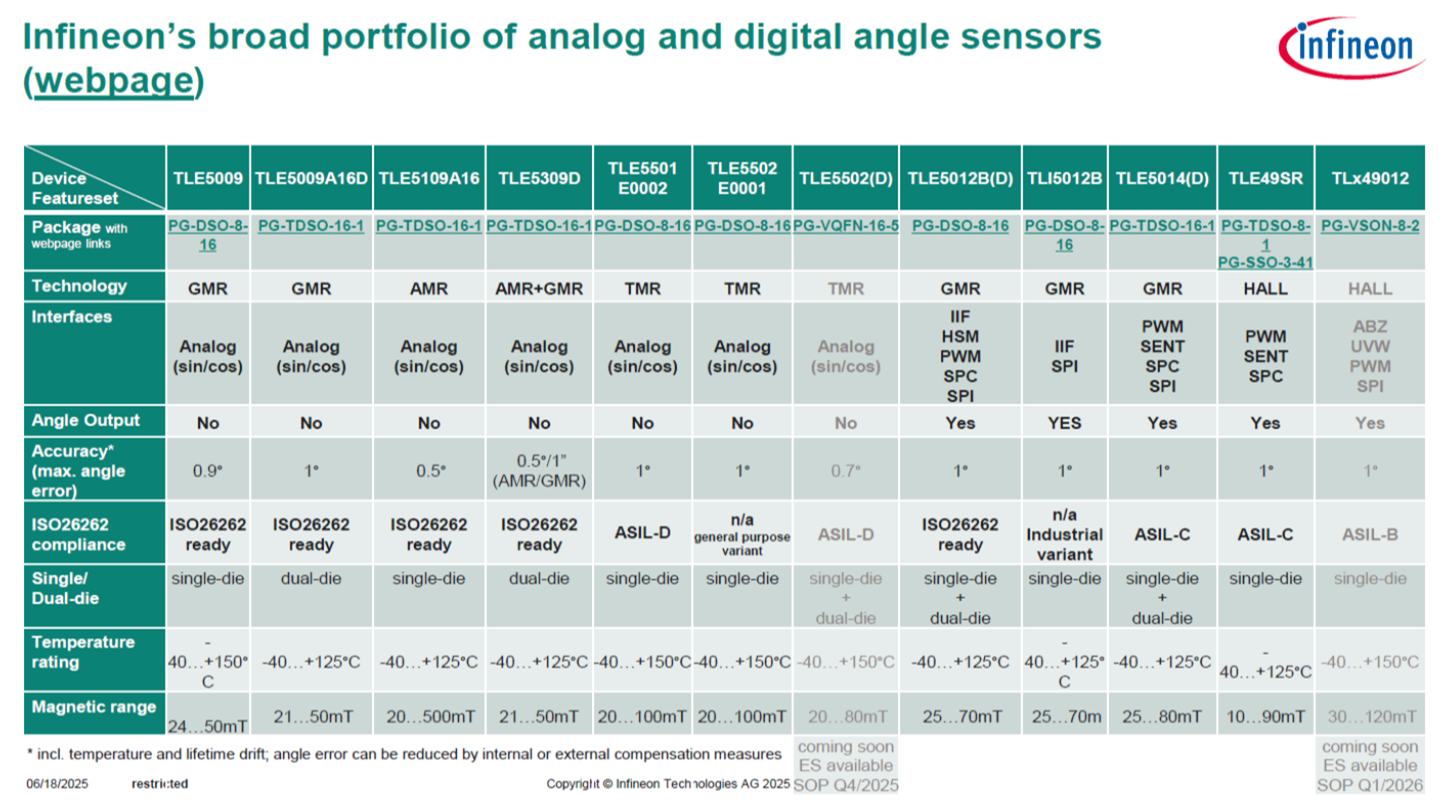
List of main features and specifications
GMR: TLE5012B (digital multi-I/F)
360° detection, 15-bit absolute angle (0.01° resolution), internal auto-calibration ensures a maximum error of ±1.0° over the sensor's lifetime (typical value).
SSC (SPI compatible), SENT/SPC, PWM, incremental I/F. AEC-Q100.
Applications: EPS, steering angle, EC motor, rotary SWITCHES, etc.
AMR+GMR: TLE5309D (diverse redundancy/analog)
AMR (0-180° high precision) + GMR (0-360°) are integrated into upper and lower heterogeneous dies, enhancing redundancy and fault isolation.
Analog Sin/Cos output, 3.3V/5V supply, -40 to 125°C. ISO 26262 Ready.
Applications: BLDC for EPS, ACTUATORS that require functional safety.
TMR: TLE5501 (high sensitivity, low power/analog)
Sin/Cos differential output by TMR bridge, large signal of maximum 0.37 V/V, easy to connect directly to MCU.
The E0002 derivative supports external redundant calculation with bridge isolation, and is ISO 26262 ASIL-D compliant (assuming safety mechanisms are in place).
AEC-Q100 Grade 0 (-40 to 150°C environment). Ideal for steering angle/BLDC commutation.
| technology | Angle Range | Strengths | Representative item | Main I/F |
|---|---|---|---|---|
| AMR | 0 to 180° (High precision) | Temperature and aging stability, high accuracy, low latency | TLE5109A16(AMR)/TLE5309D(AMR+GMR) | Analog Sin/Cos |
| GMR | 0~360° | High-speed response, 360° absolute | TLE5012B / TLE5014 / TLE5009 | SSC (SPI compatible), SENT/SPC, PWM, incremental, Sin/Cos |
| TMR | 0~360° | High sensitivity, low power consumption, and large output for easy direct connection to MCU | TLE5501 | Analog Sin/Cos |
For detailed technical information, please visit the Infineon website.

Benefits of implementation
| problems | solution |
|---|---|
| EPS provides high accuracy and low latency | PFC control minimizes phase lag by directly connecting xMR + Sin/Cos. |
| Resistant to air gaps and magnetic field variations | xMR detects the "direction" of a magnetic field and is robust to strength fluctuations. |
| Reduced burden of ASIL achievement | We offer vertically stacked dual/diverse redundancy, ASIL-compliant products, and safety documentation. |
| Miniaturization/cost optimization | Dual vertical stacking reduces board area and allows the use of low-cost magnets. |
Use cases and implementation examples
Use Case 1: EPS (Electric Power Steering) / Steering Angle
[Use case overview]
By using GMR/AMR/TMR technologies appropriately, low latency, high precision angle feedback and functional safety are both achieved. The TLE5012B (GMR) is suitable for diagnosis and redundancy design with its digital I/F, while the TLE5501 (TMR) ensures a noise margin with its highly sensitive Sin/Cos. The TLE5309D with its diverse redundancy is ideal for EPS with high safety requirements.
[Major features]
0~360° angle, speed/rotation count, self-diagnosis
[Introduction Effects]
Stabilization of steering assist, faster abnormality detection, robustness to EMC/variation

Use case 2: xEV drive motor (FOC/6 steps)
[Use case overview]
High-resolution position detection using Sin/Cos or SENT/SPC outputs improves efficiency and quietness in BLDC/PM motors for electric compressors, pumps, and axles. The high-speed response of GMR and the high output of TMR suppress phase lag and quantization noise in the control loop.
[Major features]
Sin/Cos differential, SENT/SPC, PWM, SSC (SPI compatible)
[Introduction Effects]
High efficiency, low vibration, and reduced calibration load

Use Case 3: Pedals, Valves, and Rotary SWITCHES
[Use case overview]
The xMR method is low-power, highly accurate, and robust against gap variations, improving the reliability of position detection. AMR has excellent aging and temperature stability, while GMR can read the position continuously over 360°.
[Major features]
Combined detection of angle, direction and speed, incremental I/F
[Introduction Effects]
Increased design freedom and redundancy for improved safety

Inquiry
Related Product Information

LITIX™ Automotive LED DRIVER ICHighly efficient and reliable LED DRIVER IC optimized for automotive lighting. Supports a wide range of applications, from animation lamps to matrix headlamps.
LITIX™ is a family of automotive LED DRIVER ICs that features constant current control and diagnostic and protection functions, making it highly efficient, reliable, and compatible with a wide range of lighting control applications.
- Infineon Technologies AG
- NEXT Mobility

High-side/low-side SWITCHES Replaces relays and FUSES- Automotive-quality smart SWITCHES for smarter and safer power distribution and load control.
These high-side and low-side automotive smart SWITCHES are equipped with protection and diagnostic functions for overcurrent and overtemperature, enabling safe and reliable load control.
- Infineon Technologies AG
- NEXT Mobility
OPTIREG™ Automotive Voltage RegulatorsHighly reliable and efficient POWER SUPPLIES solutions optimized for automotive ECUs. LDO, DC-DC, and PMIC support a wide range of applications from ADAS to body control.
This is a highly reliable and efficient POWER SUPPLIES IC family for automotive ECUs, and includes LDO, DC-DC, and PMIC, achieving both safety and efficiency.
- Infineon Technologies AG
- ICT and Industrial
- Smart Factories and Robotics
CoolSET™ AC-DC Integrated Power IC High efficiency AC-DC POWER SUPPLIES IC integrating a PWM controller and high voltage MOS FETS. Compact, highly reliable, and simplifies SMPS design.
This highly efficient IC for AC-DC POWER SUPPLIES integrates a PWM controller and high-voltage MOS FETS, simplifying design and improving reliability.
- Infineon Technologies AG
- ICT and Industrial
- Smart Factories and Robotics

Automotive Transceiver Highly reliable and durable CAN/LIN communication ensures safety and efficiency of next-generation automotive networks.
Infineon's automotive transceivers offer high durability and high-speed communication, and support CAN FD and LIN, making in-vehicle networks safer and more efficient.
- Infineon Technologies AG
- NEXT Mobility

XENSIV™ MEMS Microphone MEMS technology for clear audio experiences in everything from cars to smart devices
XENSIV™ MEMS microphones feature high SNR and wide dynamic range, enabling a clear voice experience and highly accurate voice processing in vehicles and smart devices.
- Infineon Technologies AG
- NEXT Mobility
- ICT and Industrial
- Smart Factories and Robotics
Link to Related Technical Columns

What is ELECTRIC CURRENT SENSORS for your purpose? | Infineon Technologies Technical Column
This article explains the role and types of ELECTRIC CURRENT SENSORS, which are indispensable in everyday life and industrial sites. ELECTRIC CURRENT SENSORS are important elements for confirming the normal operation of equipment, and we will also introduce in detail points to note when selecting a current sensor and detection methods.
Understand the characteristics of IPDs and make effective use of them | Infineon Technologies Technical Column
Explain the role and characteristics of high-performance semiconductor SWITCHES IPD and its differences from MOS FETS. By understanding the advantages and disadvantages, you can learn the key points for selecting the best device for your application.
What is POWER SUPPLIES IC? | Infineon Technologies Technical Column
Explains basic knowledge of POWER SUPPLIES IC, types, and merits of introduction. Learn about the role and importance of power supply, which is essential for electrical products, and learn more about selection points for efficient power management.

Knowing more about MOS FETS will make your work even easier! | Infineon Technologies Technology Column
Learn about MOS FETS in detail, from their basics to their operation and selection methods. Understand their important role and applications in electrical circuits, and use them to improve your work efficiency.
What is a motor driver? Explaining its uses and features | Infineon Technologies Technical Column
This article explains the importance of motor drivers and their types. It introduces the features of brushed, brushless DC, and stepping motor drivers, and briefly summarizes the key points for selection and the benefits of adopting one.