A car's fuel efficiency is determined by a variety of factors, including human and environmental factors, including the car's weight.
The heaviest part of a car is the chassis, followed by the engine, and then the wiring harness. Reducing the weight of the harness will greatly contribute to improving fuel efficiency, and it is expected that the weight of the wiring harness can be reduced by using automotive Ethernet as an internal network. One solution to the weight problem is to supply power via data lines. This column focuses on POWER SUPPLIES networks and automotive Ethernet.
*Improved fuel efficiency through reduced power consumption will be explained in TC10 (Technical Column).
POWER SUPPLIES network
The main purpose of POWER SUPPLIES network is to ensure that POWER SUPPLIES is available whenever it is needed. A constant voltage supply is required without any voltage drops. The following diagram shows the elements involved in POWER SUPPLIES network.
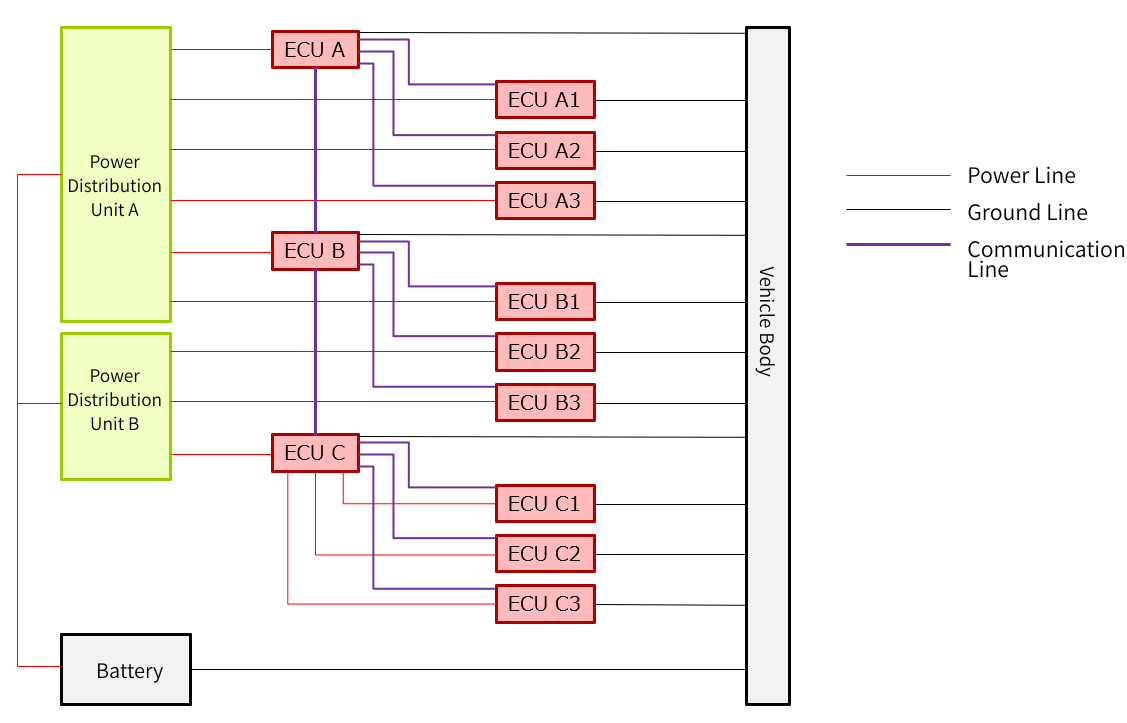
The vehicle body serves as the potential reference point, with POWER SUPPLIES and the GND of each ECU connected to the body. A power distributor ensures a reliable POWER SUPPLIES supply to the ECUs, and as a general rule, FUSES are used in the power distribution lines to protect against overload. Looking at the communication lines, ECUs A, B, and C are Ethernet SWITCHES ICs, and the communication nodes are connected only via PHYs. ECU C and ECUs C1, C2, and C3 are connected by communication lines and POWER SUPPLIES lines, but PoDL is a technology that can integrate these lines.
Power over Ethernet CABLES
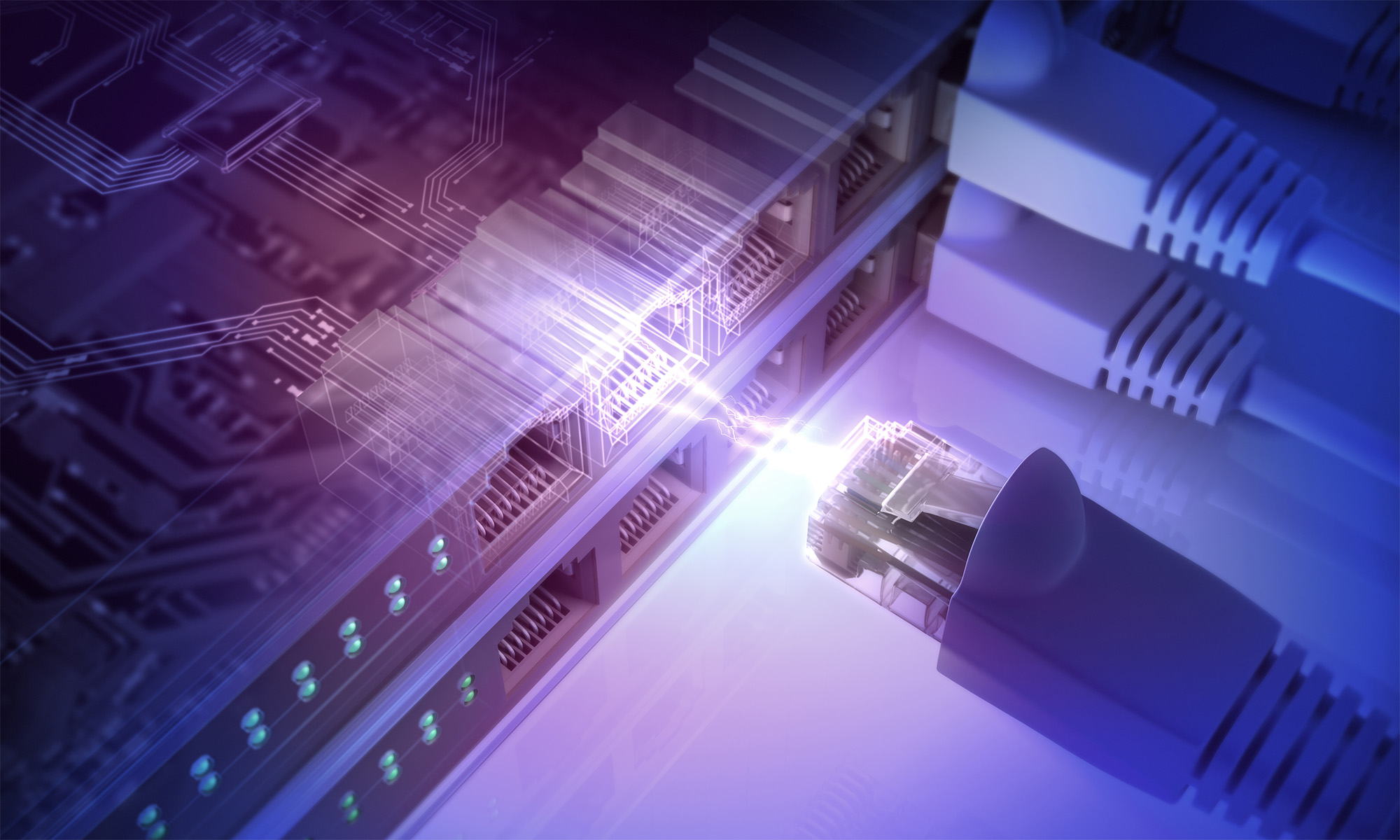
PoE (Power of Ethernet) and PoDL (Power of Data Line) are technologies that supply DC power to devices via Ethernet CABLES.
Power can be supplied using only an Ethernet CABLES, without the need for a separate POWER SUPPLIES or outlet.
PoE (Power of Ethernet)
Power over Ethernet (PoE) is primarily used in consumer and industrial equipment. Established by the IEEE802.3af standard, it defines two types of PoE devices: power sourcing equipment (PSE) and powered devices (PD). In a PSE, power is derived from the device's own conventional POWER SUPPLIES.
The PSE manages the power transmitted to the PD over the Ethernet CABLES network. The power required by the PD is provided through the RJ45 CONNECTORS, eliminating the need for an internal POWER SUPPLIES. CABLES that delivers power from the PSE to the PD is called the POWER SUPPLIES Interface (PI), which is synonymous with MDI.
POWER SUPPLIES supply pair CABLES differs depending on the mode.
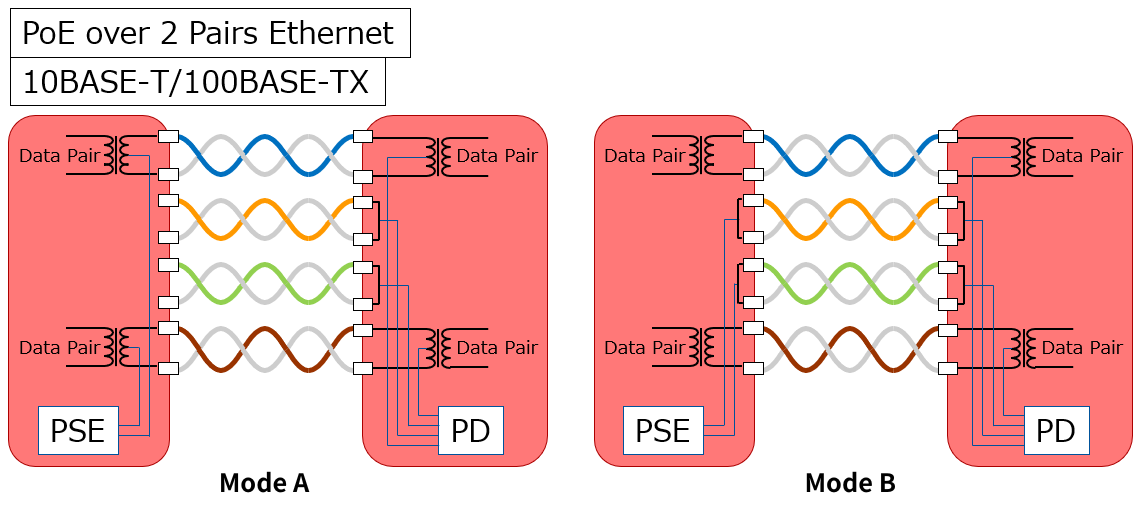
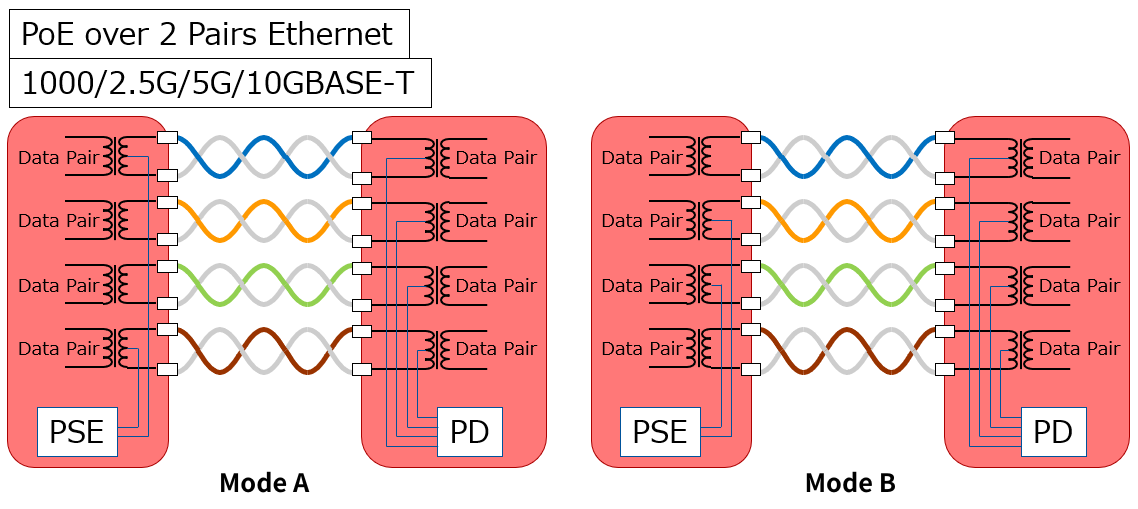
In addition, there are extensions of PoE, such as PoE+ (IEEE802.3at) and PoE++ (IEEE802.3bt), the main difference being the maximum power supply capacity.
Details are as shown in the table below.
| Specifications | PoE | PoE+ | PoE++ |
|---|---|---|---|
| standard | IEEE 802.3af | IEEE 802.3at | IEEE 802.3bt |
| Maximum PSE Power | 15.40W | 30W | 60W (Type 3) 100W (Type 4) |
| PD power supply | 12.95W | 25.5W | 51W (Type 3) 71W (Type 4) |
| Twisted Pair 2 | 2Pair | 2Pair | 4Pair |
| CABLES Type | Cat3 | Cat5 | Cat5 |
| Maximum Transmission Distance | 100m | 100m | 100m |
PoDL (Power of Data Line)
PoDL is a technology for automotive use, and is defined by IEEE802.3cg. The main difference between PoE and PoDL is the number of twisted pair CABLES used to supply power. Like PoE, power can be supplied using CABLES used for data transmission, but PoDL can supply power using only one twisted pair CABLES. It is used for 100BASE-T1, 1000BASE-T1, 10BASE-T1S, and 10BASE-T1L.

The PoDL class defines the power supply capacity, current value on the PI, and voltage value of the PSE and PD. Classes 0 to 9 are defined by IEEE 802.3bu for automotive systems, and Classes 10 to 15 are defined by 802.3cg for BA (Building automation) and FA (Factory automation).
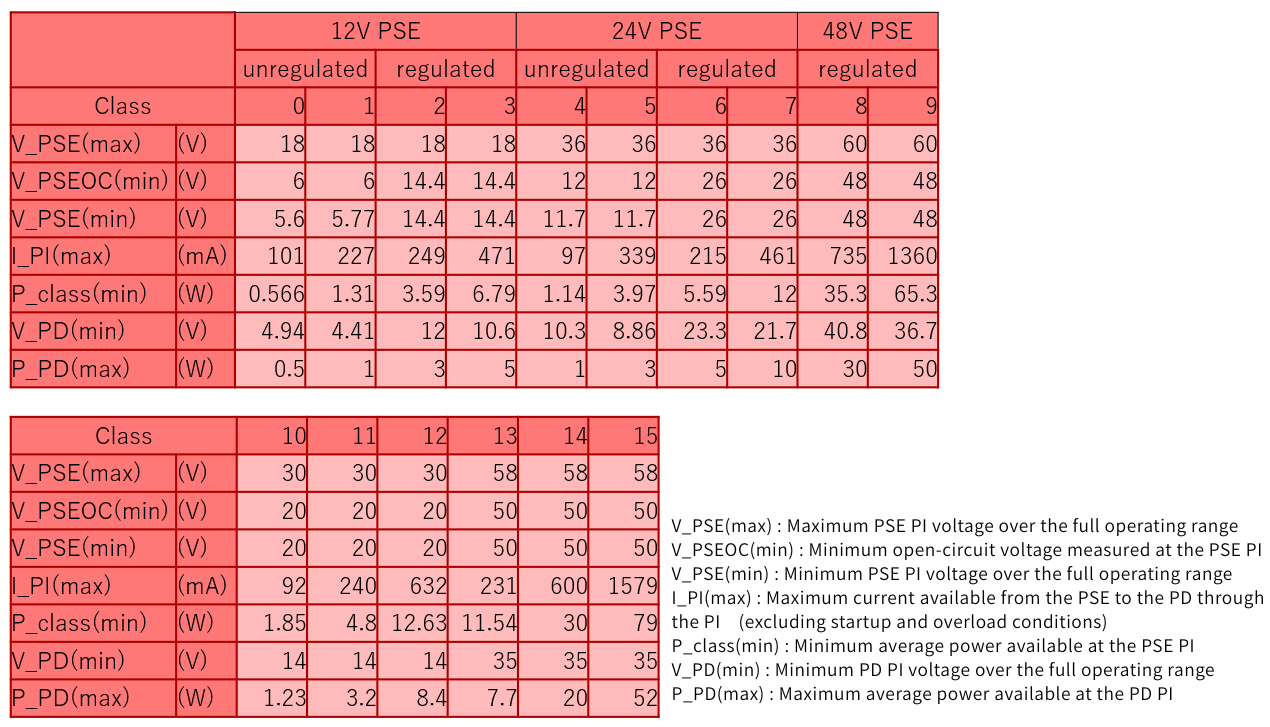
Reducing the number of power lines not only reduces weight, but also has the advantage of reducing electromagnetic interference and space by eliminating CONNECTORS addition, by adjusting the amount of current using INDUCTORS connected to the PSE and PD, it is possible to supply the optimal voltage to peripheral sensors, etc.
Inquiry
Link to Related Technical Columns
Related Product Information
The features and product lineup of the GMSL2 high-speed transmission technology for automotive applications
This article explains the features of Analog Devices' next-generation GMSL, GMSL2, which can handle video data from cameras with higher pixel counts.
- Analog Devices, Inc.
- NEXT Mobility
- ICT and Industrial
GMSL High-Speed Transmission Technology for Automotive Applications
This explains the high-speed transmission technology GMSL.
- Analog Devices, Inc.
- NEXT Mobility

Introduction to Wireless Gesture Sensors (Use Cases for Analog Devices Products)
The wireless gesture sensor developed by NEXTY Electronics enables low-cost remote control of home appliances and display products.
- Analog Devices, Inc.
- NEXT Mobility
- ICT and Industrial
- Smart Factories and Robotics
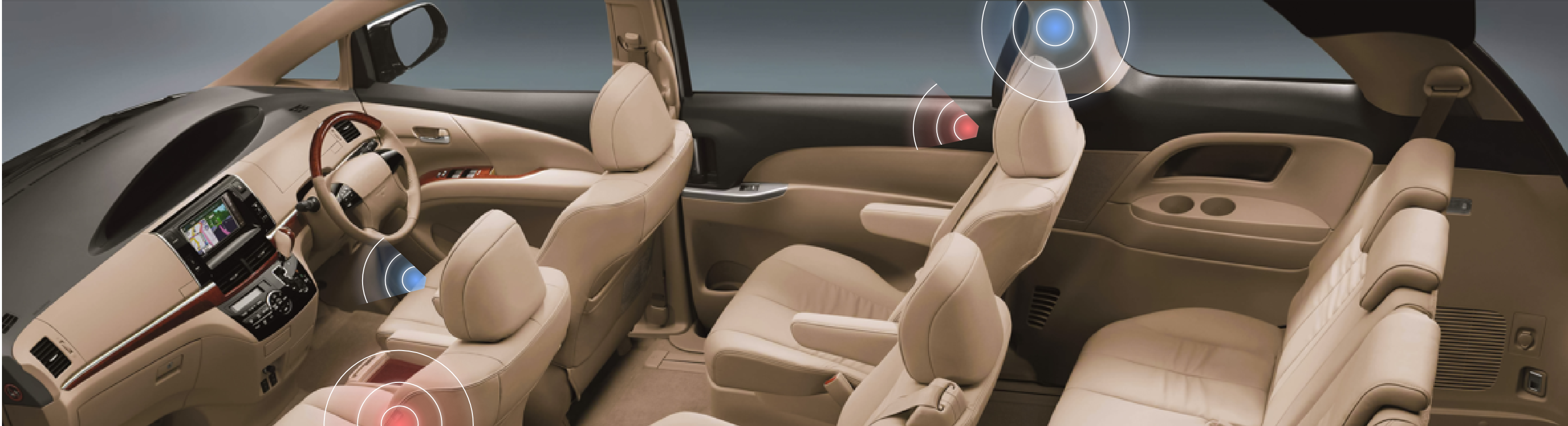
Introduction to In-Car Communication (ICC) | Use Cases of Analog Devices Products
The in-car communication system developed by our company uses voice signal processing technology to enable the voices of passengers to be heard clearly even while the car is moving.
- Analog Devices, Inc.
- NEXT Mobility
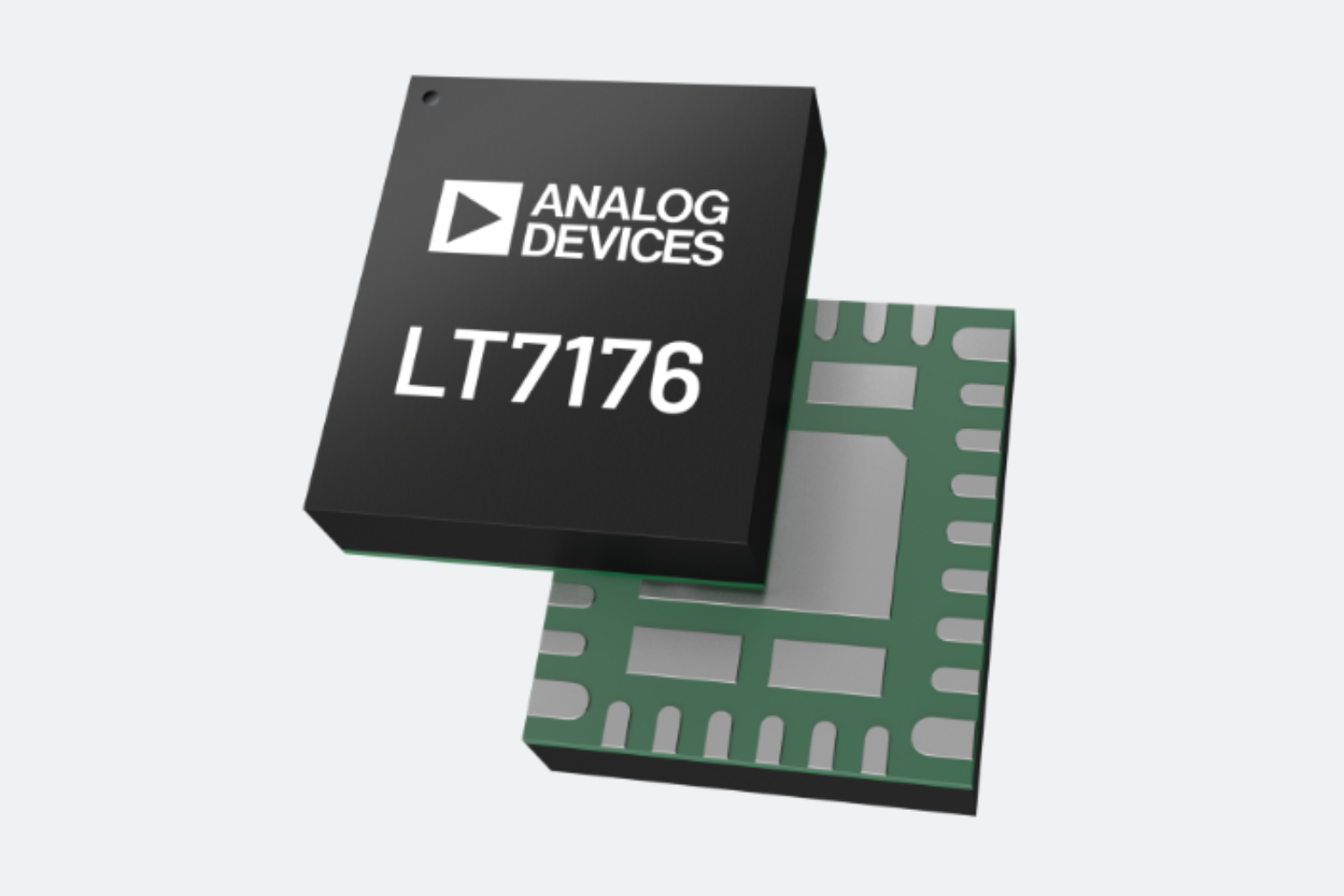
LT7176: 24A/4V, single-phase or dual-phase silent switcher step-down regulator with digital power system management capabilities.
The LT7176 is a step-down regulator with a Silent Switcher that supports up to 24A output, and also features PMBus control, telemetry, and PolyPhase operation.
- Analog Devices, Inc.
- ICT and Industrial

Lantronix - System on Module with Qualcomm IoT Application Processors
Lantronix provides SoMs equipped with Qualcomm IoT processors and offers end-to-end solutions utilizing AI and 5G.
- LANTRONIX, INC.
- ICT and Industrial
- Smart Factories and Robotics