

- NXP Semiconductors NV
- NEXT Mobility
As ECUs (Electronic Control Units) become more sophisticated and high-performance, attention tends to focus on "processor selection" and "SoC configuration," but is a system truly complete with just those factors?
In actual design work, the functionality and reliability of the entire system are only ensured when numerous peripheral devices, such as sensors, POWER SUPPLIES, interfaces, and display systems, work closely together.
In this series, we will focus on NXP's "NXP Analog IC Products," which are crucial peripheral semiconductors that influence the overall quality of these ECUs, and systematically explain everything from the overall picture to the role of each device.
NXP Special Site
NXP Official Website [External Link]
Analog IC products that support the performance of ECUs
In recent years, the performance of MCUs and SoCs in automotive ECUs has been rapidly improving. The increasing demands for autonomous driving (ADAS), connectivity, and electrification have necessitated processors with greater computing power and communication capabilities than ever before. However, actual ECUs are not composed solely of MCUs and SoCs.
Around the processor,
- A sensor that monitors temperature
- RTC (Real-Time Clock) that maintains accurate time
- Display devices such as LCDs and LEDs
- GPIO expansion device
- Redrivers that support high-speed communication
- Level conversion ICs for connecting different voltage domains
Numerous analog ICs and interface ICs are located within this configuration.
These devices are not particularly conspicuous,
"Measure," "Connect," "Protect," "Display"
It plays this crucial role, supporting the overall performance and reliability of the ECU.
In other words, if MCUs and SoCs are the "brains" of ECUs, then analog IC products can be said to be the "nerves and sensory organs" that ensure that brain operates reliably.
This article introduces NXP's analog IC products that support such ECU design, and examines how each product contributes to solving various challenges.
NXP's Recommended Analog IC Products
NXP's recommended analog IC products support the peripheral functions of these ECUs.
It is positioned as a "general-purpose analog interface IC group."
Broadly speaking, it consists of the following areas:
1. Signal Management/Interface
- GPIO Expander
- Voltage Level Translator
- Redriver/Repeater
- SWITCHES high-speed signals
2. Human-Machine Interface (HMI)
- LCD controller
- LED DRIVER
- Audio related
3. Sensors and high-precision analog sensors
- TEMPERATURE SENSORS
- RTC (Real-Time Clock)
- Battery management related
4. Power Driver System
- Motor driver
- High-side/low-side SWITCHES
- POWER SUPPLIES ICs, PMICs
These may not stand out on their own,
It supports the fundamental functions of the system: "connecting, measuring, controlling, and displaying."
Reasons why analog IC products are considered important
So why are these surrounding interchanges considered so important?
① As system integration progresses, "peripheral quality" becomes dominant.
In recent years, there has been a trend towards domain controllers, where multiple functions are integrated into a single ECU.
the result,
- Signal interference
- Noise immunity
- Interface Alignment
These kinds of problems tend to become more apparent.
Three challenges that analog ICs should solve
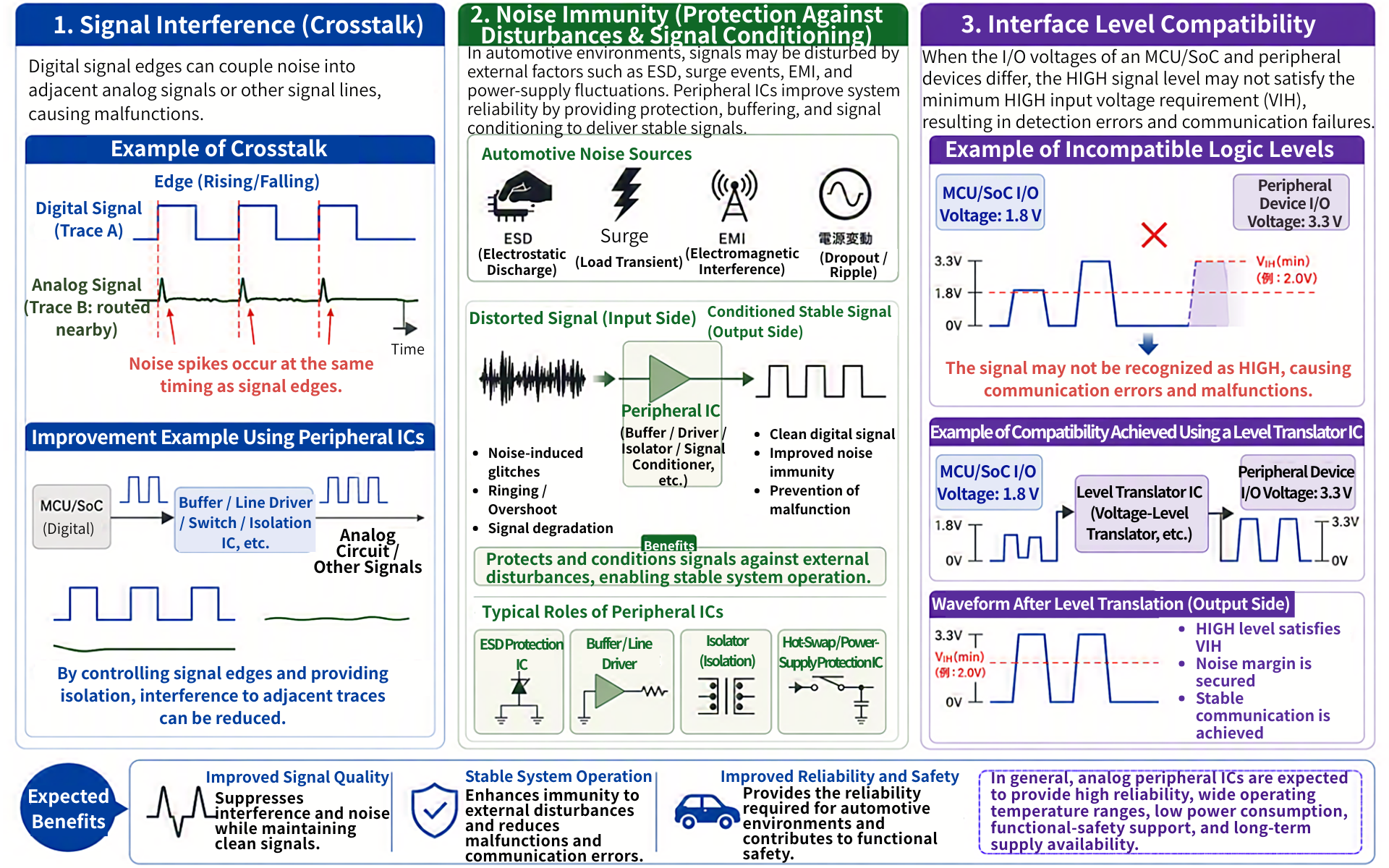
These are precisely areas where NXP analog IC products can make a contribution.
② Essential from the standpoint of stability and safety
For automotive applications, the following are essential requirements:
- Operation over a wide temperature range
- Long-term reliability
- Functional safety (ISO 26262) compliant
NXP's portfolio addresses these requirements.
It consists of
automotive-grade (AEC-Q100) products.
Reliability suitable for mass production design is ensured.
③ Achieving both low power consumption and high precision.
In particular, the following devices:
- RTC → Timekeeping with ultra-low power consumption
- TEMPERATURE SENSORS → High accuracy of ±0.5℃ level
- Level conversion → Voltage matching with the latest processors
This requires low power consumption and high-precision design.
Roles of NXP Analog IC Products as Seen in ECU Block Diagrams
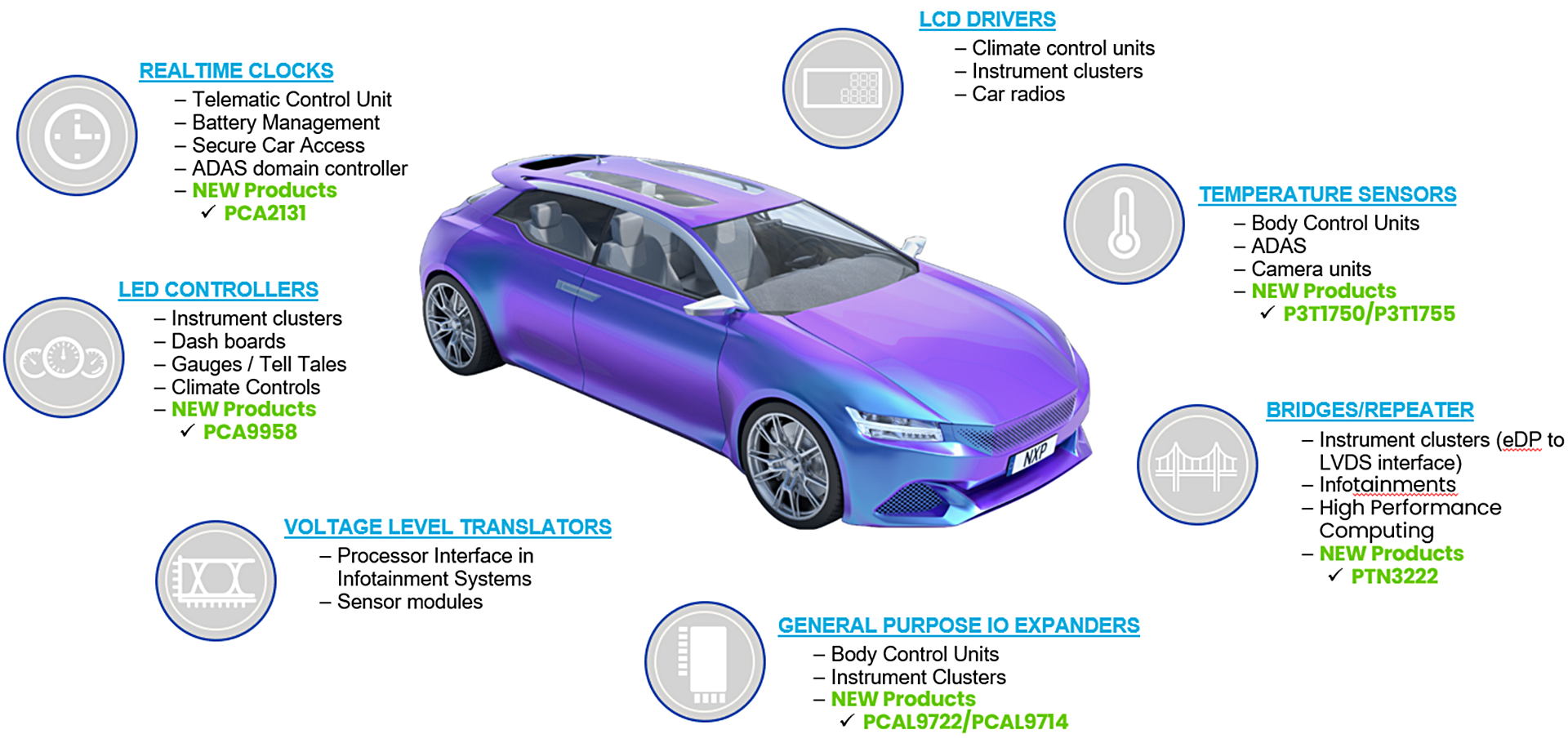
When viewing an in-vehicle system as a block, analog IC products are located in the following positions:
- Peripheral parts of MCU/SoC
- Between the sensor and the processor
- Interface with display devices
- Communication line matching and relay
In other words, these are devices that exist at "every boundary" of the system.
Unless this "boundary" is optimized,
- Malfunctions caused by noise
- Communication error
- Worsening power consumption
These kinds of problems are unavoidable.
Future series composition
In this series, we will take an in-depth look at the following NXP analog IC products, which are particularly frequently used in design environments.
- TEMPERATURE SENSORS
- Real-time clock (RTC)
- LCD controller
- GPIO Expander
- USB Redriver (Repeater)
- Voltage level conversion IC
Regarding each of them,
- role
- Selection points
- Points to note in actual design
This will be explained in detail from the perspective of a circuit designer.
Summary
NXP's analog IC products are not the main players in ECU design, but they are an indispensable part of it.
Along with the evolution of processors and SoCs,
The importance of the surrounding interchanges that support them will only increase in the future.
To further improve the design's quality,
These devices are not merely “components,”
It is important to understand that this is a crucial factor that affects the quality of the system.
Next time, we will focus on "TEMPERATURE SENSORS".
This article explains key points regarding thermal management and sensor selection in automotive applications.
Related Info
LED DRIVER related links
- [Selection Guide] LED Drivers Selector Guide
NXP offers a wide variety of LED DRIVER products. Please also see our selection guide.
Inquiry
Related Product Information
Startup Guide: Trying out the FRDM-A-S32K344
This guide explains everything from setting up the development environment for NXP's automotive development board "FRDM-A-S32K344" to building and running sample applications.
- NXP Semiconductors NV
- NEXT Mobility
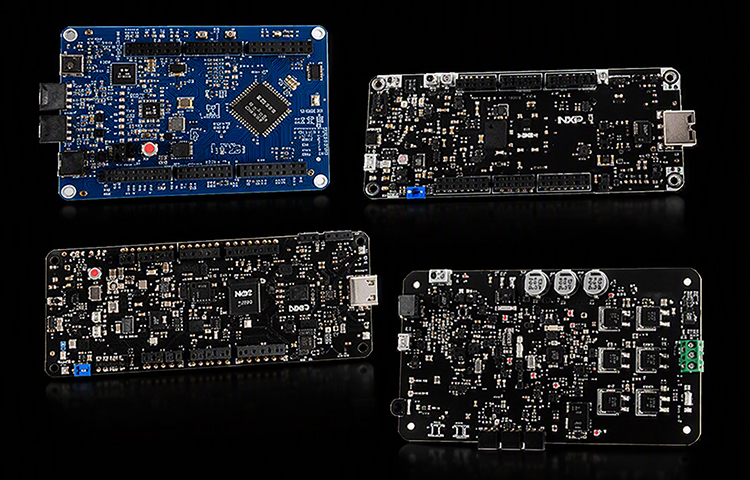
Startup Guide: Trying out the FRDM-A-S32K312
This guide provides a clear explanation of everything from setting up the development environment for the NXP FRDM-A-S32K312 to building and debugging sample code.
- NXP Semiconductors NV
- NEXT Mobility
Overview of FRDM Automotive's evaluation board for automotive microcontrollers.
Introducing NXP's FRDM Automotive automotive, MCU evaluation board. Compatible with S32K/S32M, it efficiently supports everything from evaluation to prototyping and mass production development.
- NXP Semiconductors NV
- NEXT Mobility
Introducing NXP's CAN TRANSCEIVER products with signal improvement (SIC)
NXP's SIC-equipped CAN TRANSCEIVER actively suppresses ringing on the transmitting side, stabilizing high-speed CANFD communications. It is software and pin compatible, allowing it to be replaced with existing designs, and is compliant with automotive standards.
- NXP Semiconductors NV
- NEXT Mobility

Introducing NXP's automotive LED DRIVER
Introducing NXP's automotive LED DRIVER. This product line supports constant voltage, constant current, high-precision PWM, and I2C/SPI, making it ideal for dimming multiple LEDs and displays.
- NXP Semiconductors NV
- NEXT Mobility

A thorough explanation of the appeal of NXP's automotive PMICs (Page 2/2) | An explanation of NXP's automotive PMIC portfolio and the features of its representative products.
This article explains the necessity of PMICs in automotive ECUs, as well as the features, advantages, and portfolio of NXP's automotive PMICs. This first part focuses on the automotive PMIC portfolio and the characteristics of its representative products.
- NXP Semiconductors NV
- NEXT Mobility
Link to Related Technical Columns
No need for an oscilloscope! High-precision time measurement using ARM-Cortex M DWT CYCCNT - A practical guide to minimized steps
This article provides an easy-to-understand explanation of the procedures and practical points for highly accurate time measurement on ARM Cortex-M using DWT CYCCNT without the need for external equipment.

Real-time AI tracking camera built with i.MX 93 - Achieving human tracking with NPU and servo motors
This document explains the procedure for building a camera that uses the i.MX 93 NPU and eIQ to perform face detection and track people in real time, from building a Yocto BSP to configuring PWM and using servo control.

A thorough explanation of the directories generated by bitbake | Essential for troubleshooting Yocto development
We will explain the structure and use of bitbake's tmp subdirectories (work, work-shared, deploy, etc.), as well as Yocto troubleshooting procedures using log checking and deb distribution.

Azure RTOS ThreadX Practical Guide: Practical Explanation of Task Management and Communication Functions
We will explain multitasking design and communication functions such as message queues in Azure RTOS (ThreadX).
First Steps with Azure RTOS: Creating a "Hello World" Project Using Azure RTOS
This article explains how to create, build, and debug a Hello World message using Azure RTOS (ThreadX) on the i.MX RT1170 evaluation board.

Building an i.MX Development Environment (Yocto Edition) | Technical Column
This article explains how to set up a Yocto development environment using NXP’s i.MX series. It covers hardware, preparation steps, and build procedures, helping you prepare to flash images on i.MX evaluation boards.