In this column, we will introduce some examples of optical components that NEXTY Electronics, a semiconductor trading company, has worked on.
Case Introduction: Manufacturing and design of optical components
This article can be read in 8 minutes.
In recent years, optical technology has been utilized in every aspect of our lives.
Smartphone cameras, car headlights (especially LED/laser headlights), projectors, AR/VR devices, medical endoscopes, optical communications, and more—the performance of all these devices is supported by advanced optical components.
There is a growing need for these optical components to be brighter, more compact, and more aesthetically pleasing, making optical design that can control light as desired more important than ever before.
To meet these market needs, the NEXTY Electronics Development Department provides support for simulation and optimization design of optical components. Here we will introduce some specific examples of how we are doing this.
1. Case study overview: Manufacturing optical components and adding light diffusion functionality
The following two items were addressed:
- The basics and foundation of "manufacturing optical components"
- "Addition of light diffusion function" as an initiative to improve performance
We will introduce two examples of this.
1. Manufacturing of optical components
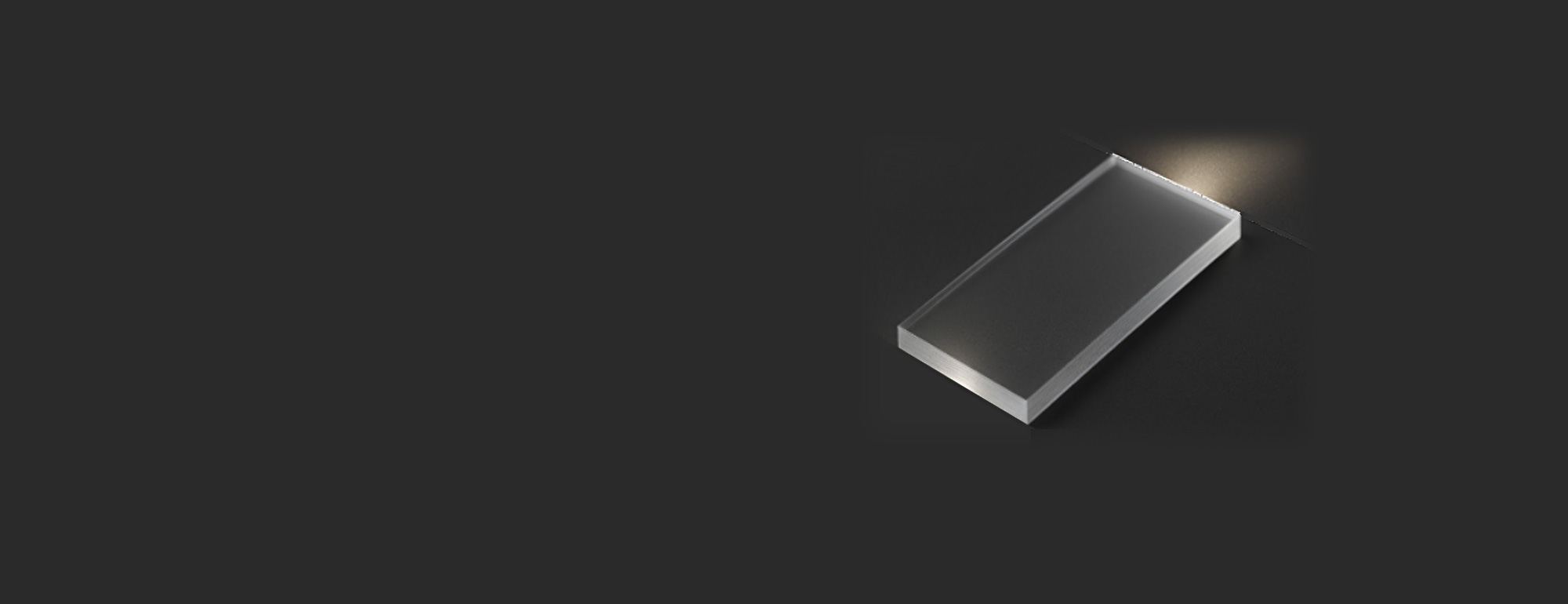
We create the molds necessary for manufacturing the optical components that are installed in optical products.
In this example, when creating the mold, we took into consideration the thickness and shape of the part and the surface position accuracy of the light-guiding function.
*The illustration is for illustrative purposes only.
②Addition of light diffusion function
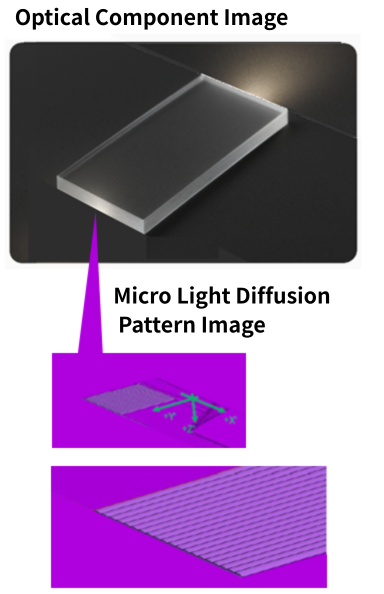
The optical components that we began manufacturing in ① had performance issues during the initial molding stage, so we are considering improving performance by adding a light diffusion function.The solution is to form a fine pattern on the surface of the optical components.
As a result, we were able to create optical components that meet the target performance.
2. Contents of support: Manufacturing introduction and light diffusion fine pattern design
The light-diffusing micropattern design for manufacturing implementation and performance improvement was carried out in the following manner.
I'll give you a brief overview of the contents.

Simulation condition setting and setting condition confirmation
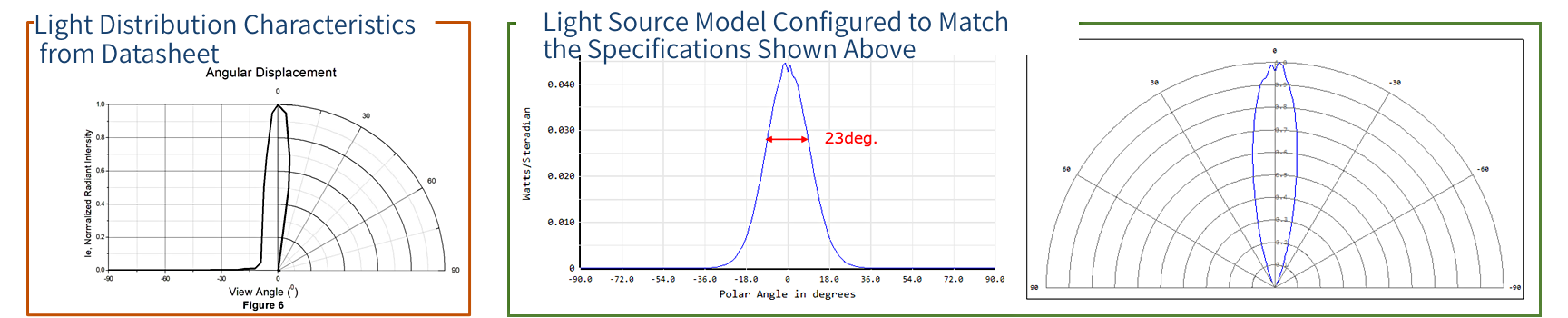
In this case, due to circumstances, we were unable to use the simulation models of the parts that are usually available, so we set the conditions required for the simulation, such as the light source, based on the part specifications.
The fine pattern is initially set to a Gaussian distribution (normal distribution) based on the light distribution angle of the light diffusion sheet selected to match the target performance in combination with the actual device.
At this point, run a simulation to confirm the set conditions.
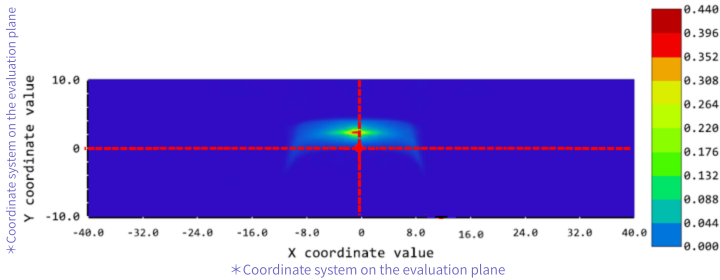
The simulation results showed that adding a light diffusion sheet concentrated the light in the center and prevented it from spreading to the left and right.
Light source settings
Light diffusion sheet settings
The characteristics of the light diffusion sheet (diffusion angle) are provisionally set using a Gaussian distribution (normal distribution)
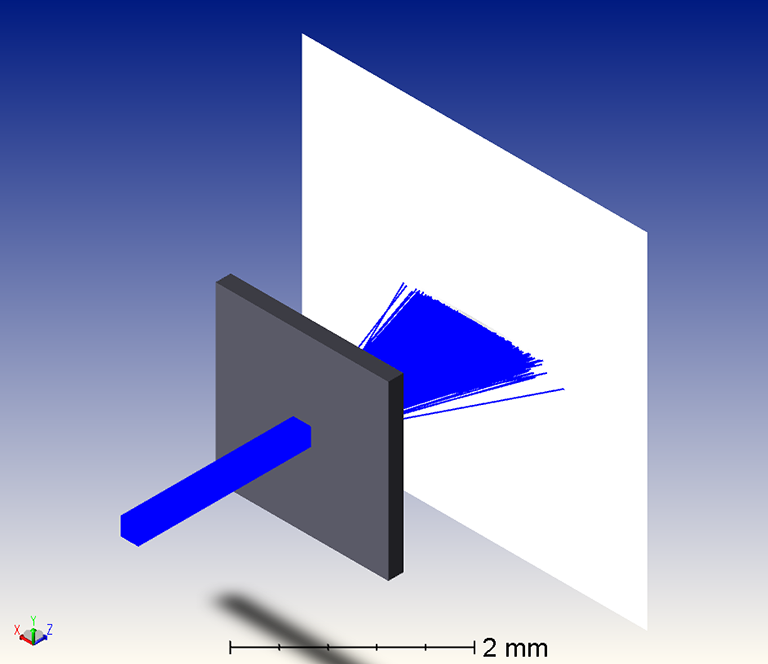
Check the setting conditions (by simulation)
Simulation results for the lens alone
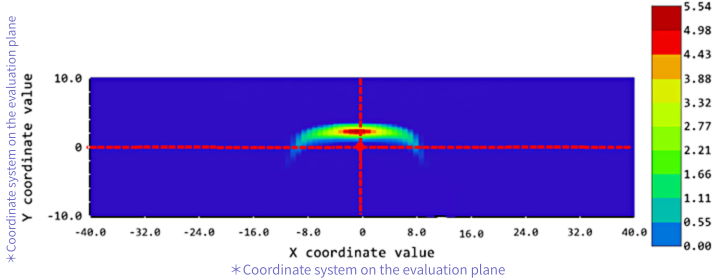
Diffusion sheet addition results
Light is concentrated in the center and does not spread to the left or right
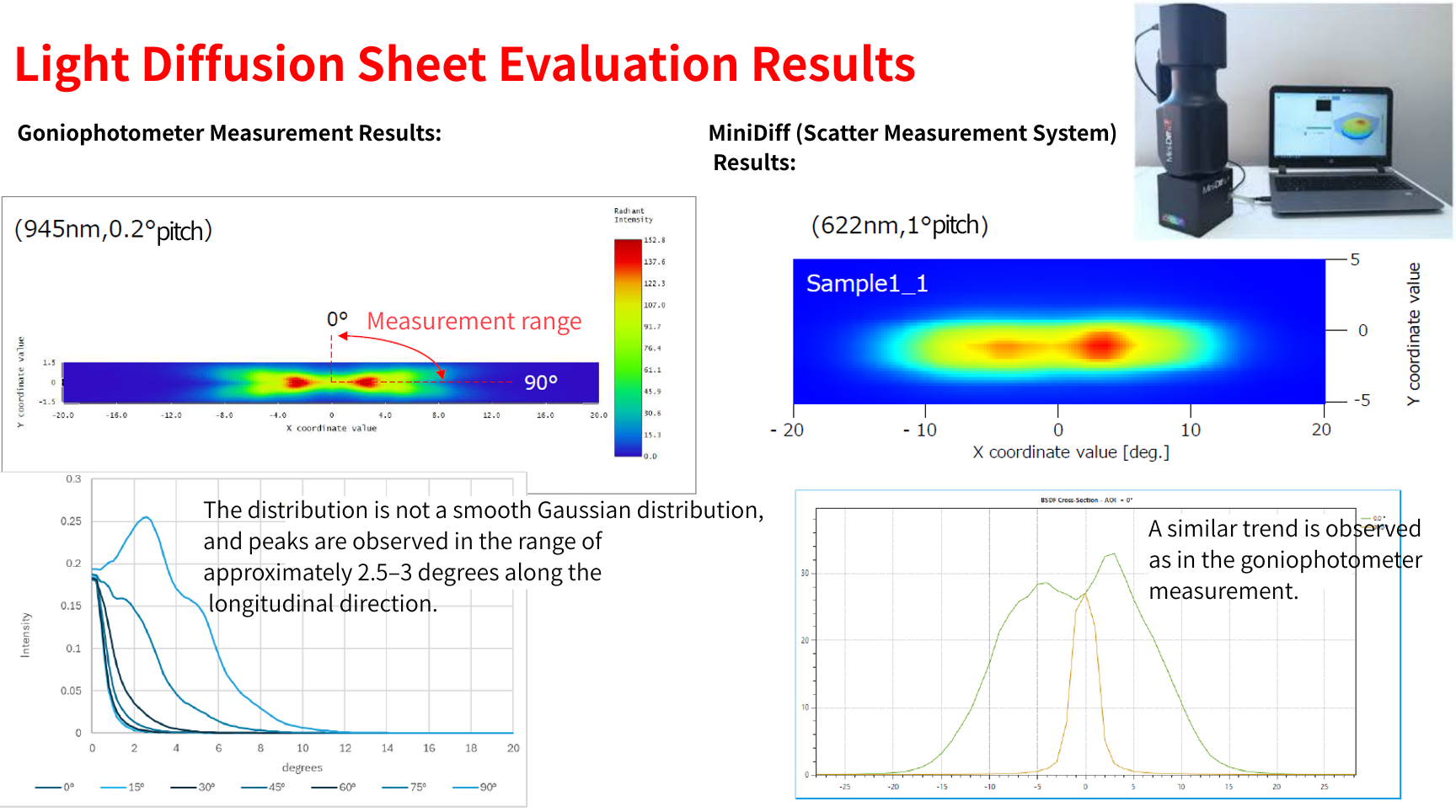
Evaluate the actual product, confirm its capabilities, and adjust the simulation conditions to match the actual product
After not getting the desired results from checking the setting conditions, we decided to evaluate the actual product and confirm its capabilities.
- The actual light diffusion sheet selected according to the target performance is evaluated and measured using an optical evaluation device.
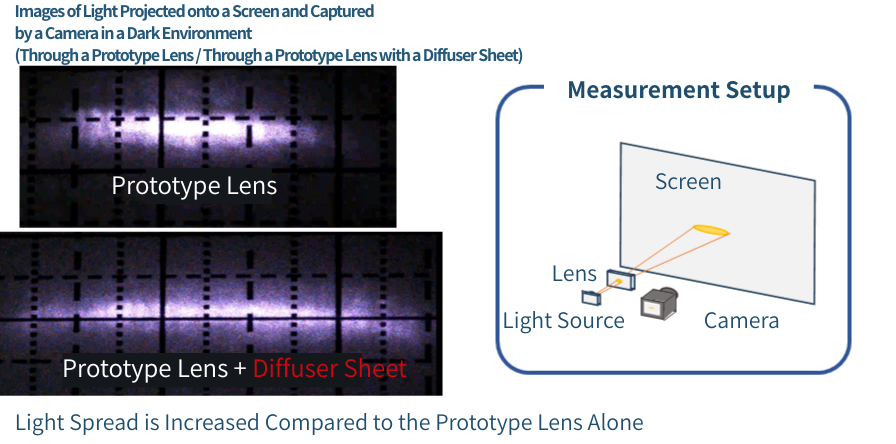
⇒Not a Gaussian distribution, but two peaks on the left and right of the center - Use a camera to capture and check the actual illumination pattern of light passing through the light diffusion sheet.
⇒ Compared to the light spread of the prototype lens, the light spread was confirmed when combined with a light diffusion sheet.
Based on these results, we have revised the simulation conditions to ensure correlation with the actual product, improving the simulation accuracy when designing fine patterns.
Optical evaluation measurement of light diffusion sheets
Camera verification of light diffusion sheet performance
Examination of multiple fine patterns - Narrowing down
Using the simulation results of a model that combines 3D CAD data of an optical component without a light diffusion structure with the selected light diffusion sheet as a reference, we performed a simulation of an optical component with multiple micropatterns.
From the results of these simulations, we narrowed down the candidates to those combinations that offer short mold processing lead times and provide equal or better results.
<Simulation example>

3. Bonus: 3D shape analysis and simulation of parts are also possible.
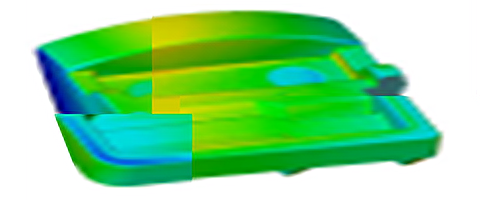
It is also possible to perform 3D shape analysis of parts, allowing you to analyze and visualize the shape of the actual part, and perform optical simulations using the analyzed shape data.
For example, if the expected optical performance is not achieved in a prototype, 3D shape analysis of the actual prototype can be performed to visualize and confirm the difference in shape from the original CAD data, or it is possible to simulate both the CAD data and the analysis data and compare them.
Shape analysis example
Lastly
We consult with customers based on drawings of optical components such as lenses and light guide plates, surface information, component configuration information, and actual components, and are able to produce lenses equivalent to the drawings, as well as design and manufacture with additional functions, as in the example.
NEXTY Electronics Corporation, led by engineers with extensive experience in elemental manufacturing technologies, is collaborating with ODM/EMS partners with a proven track record, including the optical manufacturer in question, to build a scheme to support the launch of a wide range of industries and products.
We utilize the experience and know-how we have cultivated in a wide range of fields, including automobiles and industrial equipment, to meet the needs of our customers and society and provide new value in manufacturing.
Please Inquiry via our website.